Egyptian Mythology List


Welcome to the Mythopouch list of Ancient Egyptian mythology entries! We also delve into the ancient history of Egypt, the Nile Valley and the wider world shaped by its gods, temples, tombs and pharaohs. From gods, goddesses, queens, pharaohs and sacred animals to monsters, symbols, artefacts, creatures, places, funerary objects and more - this collection will only grow over time. Mythopouch provides real-world information extracted from original source material and ancient records such as the Pyramid Texts, Coffin Texts, Book of the Dead, temple and tomb inscriptions, the Rosetta Stone, the Memphis Decree, the Metternich Stele, and classical accounts such as Plutarch's writings on Isis and Osiris. Ancient Egyptian words, symbols and stories carried powerful messages about life, death, truth, balance, magic, kingship, resurrection and the journey into the afterlife - many of which still resonate deeply in modern times. Our unique imagery is meant to capture the imagination and ignite the magic mythology spark within us all. Our "token mark" coin symbol that is assigned to each record is a visual representation of the entity, for use in Mythopouch learning modules and games.
"Nothing is given, everything is earned" at Mythopouch!
Learn - Earn - Play
Ancient Egyptian Entity Quick Index
Our current list of ancient Egyptian mythology and ancient history entities are here - which are growing day by day!
Search by using the:
-
"Search Mythology Records" function to browse all mythology records and blog pages;
-
Browse the visual cards with overviews by clicking "Go to Visual A-Z";
-
Or just browse and click the A-Z entries below....
See more list entries
Read Ancient Egyptian Insights
Click below to view our ancient Egyptian mythology blog article insights, where we delve into the current Mythopouch Tier regions and what we think you should know!


Egypt Entity Card Index
See more card entries

Caesarion
Caesarion is the Little Caesar, the only known biological son of Julius Caesar, the Roman general and dictator who conquered Gaul and crossed the Rubicon, and Cleopatra VII, the last queen of Egypt whose wit and ambition held Rome's greatest men in thrall. He is the child who was born a god, proclaimed King of Egypt at the age of three, and styled as the living Horus, the falcon-headed divine son of Isis, while his mother claimed the mantle of Isis herself. He is the boy who stood between his mother and Mark Antony, the Roman triumvir who became her lover and ally, and who was declared "King of Kings" in the Donations of Alexandria, a grandiose title that made him the heir to every eastern kingdom from Armenia to Parthia. He is the seventeen-year-old who fled to Berenice on the Red Sea when Octavian, Caesar's adopted heir and the future emperor Augustus, invaded Egypt, only to be lured back by false promises of the throne and executed on the advice that "Too many Caesars is not good." He is the last pharaoh of Egypt, the final sovereign of a line that stretched back three thousand years to Narmer and the unification of the Two Lands. And he is the ghost of what might have been, the son of the two most famous people in antiquity who never lived to see his eighteenth birthday.

Canopic Jar
Canopic jars were the sacred vessels used in Egyptian mummification to store and preserve the internal organs of the deceased. The ancient Egyptians did not use a single term equivalent to "canopic jar" - their vessels were called qebu (qAbw) or referred to by function. The modern name is itself a historical misnomer: European Egyptologists borrowed the name from Greek mythology, where Canopus was a sailor in the crew of Menelaus who died near Aboukir in the Nile Delta. The Egyptians worshipped him there in the form of a human-headed vessel, which early scholars mistakenly associated with the funerary jars.
Each canopic jar was guarded by one of the Four Sons of Horus - Imsety (human head), Hapy (baboon head), Duamutef (jackal head), and Qebehsenuef (falcon head). These divine protectors ensured the organs' safety and stood before Osiris in judgment. The jars were essential to Egyptian afterlife belief: the deceased would need a complete physical form to function in the next world, and the canopic jars guaranteed that every part of the body was accounted for and protected.

Cleopatra VII
Cleopatra VII Thea Philopator was the last active ruler of the Ptolemaic Kingdom of Egypt and the final pharaoh of ancient Egypt before its annexation by Rome in 30 BCE. She occupies a unique position in history - simultaneously a documented historical figure and a cultural icon whose image has been shaped by Roman propaganda, Shakespearean drama, Hollywood cinema, and modern scholarship. She was the first Ptolemaic ruler to learn the Egyptian language, and she presented herself as the living incarnation of Isis, the goddess of magic, motherhood, and queenship.
Her twenty-one-year reign represents the final act of three thousand years of pharaonic civilization - the last time an Egyptian monarch would rule from the Nile, the last time the double crown was worn, and the last time the crook and flail would be wielded by a sovereign of Egypt. Plutarch, the primary ancient biographer of Cleopatra, wrote that her actual beauty "was not in itself so remarkable that none could be compared with her," but her intellect, wit, charm, and eloquence made her presence "irresistible." Coins from her reign depict her with prominent features characteristic of Macedonian Greek aristocracy - realistic portrayals rather than idealized beauty.
Coffin Texts
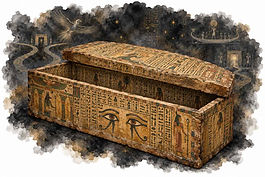
The Coffin Texts are ancient Egypt's words of protection for the journey beyond death, a collection of spells best known from the decorated coffins of the Middle Kingdom. They offered the deceased nourishment, movement, divine identities and ways past the dangers of the otherworld. Some preserved older traditions found in the Pyramid Texts; others explored different paths towards renewal. Within this varied corpus, the Book of Two Ways combined instructions with maps of a perilous sacred landscape. These are historical religious texts, not evidence that their supernatural promises occurred, but they reveal the care with which Egyptians prepared for an existence they believed would continue after burial.

Coptos
Coptos is the ancient city at the meeting of river and desert, where the Nile's transport routes connected with roads leading towards the Red Sea and the resources of the Eastern Desert. Known as Gebtu in Egyptian and surviving as modern Qift, it was a centre of Min's worship, a home to important temples and a staging point for journeys beyond the cultivated valley. Its monuments and royal decrees preserve the changing relationship between pharaohs, priests and provincial power. Coptos was not merely a gateway on a map: it was a working city where sacred protection, royal ambition and the movement of valuable goods met.

Criosphinx
The criosphinx is the Egyptian sphinx with the head of a ram, distinguished from the human-headed androsphinx and the hawk-headed hieracosphinx. The term was coined by Greek historians - notably Herodotus - to classify the ram-headed lion-bodied creatures they encountered in Egypt. The criosphinx was specifically associated with the god Amun, whose sacred animal was the ram with curved horns, and it served as a powerful emblem of Amun's authority and fertility.
The most famous assemblage of criosphinxes is the Avenue of Sphinxes at Karnak Temple - the western approach known to the ancient Egyptians as "The Way of the Rams." Here, dozens of criosphinx statues originally lined the processional route leading to the temple's first pylon, each bearing a small statue of the reigning pharaoh between its paws.

Deir el-Bahri
Deir el-Bahri is the great temple bay beneath the cliffs of western Thebes, where royal monuments were built in conversation with the mountain around them. Mentuhotep II established a major funerary complex here, Hatshepsut raised the terraced temple of Djeser-Djeseru, and Thutmose III added a sanctuary of his own. The bay preserves royal claims, religious ceremonies, trading scenes and the later protection of endangered royal burials. Its familiar name comes from a Christian monastery that occupied part of the site centuries after the pharaohs. Deir el-Bahri is therefore both an architectural landmark and a record of changing sacred use.

Djed Pillar
The Djed Pillar is the oldest symbol of stability in Egypt, the crossbarred column that stood for everything that endures: the spine, the tree, the kingdom, and the god who rose from the dead. It is the backbone of Osiris, the murdered and resurrected lord of the underworld, whose body was believed to stand upright again wherever the pillar was raised. It is the centrepiece of one of Egypt's greatest ceremonies, the Raising of the Djed, when the pharaoh himself hauled a great wooden column upright with ropes to proclaim that the land was stable and the god lived. It is the palace pillar of Byblos, the tree that grew around the coffin of Osiris on a foreign shore and became a column in a king's hall. It is the golden amulet laid at the throat of every mummy so the dead would rise with the god's own spine. And it is the partner of the knot of Isis, the two signs of the divine couple that guarded Egypt for three thousand years.

Djedi
Djedi is the legendary magician whose wisdom places a limit on a king's demand for wonder. In the Westcar Papyrus, he is a 110-year-old man brought before Khufu, the ruler associated with the Great Pyramid. He can restore a severed head to its body, yet refuses to demonstrate that power on a human prisoner. His animal wonders are followed by a prophecy about children destined to become kings. Djedi belongs to the world of Egyptian storytelling rather than securely documented biography, and his tale joins magical knowledge with an unusually memorable act of restraint.

Djer
Djer is the early Egyptian king whose burial place acquired a second identity as the tomb of a god. He ruled during the First Dynasty, when the institutions of a united Egypt were still taking shape, and his name survives on labels, seal impressions and objects placed in the burials of that distant age. He is the successor of Aha, also called Hor-Aha, and the predecessor of Djet, one of the rulers who followed Narmer at the beginning of pharaonic history. He is the owner of Tomb O at Umm el-Qa'ab in Abydos, an extensive royal burial surrounded by the smaller graves of members of the court. And he is the king whose tomb later drew worshippers of Osiris, the god of the dead, turning a monument of early kingship into a sacred destination for generations who came seeking divine renewal.

Djeser-Djeseru
Djeser-Djeseru is the temple of rising terraces that Hatshepsut built beneath the cliffs of Deir el-Bahri. Its name is often translated as Holy of Holies or Sublime of Sublimes, and its long colonnades remain among the most recognisable forms in Egyptian architecture. It is the monument closely associated with Senenmut, the powerful royal official who served the queen who became pharaoh. It is the sanctuary where the cult of Amun-Ra met the commemoration of Hatshepsut and her royal ancestors, and where reliefs presented a trading expedition to Punt beside the religious story of her divine birth. It is also a building marked by destruction, reuse and patient reconstruction. The temple belongs within the larger archaeological landscape of Deir el-Bahri; the two names describe related places, not identical records.

Djoser
Djoser is the Blessed One, the pharaoh who built the first pyramid on earth and in doing so invented monumental stone architecture, a leap so vast that nothing like it had ever been attempted by human hands. He is the king whose vizier Imhotep, a man of such genius that he would later be worshipped as a god of medicine by the Greeks, designed the Step Pyramid at Saqqara, a six-tiered mountain of limestone that rose sixty metres above the desert and housed four hundred underground rooms. He is the ruler of the Famine Stela, the granite inscription on Sehel Island that tells how Egypt suffered seven years of drought until the god Khnum appeared to Imhotep in a dream and promised to restore the Nile flood. He is the first pharaoh of the Old Kingdom, the founder of the Third Dynasty, whose nineteen-year reign shifted the royal burial ground forever from Abydos to the necropolis of Memphis and set the pattern for every pyramid that followed, from the smooth-sided wonders of Giza to the crumbling heaps of the Fifth Dynasty. He is the man whose life-sized statue, carved in painted limestone and fitted with inlaid eyes of rock crystal, still sits in its serdab chamber behind a wall with two peepholes, staring out at visitors who come to pay homage three thousand years after his death. And he is the king whose name was remembered with such reverence that New Kingdom scribes, writing graffiti inside his pyramid complex a thousand years after he died, praised him as the greatest of the ancients.