Egyptian
Nefertiti
Name in Non-English, or Alternative Name/s
nfr.t-jy.tj (Egyptian)
Also known as, and/or Titles and Roles
Neferneferuaten Nefertiti, the Beautiful One Has Come, the Mistress of Upper and Lower Egypt, the Female Horus of Gold, the Co-Regent of the Aten

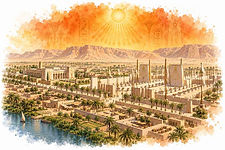
Mythopouch artistic interpretation
Details
Region
Egyptian
Regional Information Additional (if applicable)

Ancient Egypt
Category
Person
Historicity (actuality or factual truth of persons, events, and claims)
Historical
Gender
Female
Time Period
c. 1370 - 1330 BCE (18th Dynasty)
Symbol
The painted limestone bust with the flat blue crown, the sun disk of the Aten, the smiting pose
Tags
egyptian, nefertiti, 18th-dynasty, amarna-period, akhenaten, aten, berlin-bust, neferneferuaten, egyptian-mythology
Introduction - Overview
Nefertiti is the Beautiful One Has Come, the queen whose painted limestone bust, discovered in 1912 in the workshop of the royal sculptor Thutmose at Amarna, has become the most recognisable face of ancient Egypt and the subject of one of archaeology's most bitter repatriation disputes. She is the Great Royal Wife of Akhenaten, the heretic pharaoh who abandoned the gods of Egypt and declared that only the sun disk Aten was divine, and she is depicted on temple walls smiting Egypt's enemies with a mace, a pose reserved for kings alone, proof that her power rivalled her husband's. She is the mother of six daughters, including Meritaten, who succeeded her as queen, and Ankhesenpaaten, who would later change her name to Ankhesenamun and marry Tutankhamun, the boy king whose tomb would dazzle the modern world. She is the woman who vanished from history in the twelfth year of Akhenaten's reign, her name and image abruptly disappearing from the record, leaving Egyptologists to debate whether she died, fell from favour, or assumed a new identity entirely. She is the pharaoh Neferneferuaten, according to one compelling theory, the female king who ruled Egypt for two or three years between Akhenaten's death and Tutankhamun's accession, using the throne name Ankhkheperure and attempting to steer the kingdom back toward the old gods while maintaining the Aten cult at Amarna. She is the queen whose tomb Nicholas Reeves believes lies hidden behind the north wall of Tutankhamun's burial chamber in the Valley of the Kings, a theory based on high-resolution scans that revealed fissures in the plaster that may be sealed doorways. And she is the ghost of the Amarna Period, the woman whose face launched a thousand museum exhibitions and whose fate remains one of Egyptology's greatest unsolved mysteries.
Gallery
Main Article - Who or What was...
Nefertiti
Nefertiti was born around 1370 BCE, probably at Thebes, though her origins remain one of the enduring puzzles of her life. She was not a king's daughter, which makes her elevation to Great Royal Wife unusual. Some scholars believe she was the daughter of Ay, the courtier who would later become pharaoh after Tutankhamun's death, and his wife Tey, a theory based on the prominence of Ay's family at court and on Nefertiti's nursemaid being recorded as the sister of Ay's wife. Others suggest she was a foreign princess, possibly from the Mitannian kingdom of northern Syria, sent to Egypt as part of a diplomatic marriage. Whatever her origins, she was already married to Amenhotep IV, the crown prince who would later change his name to Akhenaten, before he ascended the throne in 1353 BCE, and she bore him six daughters: Meritaten, Meketaten, Ankhesenpaaten, Neferneferuaten the Younger, Neferneferure, and Setepenre.
The defining transformation of her life came with Akhenaten's religious revolution. In the fifth year of his reign, the pharaoh abandoned the traditional gods of Egypt - Amun, Osiris, Isis, and the entire pantheon - and declared that only the Aten, the visible sun disk whose rays ended in tiny hands that pressed the ankh, the key of life, to the noses of the king and queen, was worthy of worship. He closed the temples, seized the priesthoods' revenues, and moved the capital from Thebes to a new desert city called Akhetaten, the Horizon of the Aten, on the east bank of the Nile midway between Thebes and Memphis. Nefertiti stood beside him in every scene. On the boundary stelae that marked the limits of the new city, she appears with her full titles: Neferneferuaten Nefertiti, Great Royal Wife, Mistress of Upper and Lower Egypt, May she live forever. In temple reliefs she is shown at equal scale to Akhenaten, a visual equality that no previous queen had enjoyed, and in some scenes she even performs the smiting ritual, the classic pose of Egyptian kingship in which the pharaoh raises a mace to strike a kneeling enemy. The message was revolutionary: Nefertiti was not merely the king's consort. She was his partner in power.
The artistic style of the Amarna Period, which broke with three thousand years of Egyptian tradition to depict the royal family with elongated skulls, slender limbs, and exaggerated features, has made Nefertiti's face one of the most famous in the world. The bust discovered by the German Egyptologist Ludwig Borchardt on 6 December 1912 in the workshop of the sculptor Thutmose at Amarna is forty-nine centimetres of painted limestone and stucco, with one eye inlaid with rock crystal and wax while the other socket remains empty, a detail that Borchardt interpreted as proof the bust was a sculptor's model rather than a finished work. The queen wears a flat-topped blue crown, the so-called Nefertiti cap crown, with a ribbon wrapped around it, and her skin is rendered in warm ochre tones with touches of blush on the cheeks. The bust was taken to Germany in 1913, donated to the Berlin State Museums in 1920, and unveiled in 1923, where it immediately became the museum's most famous object. Egypt has demanded its return ever since, arguing that Borchardt concealed its value from Egyptian inspectors during the division of finds, a claim supported by documents discovered in 2009 that suggest the Egyptologist deliberately downplayed the bust's importance. Adolf Hitler reportedly refused to return it in the 1930s, declaring it his favourite work of art, and it remains in the Neues Museum in Berlin to this day, classified as non-transportable due to its fragility.
Then, in the twelfth year of Akhenaten's reign, Nefertiti vanished. Her name and image disappear from the monuments, and the historical record falls silent. Theories abound. Some scholars believe she died, perhaps from the plague that swept through Amarna around this time, or from complications following the death of her daughter Meketaten, whose tomb at Amarna shows a scene of mourning that may depict the queen grieving over the child's body. Others suggest she fell from favour, possibly because she failed to produce a son, though this seems unlikely given Akhenaten's devotion to her and the fact that he already had a son, Tutankhaten, by a secondary wife named Kiya. A more compelling theory, advanced by Egyptologists including Jacobus van Dijk and Athena Van der Perre, holds that Nefertiti did not die or fall from grace but instead assumed a new identity: Neferneferuaten, the female pharaoh who ruled Egypt after Akhenaten's death.
The evidence for this theory is substantial. After Akhenaten's death around 1336 BCE, a pharaoh named Neferneferuaten appears in the record, using the throne name Ankhkheperure and the epithet Mery-Waenre, "Beloved of Akhenaten." This pharaoh is attested at Amarna, Thebes, and Saqqara, and ruled for approximately two to three years before Tutankhamun, then a boy of eight or nine, ascended the throne. The name Neferneferuaten was already part of Nefertiti's full titulary, and the epithet "Beloved of Akhenaten" strongly suggests a close familial relationship. A box lid from Tutankhamun's tomb is inscribed with the names of both Akhenaten and Neferneferuaten, confirming that the latter ruled after the former. Several objects found in Tutankhamun's tomb, including miniature canopic coffins and gold mummy bands, bear traces of Neferneferuaten's cartouches that have been overwritten with Tutankhamun's name, suggesting that the boy king inherited his predecessor's burial equipment. If Neferneferuaten was indeed Nefertiti, then she did not vanish at all. She became pharaoh.
If she ruled as pharaoh, her reign was brief and troubled. She attempted a compromise between the old religion and the new, restoring some cults of Amun while maintaining the Aten temple at Amarna, a policy that satisfied neither the traditionalist priests nor the hardline Atenists. When she died, probably around 1333 BCE, Tutankhamun's officials - including Ay and Horemheb, the men who would later rule Egypt themselves - moved swiftly to erase the Amarna Period from history. They abandoned the city of Akhetaten, returned the capital to Thebes, and restored the temples of Amun. Nefertiti's monuments were defaced, her name chiselled from the walls, and her memory condemned to the same damnatio memoriae that swallowed her husband and her dynasty.
The mystery of her tomb has obsessed Egyptologists for a century. In 2015, the British archaeologist Nicholas Reeves announced a theory based on high-resolution scans of Tutankhamun's tomb, KV62, in the Valley of the Kings. Reeves identified straight lines in the north and west walls of the burial chamber that he interpreted as the outlines of sealed doorways, suggesting that the tomb was originally constructed for Nefertiti and that Tutankhamun's unexpected early death prompted officials to seal off her burial suite and inter the boy in the outer chamber. The theory generated enormous excitement and subsequent radar scans, but the results have been inconclusive, with some surveys supporting the existence of voids behind the walls and others finding nothing. The Egyptian authorities have authorised further investigation, but as of today, no hidden chambers have been opened, and Nefertiti's final resting place remains unknown.
Summary
Nefertiti endures as the most famous queen of the ancient world, a face carved in limestone that has outlasted every empire and every religion that tried to erase her. From the boundary stelae of Akhetaten to the bust in Berlin, from the smiting pose on temple walls to the phantom pharaoh Neferneferuaten, her life represents both the brilliance and the tragedy of the Amarna experiment: a woman who rose to equal power with her husband, who may have ruled as king in her own right, and who vanished so completely that three thousand years later we still do not know where she lies. A detail worth remembering: the empty eye socket of the Berlin bust, which Borchardt believed proved the object was merely a model, but which others interpret as a deliberate artistic choice, the one imperfection that makes the perfect face human. In the human imagination, Nefertiti remains the eternal enigma, the proof that a single woman can be so beautiful, so powerful, and so mysterious that the world will never stop searching for her.
Now enter the Mythopouch World!
You’ve discovered:
Nefertiti
From Myth to Game
Join to access FREE real-world mythology "Learn Quests" and "Courses". Sign up to the newsletter for new releases, game updates, insider news, and more as Mythopouch brings real mythology to life. EARN the right to purchase an offline board game by completing FREE modules.


It's FREE to join as a MEMBER!
Not ready to join? Get the newsletter instead below



Looking for others?
Click into the field below to search, or click the icon to go to full page search function!

Looking for Mythology Insights?


Click below to view our mythology blog article insights, where we delve into the current Mythopouch Tier regions, and what we think you should know!
Sources & Retellings
Explore the original mythological Source texts (most from over 75 years ago, some as translated, possibly with mature content) and Mythopouch's source Retellings (a modern retelling also suitable for 15+) connected to this mythological entity. We are growing this resource and will link these in the future; for now, check the References below, then find the Sources or Retellings on those pages!


References
Validation References:
- Bust of Nefertiti, Neues Museum Berlin ÄM 23100 (18th Dynasty, c. 1345 BCE) - discovered 6 December 1912 by Ludwig Borchardt in Thutmose's workshop at Amarna
- Boundary Stela U, Akhetaten (Year 6 of Akhenaten, c. 1346 BCE) - Nefertiti's full titulary and role in the Aten cult
- Tomb of Meketaten, Amarna (c. 1344 BCE) - scene of mourning possibly depicting Nefertiti over her daughter's death
- Box lid from Tutankhamun's tomb, Carter 001k (18th Dynasty, c. 1333 BCE) - inscription confirming Neferneferuaten ruled after Akhenaten
- Miniature canopic coffins and gold mummy bands, Tutankhamun's tomb (18th Dynasty, c. 1333 BCE) - traces of Neferneferuaten's cartouches overwritten with Tutankhamun's name
- Tomb of Meryre II, Amarna (TA2) - unfinished durbar scene showing Smenkhkare and Meritaten
- Inscription from the tomb of Pairi, TT139 (Year 3 of Neferneferuaten) - hieratic graffito confirming the female pharaoh's reign
- Nicholas Reeves, "The Burial of Nefertiti?" (2015) - theory of hidden chambers behind the north wall of Tutankhamun's tomb
- Jacobus van Dijk, "The Death of Meketaten," in Causing His Name to Live (2009) - analysis of Nefertiti's disappearance and possible identification as Neferneferuaten
- Athena Van der Perre, "The Year 16 Graffito of Akhenaten in Dayr Abu Hinnis," Orientalia Lovaniensia Periodica 45 (2014) - evidence for Nefertiti's continued presence in Year 16 of Akhenaten's reign
- Joyce Tyldesley, Nefertiti: Egypt's Sun Queen (Viking, 1998) - comprehensive biography and analysis of the queen's role in the Amarna Period
- Aidan Dodson, Amarna Sunset: Nefertiti, Tutankhamun, Ay, Horemheb, and the Egyptian Counter-Reformation (American University in Cairo Press, 2009) - the succession crisis and Nefertiti's possible reign as pharaoh
Cultural Context Notice
Mythology developed across different cultures, periods and traditions, and there is rarely one universally accepted version of a story. Mythopouch approaches these traditions with respect while remaining faithful to the complexity of the surviving material. Retellings and educational content may interpret or adapt historical sources, but are not presented as definitive accounts of any culture, religion or belief system.