Details
Region
Egyptian
Regional Information Additional (if applicable)

Ancient Egypt; New Kingdom; Nineteenth Dynasty; Libyan and Levantine campaigns
Category
Person
Historicity (actuality or factual truth of persons, events, and claims)
Historical
Gender
Male
Time Period
c. 1213-1203 BCE; Nineteenth Dynasty (approximate conventional reign dates)
Symbol
Victory stela
Tags
merneptah, egyptian-history, ramesses-ii, nineteenth-dynasty, merneptah-stela, sea-peoples, libyan-campaign, memphis, kv8
Introduction - Overview
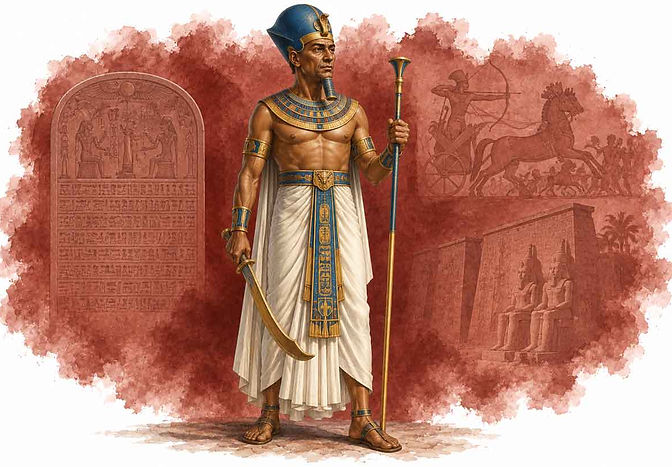
Merneptah is the son of Ramesses II who reached the throne after his father's exceptionally long reign. The thirteenth royal son, born to Isetnofret I, he ruled Egypt for approximately a decade near the end of the thirteenth century BCE. His monuments present a king defending the Delta, maintaining royal authority and celebrating victory in the language of divine order. His best-known inscription, the Merneptah Stela, also called the Israel Stela, contains the earliest generally accepted extra-biblical reference to Israel. That fame should not reduce his reign to a single line: a palace at Memphis, temple inscriptions and his royal burial also preserve his historical presence. Nor should this pharaoh automatically be given the family of the similarly named king in the Setne tale. Merneptah belongs to the documented Nineteenth Dynasty; the legendary Mernebptah is treated separately.
Gallery
Main Article - Who or What was...
Merneptah
Merneptah was a son of Ramesses II and Isetnofret I, one of the king's principal wives. His position as thirteenth son placed several older princes ahead of him, but the length of his father's reign changed the succession. He eventually became heir and then king, conventionally dated to about 1213 BCE. He was already an older man by the standards of royal accession. His earlier military responsibilities form part of his career, but the surviving evidence does not justify a colourful account of precisely how every older brother died or how the court reacted to his advancement. What can be said securely is that his kingship followed a long period within the Ramesside royal household.
The major conflict of his fifth regnal year came from the west. A Libyan-led coalition, including groups commonly discussed under the modern label Sea Peoples, entered the Delta region. Royal inscriptions celebrate Merneptah's defeat of this force. The Great Karnak Inscription supplies names, captured goods and casualty claims, while other monuments present the victory as protection granted by the gods. These are important historical records, but they are not neutral battlefield reports. Exact totals and claims of overwhelming success belong to the royal account and should be attributed accordingly. The collective term Sea Peoples also needs care: it does not mean that every group named by Egyptian scribes formed one nation with a single origin and purpose.
The Merneptah Stela turns military achievement into a royal victory hymn. Its best-known closing section names several places and peoples associated with the Levant, including Ashkelon, Gezer, Yanoam and Israel. The reference to Israel, around 1208 BCE in the conventional chronology, is widely accepted as the earliest secure extra-biblical attestation of that name. The accompanying signs classify Israel as a people rather than a place-name of the same kind as the listed cities. They do not, on their own, describe its complete social or political organisation. The boast that an enemy has been eliminated is likewise the language of victory, not independent proof of literal extinction. The inscription is valuable precisely when its information and its purpose are read together.
At Memphis, Merneptah left evidence beyond the battlefield. Excavations at Mit Rahina by the University of Pennsylvania recovered material from his ceremonial palace near the sanctuary of Ptah, including decorated architectural elements. This palace belongs to a city that remained important for royal administration and religious life even when other centres drew much of the attention. His name, conventionally translated as Beloved of Ptah, connected him with the city's great craftsman god. The material remains allow the ruler to be studied through construction, ceremonial space and inscriptions, rather than only through the literary force of a victory hymn.
His reign also included military activity in Nubia. Such campaigns show that royal authority had to be maintained on more than one frontier, but the available record should not be expanded into a claim that every problem was permanently settled. Merneptah inherited the institutions and international relationships of his father's reign, not a kingdom outside the pressures of its age. The shortness of his own rule makes the surviving building and inscriptional evidence particularly important. Each monument records an action or a chosen royal image; none gives a complete explanation of the government's daily work.
Merneptah was buried in KV8 in the Valley of the Kings. His mummy was later moved to the tomb of Amenhotep II, KV35, as part of the protection and reorganisation of royal burials, and it was found there in 1898. The tomb and the recovered body therefore preserve different stages of his funerary history. KV8 was his original royal resting place, while KV35 was the later cache in which his remains survived. Confusing the two would obscure the efforts of later custodians as well as the history of the burial itself.
His son Seti II belonged to the troubled succession that followed. Amenmesse challenged Seti II's authority in Upper Egypt, although the exact relationship and chronology of the rival claims remain debated. This later conflict should not be turned into a simple moral verdict on Merneptah's reign. His historical record is narrower and more concrete: royal descent, accession, campaigns, a ceremonial palace, inscriptions and a tomb. The legendary pharaoh Mernebptah appears in a different kind of evidence, the story of Naneferkaptah and the Book of Thoth. Similar royal names can connect literary memory with Egypt's past without making every episode of a tale a documented event.
Summary
Merneptah is remembered through a reign that combined military action, royal building and the careful presentation of victory. His place after Ramesses II is secure, as are the monuments that preserve his name. The Merneptah Stela is especially important for its early reference to Israel, but its language still belongs to a king's celebration of conquest. A detail worth remembering is the separation between his original tomb, KV8, and the later cache in KV35 that preserved his mummy. Reading those distinctions keeps both the historical ruler and the stories attached to similar names in their proper settings.
Now enter the Mythopouch World!
You’ve discovered:
Merneptah
From Myth to Game
Join to access FREE real-world mythology "Learn Quests" and "Courses". Sign up to the newsletter for new releases, game updates, insider news, and more as Mythopouch brings real mythology to life. EARN the right to purchase an offline board game by completing FREE modules.


It's FREE to join as a MEMBER!
Not ready to join? Get the newsletter instead below


Looking for others?
Click into the field below to search, or click the icon to go to full page search function!

Looking for Mythology Insights?


Click below to view our mythology blog article insights, where we delve into the current Mythopouch Tier regions, and what we think you should know!
Sources & Retellings
Explore the original mythological Source texts (most from over 75 years ago, some as translated, possibly with mature content) and Mythopouch's source Retellings (a modern retelling also suitable for 15+) connected to this mythological entity. We are growing this resource and will link these in the future; for now, check the References below, then find the Sources or Retellings on those pages!


References
Validation References:
- National Museum of Egyptian Civilization, Merenptah: parents, thirteenth-son status, military campaigns, KV8 and later KV35 burial. Only the Merenptah section is used; unrelated Ramses III text appended on the webpage is excluded.
- https://nmec.gov.eg/mummies-hall/merenpetah/
- Merneptah Stela, Year 5: royal victory hymn and the Israel name. Josh Meynell's translation and sign discussion, Tyndale House, 14 June 2024; broader apologetic conclusions are not adopted.
- https://tyndalehouse.com/2024/06/14/merneptah-stele/
- Penn Museum, Egyptian Section: excavations at Memphis, the sanctuary of Ptah and the ceremonial palace of Merenptah.
- https://www.penn.museum/about-collections/curatorial-sections/egyptian-section
- National Museum of Egyptian Civilization, Seti II: Merneptah's son and the disputed succession involving Amenmesse.
- https://nmec.gov.eg/mummies-hall/seti-ii/
- First Tale of Setne, Cairo CG 30646: literary Mernebptah is separately catalogued; its family narrative is not used as historical genealogy.
- https://www.attalus.org/egypt/setne.html
Cultural Context Notice
Mythology developed across different cultures, periods and traditions, and there is rarely one universally accepted version of a story. Mythopouch approaches these traditions with respect while remaining faithful to the complexity of the surviving material. Retellings and educational content may interpret or adapt historical sources, but are not presented as definitive accounts of any culture, religion or belief system.