Arthurian Mythology List


Welcome to the Mythopouch list of Arthurian Legend mythology entries! We also delve into the early history of Britain, Wales, and the Celtic and medieval traditions that shaped the Arthurian world. From kings, queens, knights and mages to castles, quests, monsters, artefacts, weapons, enchanted objects, creatures and more, this collection will continue to grow over time. Mythopouch provides real-world background and mythological information drawn from early chronicles, Welsh tales and medieval romances such as: the Welsh Triads, Culhwch and Olwen, the Historia Brittonum, the Annales Cambriae, Geoffrey of Monmouth, Chrétien de Troyes, the Lancelot-Grail or Vulgate Cycle, Sir Gawain and the Green Knight, and Thomas Malory’s Le Morte d’Arthur. Arthurian legend carries powerful ideas about courage, honour, loyalty, temptation, sacrifice, prophecy, betrayal and the dream of a better kingdom - messages passed from storyteller to storyteller for centuries, many of which still speak to modern life. Our unique imagery is meant to capture the imagination and ignite the Arthurian spark within us all. Our “token mark” coin symbol assigned to each record is a visual representation of the entity, for use in Mythopouch learning modules and games.
"Nothing is given, everything is earned" at Mythopouch!
Learn - Earn - Play
Arthurian Entity Quick Index
Our current list of ancient British mythology (Arthurian Legend) and ancient history entities are here - which are growing day by day!
Search by using the:
-
"Search Mythology Records" function to browse all mythology records and blog pages;
-
Browse the visual cards with overviews by clicking "Go to Visual A-Z";
-
Or just browse and click the A-Z entries below....
See more list entries
Read Arthurian Legend Insights
Click below to view our Arthurian Legend (ancient British) mythology blog article insights, where we delve into the current Mythopouch Tier regions and what we think you should know!


Arthurian Entity Card Index
See more card entries

Erbin (King)
King Erbin is the ageing ruler whose need for a successor calls Geraint home from Arthur's court in the Welsh romance Geraint son of Erbin. His son has won renown and married Enid, but the father's weakening authority makes continued absence dangerous. Neighbouring chiefs covet the lands that Erbin can no longer defend as vigorously as before. Instead of concealing his difficulty, he sends envoys to Arthur and asks that Geraint return to protect his inheritance. The homecoming becomes a public transfer of responsibility, supported by the household, the nobles and the companions who travel with the young couple. Geraint would prefer his father to retain power, but Erbin insists that the time has come for younger hands to maintain the dominion. His name belongs to a wider network of Welsh genealogies and heroic references, including the patronymic by which Geraint is remembered. This entry concerns that legendary father and ruler, not a securely documented fifth-century reign.

Eri
Eri is the father named in the expression Greid son of Eri in Culhwch and Olwen. His name belongs to the family language of the tale rather than an independently narrated adventure: the text supplies no speech, appearance or deed for Eri himself. Greid is among the figures invoked in Culhwch's appeal to Arthur, is associated with the hound Drudwyn, and appears among the captives taken by Gwyn ap Nudd. The repeated patronymic keeps Eri's name present in those episodes without making him a participant in them. This distinction is essential. Drudwyn is Greid's hound, not Eri's grandson, and the suffering of Greid does not establish that Eri shared his prison. Eri offers a small but revealing example of how an Arthurian figure can survive through a relationship alone. The surviving references support a father and a name; a lost heroic career may be imagined, but it cannot be recovered from those references as fact.

Esclabor (King)
King Esclabor is the pagan king of Babylon who journeyed to Rome as a tribute from his homeland, saved the life of the emperor, and then travelled to Britain where he saved the life of King Pellinore and entered the service of King Arthur. He is the father of Palamedes, the Saracen knight who hunted the Questing Beast and loved Iseult; of Safir, who killed the Count of the Plank; of Segwarides, who joined the Round Table; and of the maiden Florine, whose name echoes through the romances. He is the heathen who Arthur assumed was Christian until the truth was revealed, earning him the epithet "the Unknown," and who was eventually baptised into the faith of the land he had adopted. He is the warrior who adventured alongside his son Palamedes and the perfect knight Galahad during the Grail Quest, helping to repel King Mark's first invasion of Logres. And he is the father who could not survive the grief of his son's death, who took his own life after Palamedes was slain by Gawain, a tragedy that closes one of the darkest chapters in the Arthurian saga and reminds us that the love of a father for his son is older than any kingdom and stronger than any sword.

Esclados the Red
Esclados the Red is the guardian knight of the most famous magic spring in Arthurian romance, the lord who defended the fountain of Barenton in the enchanted forest of Broceliande for sixty years. He is the knight who appears whenever a stranger pours water upon the stone slab beside the spring, riding out of the forest in a fury to punish whoever has dared to disturb the waters that summon storms. He is the generous conqueror who defeated Yvain's cousin Calogrenant in single combat yet spared his life, taking only his horse as a trophy and sending the humiliated knight back to Arthur's court on foot. He is the master of Landuc, the husband of Laudine, one of the most beautiful women in all Arthurian legend, and the champion whose death at Yvain's hands launched the greatest love story in Chretien de Troyes's romances. And he is the man whose custom of defending the spring had been kept for sixty years before Yvain ever rode into Broceliande, a reminder that in the oldest Arthurian tales, even the defeated knight may have been the rightful guardian all along.

Excalibur
Excalibur is the legendary sword of King Arthur, the most famous weapon in Western mythology. Its origins lie in the Welsh name Caledfwlch ("hard cleft" or "lightning sword"), which appears in the tale Culhwch and Olwen (c. 1100), part of the Mabinogion. Geoffrey of Monmouth latinized the name to Caliburnus in his Historia Regum Britanniae (c. 1136). The sword became "Excalibur" through French adaptations (Escalibor, Excalibor) and finally Malory's English Le Morte d'Arthur (1485).
Two distinct swords are conflated in the later Arthurian tradition: the Sword in the Stone (Caliburn), which proves Arthur's right to rule, and Excalibur, given to Arthur by the Lady of the Lake. Caliburn was a ceremonial weapon of selection; Excalibur was a practical sword of combat. Over centuries of retelling, these two weapons merged into one narrative, with Caliburn becoming the "first sword" that Arthur breaks in battle, necessitating the acquisition of Excalibur.

Excalibur's Scabbard
Excalibur's Scabbard is the golden sheath that Merlin declared was worth ten of the sword itself, the magical object that made King Arthur nearly invincible in battle so long as it hung at his hip. It is the scabbard that the Lady of the Lake, the enchantress who dwells beneath the waters with her fairy court, gave to Arthur along with Excalibur's shining blade, the gift whose value the young king failed to understand when he told Merlin he preferred the sword. It is the sheath that Morgan le Fay, Arthur's half-sister and the most dangerous sorceress in Britain, stole from Arthur's bedside in the dead of night and cast into the deepest water she could find, sentencing her brother to bleed. It is the artefact whose loss turned the final battle of Camlann, the field where Arthur's reign ended in blood, from a skirmish into a tragedy, for without the scabbard's protection Arthur could not survive the wound that Mordred, the son born of Arthur's unwitting incest with his own half-sister, dealt him. And it is the forgotten half of the most famous weapon in British mythology, the humble sheath that outshone the blade and proved that the greatest power is sometimes the power to endure, not the power to strike.

Fisher King
Gareth then takes Percard’s black armour and horse. This causes Percard’s brother Pertolepe to mistake the approaching rider for him, beginning Gareth’s successive encounters with Pertolepe the Green Knight, Perimones the Red Knight—later commonly distinguished as the Puce Knight—and Persant of Inde, the Blue Knight.

Gaheris
Gaheris is the third son of King Lot of Orkney and Queen Morgause, the brother of Gawain and Gareth and the half-brother of Mordred, a knight whose loyalty to his family was absolute and whose crimes against it were unforgivable. He is the squire who rode beside Gawain on the quest of the white hart, the young man who rebuked his brother for slaying a lady and taught him that a knight without mercy is without worship. He is the warrior who helped his brothers ambush and kill King Pellinore, the man who had murdered their father at the Battle of Tarabel, and who later hunted down Sir Lamorak, Pellinore's son and his mother's lover, stabbing him in the back while his brothers held him down. He is the son who walked into his mother's chamber and found her in bed with Lamorak, and who drew his sword and struck off her head before the knight could even rise from the bed. And he is the knight who, years later, stood unarmoured beside his brother Gareth at the stake where Guinevere was to burn, refusing to take part in Agravaine's plot against Lancelot, only to be cut down by Lancelot's blind wrath in the rescue, the death that drove Gawain into a fury so terrible that it destroyed the Round Table forever.
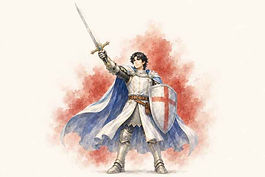
Galahad (Sir)
Sir Galahad stands as the supreme exemplar of purity and spiritual perfection in Arthurian legend-the only knight deemed worthy enough to achieve the Holy Grail. First emerging in the 13th-century Lancelot-Grail (Vulgate) Cycle, Galahad was conceived through a web of prophecy, deception, and divine purpose. He is the illegitimate son of Sir Lancelot du Lac, the greatest knight of the Round Table, and Elaine of Corbenic, daughter of the Fisher King. His very existence was orchestrated by King Pelles, who through magical foreknowledge understood that Lancelot would father a child destined to become the Grail Knight. The enchantress Dame Brusen provided Elaine with a magic ring that disguised her as Queen Guinevere, Lancelot's true love, making Galahad's conception both a betrayal and a fulfillment of destiny. Merlin himself had prophesied that Galahad would surpass his father in valor and complete the quest that all other knights would fail.
Galahad's arrival at King Arthur's court at Camelot was marked by supernatural portents. During the Pentecost feast, the young knight-barely fifteen years old-was led to the Siege Perilous, the forbidden seat at the Round Table reserved for the knight who would achieve the Grail. Where all others who had sat there perished, Galahad survived, the chair's inscription transforming to read: "This is the siege of Galahad the haut prince." He also drew a sword from a floating stone that no other knight could move, confirming his predestined role. His resemblance to his father Lancelot was unmistakable, yet where Lancelot embodied earthly chivalry compromised by his love for Guinevere, Galahad represented perfect spiritual purity-celibate, humble, and divinely favored.

Galehaut
Galehaut is the most powerful knight in Arthurian legend, the half-giant lord who conquered thirty kingdoms and then surrendered them all for the friendship of a single man. He is the son of the Beautiful Giantess and the evil knight Brunor, the towering figure who stood six inches taller than the tallest knight at Arthur's Round Table and whose very name made kings tremble. He is the Uncrowned King who refused the crown of Sorelois and twenty-nine other realms until he could add Logres, the kingdom of King Arthur, to his list of conquests. He is the commander whose army was so vast that Arthur could not match it, who stood on the brink of total victory and then threw it away because he could not bear to destroy the man who fought beside Arthur, the mysterious Black Knight whose prowess on the battlefield stopped his heart with admiration. He is the friend who became Lancelot's companion, who arranged the first kiss between Lancelot and Queen Guinevere, and who gave the lovers refuge in his own kingdom when the False Guinevere threatened to destroy them. And he is the man who died of grief at the age of thirty-nine, fasting alone in a locked chamber because he believed that Lancelot was dead, leaving behind a name that Dante would immortalise in the Inferno and that Boccaccio would borrow for the greatest story collection of the Middle Ages.

Gareth (Beaumains)
Beaumains is the kitchen knight who rose from the scullery of Camelot to become one of the most beloved heroes of the Round Table, the young man who let himself be mocked for a year so that he could prove his worth by deeds rather than by blood. He is Gareth of Orkney, the youngest true-born son of King Lot of Orkney and Queen Margawse, Arthur's sister, the brother of Gawain, Gaheris, and Agravaine, and the uncle of the fellowship that gathered at Camelot. He is the knight who arrived at Arthur's Pentecost feast in rags, leaning on the shoulders of two men, and asked only for food and drink for a year before he would reveal his name or claim his birthright. He is the boy whom Sir Kay, Arthur's sharp-tongued steward, nicknamed Beaumains, meaning Fair Hands, in mockery of his uncalloused palms, and whom Kay put to work in the kitchen among the scullions. He is the warrior who, when a damsel named Lynette came begging for a champion to rescue her sister from the Red Knight of the Red Launds, asked Arthur for the adventure and for Sir Lancelot to knight him, and then proved himself the equal of any knight in Christendom. And he is the gentle giant who could have boasted of his royal blood but chose instead to let his sword speak for him, the knight whose humility was as great as his strength and whose story is the purest fairy tale in all of Arthurian legend.

Gargoyle
A gargoyle is a carved architectural waterspout designed to throw rainwater clear of a building's walls. Medieval builders often shaped these projecting spouts as animals, monsters or grotesque human faces, turning practical drainage into dramatic sculpture. A carved grotesque that carries no water is technically not a gargoyle, although modern speech often uses the same word for both. Rouen preserves a separate local legend of Saint Romanus defeating a dragon called La Gargouille, but that story should not be treated as the proven origin of all architectural gargoyles. Gargoyles do not play a speaking or fighting role in the medieval Arthurian romances; their connection with Camelot belongs mainly to later Gothic visualisations of castles, chapels and fantasy worlds.