Arthurian Mythology List


Welcome to the Mythopouch list of Arthurian Legend mythology entries! We also delve into the early history of Britain, Wales, and the Celtic and medieval traditions that shaped the Arthurian world. From kings, queens, knights and mages to castles, quests, monsters, artefacts, weapons, enchanted objects, creatures and more, this collection will continue to grow over time. Mythopouch provides real-world background and mythological information drawn from early chronicles, Welsh tales and medieval romances such as: the Welsh Triads, Culhwch and Olwen, the Historia Brittonum, the Annales Cambriae, Geoffrey of Monmouth, Chrétien de Troyes, the Lancelot-Grail or Vulgate Cycle, Sir Gawain and the Green Knight, and Thomas Malory’s Le Morte d’Arthur. Arthurian legend carries powerful ideas about courage, honour, loyalty, temptation, sacrifice, prophecy, betrayal and the dream of a better kingdom - messages passed from storyteller to storyteller for centuries, many of which still speak to modern life. Our unique imagery is meant to capture the imagination and ignite the Arthurian spark within us all. Our “token mark” coin symbol assigned to each record is a visual representation of the entity, for use in Mythopouch learning modules and games.
"Nothing is given, everything is earned" at Mythopouch!
Learn - Earn - Play
Arthurian Entity Quick Index
Our current list of ancient British mythology (Arthurian Legend) and ancient history entities are here - which are growing day by day!
Search by using the:
-
"Search Mythology Records" function to browse all mythology records and blog pages;
-
Browse the visual cards with overviews by clicking "Go to Visual A-Z";
-
Or just browse and click the A-Z entries below....
See more list entries
Read Arthurian Legend Insights
Click below to view our Arthurian Legend (ancient British) mythology blog article insights, where we delve into the current Mythopouch Tier regions and what we think you should know!


Arthurian Entity Card Index
See more card entries

Persant
Sir Persant of Inde is the fourth and final brother encountered by Sir Gareth before Gareth reaches the siege of Castle Dangerous. Malory describes Persant’s pavilion, attendants, horses, shields and spears as being of the colour of Inde, a colour generally represented as deep blue or indigo.
Persant is the lord of a rich city and maintains an elaborate tournament ground in a meadow outside it. Five hundred knights and gentlemen are said to gather around him for jousting, tournaments and other knightly games, although Persant faces Gareth alone.
Their battle lasts for more than two hours and kills both horses. Persant eventually yields and offers Gareth the permanent service of one hundred knights. He provides Gareth with food and rest, warns him about Sir Ironside and becomes one of the first people entrusted with Gareth’s true identity. Persant later becomes a Knight of the Round Table and serves as chief server at Gareth’s wedding.
Pertolepe
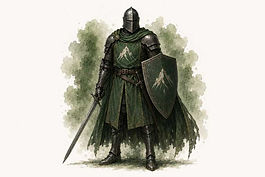
The Green Knight, Sir Pertolepe, is the second of four brothers encountered by Sir Gareth while Gareth travels under the name Beaumains. Pertolepe sees Gareth wearing the black armour of his brother Sir Percard and initially believes that Percard is approaching. When he learns that Gareth has killed the Black Knight, he challenges him in defence of his brother’s honour.
Pertolepe and everything associated with his encounter are coloured green. He rides a green horse, wears green armour and carries a green shield and spear. After a fierce mounted and foot battle, Gareth overcomes him but spares his life at Dame Lynette’s request.
In return, Pertolepe forgives Percard’s death, yields himself to Gareth and promises the service of thirty knights. He shelters Gareth and Lynette at his manor, protects Gareth from treachery during the night and escorts them safely through the forest. He later submits to King Arthur, becomes a Knight of the Round Table and serves as chamberlain at Gareth’s wedding to Dame Lionesse.

Prydwen
Prydwen is the ship of King Arthur in the oldest Welsh tradition, the vessel that carried him to Annwn, the Celtic Otherworld, on a raid from which only seven men returned alive, and the only one of Arthur's named possessions that was neither a weapon nor an item of clothing but a means of passage between worlds. It is the ship that appears in the cryptic poem Preiddeu Annwn, preserved in the Book of Taliesin, where the bard Taliesin, the legendary poet who was reborn from the cauldron of the enchantress Ceridwen, sings of three shiploads of Prydwen sailing to the Otherworld to seize a magic cauldron, and of the terrible cost of that voyage. It is the galley that Arthur named in the tale of Culhwch and Olwen when he listed the things he would never give away, alongside his sword Caledfwlch, his spear Rhongomyniad, his dagger Carnwennan, his shield Wynebgwrthucher, and his wife Gwenhwyfar. It is the vessel that carried Arthur's war-band to Ireland to steal the cauldron of Diwrnach the Irishman, and that followed the monstrous boar Twrch Trwyth across the Irish Sea when the hunt drove the beast from one island to the other. And it is the ship whose name Geoffrey of Monmouth borrowed for Arthur's shield when he made the king famous across Europe in 1136, transforming a vessel of the Otherworld into a piece of battlefield equipment, a repurposing that has puzzled scholars ever since and that speaks to the deep Celtic ambiguity of the name itself, which means "Fair Form" or "Blessed Form" and could apply as easily to a painted shield as to a ship that sails between the living and the dead.
Questing Beast
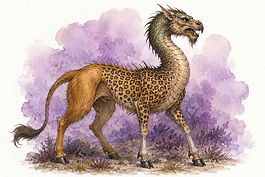
The Questing Beast (or Beast Glatisant, from Old French glapissant, "yelping" or "barking") ranks among the strangest and most symbolically charged creatures in Arthurian legend-a chimeric monster pursued endlessly by knights yet never captured, embodying the theme of unattainable quests that pervades the Matter of Britain. First appearing in the 13th-century French romances including the Prose Tristan, Perlesvaus, and the Post-Vulgate Cycle, the beast assumed its definitive form in Sir Thomas Malory's Le Morte d'Arthur. Malory describes it as "a beast with a head like a serpent's head, and a body like a leopard, buttocked like a lion and footed like a hart," with a noise emanating from its belly "as it had been the noise of thirty couple of hounds questing." This bizarre biology-part leopard, part lion, part hart, part serpent, with the sound of a hunting pack issuing from within its stomach-makes the Questing Beast unique even among the menagerie of Arthurian monsters.
The creature's origin story, related by Merlin in the Post-Vulgate Cycle, adds a layer of profound moral horror to its already disturbing appearance. The beast was born from a mortal woman who lusted after her own brother. When she accused her innocent brother of rape, their father King Hipomenes ordered the son torn apart by dogs. With his dying breath, the brother prophesied that his sister would give birth to a monster that would make the same sounds as the dogs that killed him. The birth killed most of the attending midwives, and the abomination escaped into the forest. Merlin later reveals to Arthur that the beast first appeared after Arthur's own unwitting incest with his half-sister Morgause-the act that conceived Mordred-making the Questing Beast a living symbol of that sin and the destruction it would bring upon Camelot.

Raasay
Raasay is the Isle of the Roe Deer, the slender island that lies between the towering Cuillin mountains of Skye and the mainland of Scotland, a place of red sandstone and volcanic rock where Gaelic poets, Jacobite fugitives, and clan chiefs have all left their mark. It is the island whose well, Tobar na Ba Bàine, the Well of the Pale Cow, has flowed since Celtic and Iron Age times, when the pale cow was thought to bring fertility to the land and the water that filters through Jurassic sandstone still carries the mineral memory of ancient belief. It is the birthplace of Sorley MacLean, the greatest Gaelic poet of the twentieth century, whose poem Hallaig captured the grief of the Highland Clearances that emptied the island of over a thousand souls and left only the ghosts of a vanished community. It is the island where Bonnie Prince Charlie spent two nights hiding from Hanoverian troops after the disaster of Culloden in 1746, and where the MacLeods of Raasay suffered brutal retribution for their loyalty to the Jacobite cause, their livestock slaughtered, their homes and boats burned. And it is the island of Calum's Road, the 1.75-mile track built by one man with a pick, a shovel, and a wheelbarrow over ten years so that his daughter could visit him from school on Skye, a monument to the stubbornness of island life that outlasts every empire and every clearance.

Ragnelle (Dame)
Dame Ragnelle is the loathly lady of Inglewood Forest whose answer to the riddle "What do women most desire?" saved King Arthur's life and whose marriage to Sir Gawain became one of the most beloved tales in Middle English romance. She is the foul ladye, a creature so hideous that Arthur and Gawain both refer to her as a fiend, with a face like a boar's snout, tusks like a hog, and a body that seemed half-woman and half-beast. She is the possessor of the one answer that no knight or sage in Britain could find, the knowledge that women desire sovereignty above all else, the power to rule their own lives and choose their own fates. She is the bride who demanded a public wedding with all the trimmings, who ate enough at the feast to shame six ordinary guests, and who transformed into the fairest woman in England when her husband kissed her on their wedding night. And she is the lady who gave Gawain an impossible choice - fair by day or fair by night - only to have him break her curse by giving her the sovereignty she had named.
Red Dragon
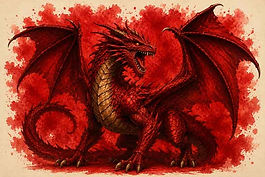
The Red Dragon-Y Ddraig Goch-ranks among the most enduring symbols to emerge from Arthurian legend, representing the native Britons in their eternal struggle against invasion and oppression. Its story begins in the same underground pool at Dinas Emrys where the young Merlin (then called Emrys) interpreted the battle between two dragons for the British warlord Vortigern. Where the White Dragon symbolized the invading Saxons, the Red Dragon embodied the Britons themselves-the Celtic peoples of Romano-British descent who resisted the Anglo-Saxon conquest and preserved their identity in Wales, Cornwall, and the north. The Red Dragon's eventual victory over the White Dragon in Merlin's prophecy became the foundation myth of Welsh national identity, a symbol so powerful that it adorns the Welsh flag to this day.
The color red carried specific symbolic weight in the dragon prophecy. In medieval Welsh tradition, warriors were often called "dragons" in reference to their fearsomeness in battle, and the red color associated the Britons with Roman military tradition-Roman commanders had worn the paludamentum, a cloak typically dyed red. The Red Dragon thus represented not merely the Celtic Britons but their claimed inheritance of Roman civilization and legitimacy, set against the barbarian invaders represented by the pale White Dragon. When Geoffrey of Monmouth recorded and expanded the Dinas Emrys legend in his Historia Regum Britanniae, he transformed a local Welsh folktale into a prophecy of national destiny, making the Red Dragon's triumph a promise that sustained Welsh resistance to English domination for centuries.

Rhongomyniad
Rhongomyniad is the spear of King Arthur in the oldest Welsh tradition, the weapon that stood beside Caledfwlch his sword and Carnwennan his dagger as one of the three sacred arms that God had given him, and the only one of the three that never acquired a magical reputation in the romances that followed. It is the spear that Arthur named in the tale of Culhwch and Olwen when he listed the things he would never give away, alongside his ship Prydwen, his mantle, his sword, his shield Wynebgwrthucher, his dagger, and his wife Gwenhwyfar. It is the lance that Geoffrey of Monmouth called Ron when he made Arthur famous across Europe in 1136, the spear that Arthur carried in his right hand at the Battle of Mount Badon, the battle that stopped the Saxon advance for a generation. It is the weapon that the English poet Layamon said was forged in Carmarthen by a smith named Griffin and had once belonged to Uther Pendragon, Arthur's father, before it passed to the son who would outshine him. And it is the forgotten weapon of the Arthurian arsenal, the spear that never glowed like thirty torches, never cut through iron as if it were wood, and never returned to a fairy lake, yet was named with love and pride by the Welsh bards who first sang Arthur's wars, a plain spear for a warlord who needed no magic to win.

Rience (King)
King Rience is the royal challenger who demands Arthur's beard to complete a mantle trimmed with the beards of defeated kings. In Malory's Le Morte d'Arthur he rules North Wales, Ireland and many isles, and his messenger announces the submission of eleven rulers. Arthur refuses to supply the remaining ornament or acknowledge Rience as his lord. Their conflict turns a humiliating demand into war, but the king's defeat comes away from the main battlefield. Guided by Merlin, Balin and Balan intercept him during a night journey to meet Lady de Vance. They wound and capture him, then send him into Arthur's custody. His brother Nero continues the fighting after that capture. The beard-mantle also recalls the giant Ritho in Geoffrey of Monmouth and related Welsh tradition, though the human king and mountain giant should not be combined into one life. Rience remains the ruler whose threat to reduce Arthur to a trophy ends with his own loss of freedom.
Round Table
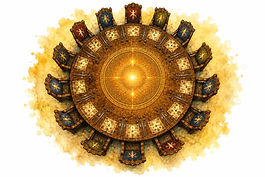
The Round Table is the great wheel of the Arthurian world, the vast circle at which King Arthur gathered the finest fellowship of knights the earth has seen, a table with no head and no foot where no man might boast that he sat above his brother. It is the table that first appears in Wace's Roman de Brut, made so that all should be equal, and the table that Merlin raised in the pattern of the table of the Last Supper and the table of Joseph of Arimathea, the third and last of the sacred tables of the world. It is the table that came to Arthur as the dowry of Guinevere, its seats lettered in gold with the names of the knights, and its single empty place, the Siege Perilous, fatal to every man but the destined Grail knight, whose name appeared there on the day he came to court. It is the order that swore the Pentecostal oath each year, to flee treason, to show mercy, and to succour every damsel in distress. And it is the fellowship that broke under the sin it could not survive, the circle that was never whole again after the Grail quest, the dream of equality that died with the king at Camlann.

Siege Perilous
The Siege Perilous is the empty seat at the Round Table, the one chair in Camelot that no knight, however great, was permitted to take, the chair that kept a place for a man who had not yet been born. It is the seat Merlin ordained when he made the Round Table for Uther Pendragon, modelled on the empty place of Judas at the table of the Last Supper and on the empty seat at the table of Joseph of Arimathea, where the Grail was kept. It is the seat that destroyed the presumptuous: the romances tell of a false disciple named Moyses who dared the empty seat of the Grail table and was swallowed by the earth alive, crying out as it closed. It is the seat that wrote prophecies in letters of gold, foretelling the year it would be filled, until on a feast of Pentecost the letters changed and read: this is the siege of Galahad, the high prince. And it is the seat whose filling was the end of the age, for when the Grail knight sat in it at last, the quest began that emptied Camelot for ever.

Sons of Palug
The Sons of Palug are the unnamed men who foster Hen Wen's discarded kitten on Môn, allowing it to become Cath Palug. Their role comes from the fuller White and Red Book version of Welsh Triad 26. After Coll son of Collfrewy throws the kitten into the Menai, the sons of Palug rear it 'to their own harm', and it becomes one of the great oppressions nurtured on the island. The text does not name the sons, state how many there were, explain why they fostered the animal or describe exactly what harm befell them. A separate early Arthurian poem, Pa Gur, connects Cath Palug with Cai and says that nine score warriors would fall for its food, but the Sons of Palug do not appear in that poem. Their record must therefore preserve the surviving silence rather than turning them into a detailed household of invented princes or monster hunters.