Arthurian Mythology List


Welcome to the Mythopouch list of Arthurian Legend mythology entries! We also delve into the early history of Britain, Wales, and the Celtic and medieval traditions that shaped the Arthurian world. From kings, queens, knights and mages to castles, quests, monsters, artefacts, weapons, enchanted objects, creatures and more, this collection will continue to grow over time. Mythopouch provides real-world background and mythological information drawn from early chronicles, Welsh tales and medieval romances such as: the Welsh Triads, Culhwch and Olwen, the Historia Brittonum, the Annales Cambriae, Geoffrey of Monmouth, Chrétien de Troyes, the Lancelot-Grail or Vulgate Cycle, Sir Gawain and the Green Knight, and Thomas Malory’s Le Morte d’Arthur. Arthurian legend carries powerful ideas about courage, honour, loyalty, temptation, sacrifice, prophecy, betrayal and the dream of a better kingdom - messages passed from storyteller to storyteller for centuries, many of which still speak to modern life. Our unique imagery is meant to capture the imagination and ignite the Arthurian spark within us all. Our “token mark” coin symbol assigned to each record is a visual representation of the entity, for use in Mythopouch learning modules and games.
"Nothing is given, everything is earned" at Mythopouch!
Learn - Earn - Play
Arthurian Entity Quick Index
Our current list of ancient British mythology (Arthurian Legend) and ancient history entities are here - which are growing day by day!
Search by using the:
-
"Search Mythology Records" function to browse all mythology records and blog pages;
-
Browse the visual cards with overviews by clicking "Go to Visual A-Z";
-
Or just browse and click the A-Z entries below....
See more list entries
Read Arthurian Legend Insights
Click below to view our Arthurian Legend (ancient British) mythology blog article insights, where we delve into the current Mythopouch Tier regions and what we think you should know!


Arthurian Entity Card Index
See more card entries
Mordred
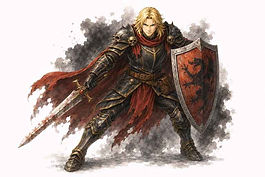
Mordred stands as the quintessential traitor of Arthurian legend-the illegitimate son of King Arthur who brought about the Battle of Camlann and the fall of Camelot. His earliest appearance comes not as a villain but as a figure of ambiguity: the 10th-century Annales Cambriae records simply that "the strife of Camlann, in which Arthur and Medraut fell," without indicating whether they fought together or against each other. Welsh tradition preserved this complexity-the Dream of Rhonabwy suggests Medrawd was one of Arthur's warriors, while certain triads describe him as a man of gentle words. It was Geoffrey of Monmouth, in his Historia Regum Britanniae (c. 1136), who transformed Mordred into the archetypal usurper, and later French romances who added the darkest element of his story: that he was Arthur's son by incest with his half-sister Morgause, making his betrayal a crime of flesh as well as treason.
The fully developed tradition, recorded in the Vulgate Cycle and Malory's Le Morte d'Arthur, presents Mordred as the product of a fateful union. Morgause, wife of King Lot of Orkney and Arthur's half-sister, visited Camelot on a diplomatic mission early in Arthur's reign. Unaware of their kinship, Arthur and Morgause conceived a child. Merlin prophesied that this child would grow to destroy Arthur's kingdom, prompting the king to order the drowning of all infants born on May Day. Mordred alone survived, washed ashore and raised by a fisherman until he eventually came to his father's court. This traumatic origin-survival of mass infanticide, hidden parentage, and a destiny foretold-shaped a character who moved from loyal service to utter destruction.

Morgan Le Fay
Morgan Le Fay stands as the most powerful sorceress in Arthurian legend-a figure of extraordinary complexity who evolved from benevolent healer to Arthur's chief antagonist across centuries of storytelling. Her first appearance, in Geoffrey of Monmouth's Vita Merlini (c. 1150), presents her in a surprisingly positive light: as Morgen, the eldest of nine enchantress sisters who rule the Isle of Avalon, where she heals the mortally wounded Arthur after Camlann. She is described as beautiful, knowledgeable in mathematics and astronomy, expert in medicinal herbs, and capable of shapeshifting and flight. This original Morgan was no villain but a divine healer-almost a goddess figure-who offered Arthur sanctuary and the possibility of restoration. Her name derives from Old Welsh Morgan, meaning "sea-born," and the French epithet la Fée ("the Fairy") identifies her with the Celtic Otherworld.
The transformation of Morgan from benevolent healer to antagonist represents one of the most striking character developments in medieval literature. Chrétien de Troyes and subsequent French romances began darkening her portrait, making her Arthur's half-sister (daughter of Igraine and Gorlois, Duke of Cornwall), a student of Merlin's magic, and increasingly hostile to Arthur and his queen. The Vulgate Cycle completed her villainous transformation: she became sexually promiscuous, schemed against Arthur's life, attempted to expose Lancelot and Guinevere's affair, and in some versions sought to steal Excalibur and its enchanted scabbard. Yet even in her antagonism, Morgan retained traces of her original power and ambiguity-she was never merely evil but dangerously autonomous, a woman whose magic made her equal to any man in the Arthurian world, including Merlin himself.

Nine Sisters of Avalon
The Nine Sisters of Avalon are the enchanted council of nine women who rule the Fortunate Isle beyond the western sea, the paradise where no farmer ploughs and where men live for a hundred years or more. They are the sisterhood who received the dying King Arthur after the battle of Camlann and laid him upon a golden bed in their chamber, where their chief healer inspected his wound and promised to restore him if he would submit to their care. They are the learned women who govern by a pleasing set of laws, who study mathematics and the properties of herbs, and whose youngest sister Thiten is famed for her skill on the cither, a stringed instrument like a lyre. They are the nymphs who echo the nine virgin priestesses of the Ile de Sena off the coast of Brittany, the Gallizenae who could cure the sick and change their shape at will, and who stand at the end of a long Celtic tradition of ninefold female power. And they are the collective that would later be absorbed into a single figure, Morgan le Fay, as centuries of retelling collapsed the sisterhood into one sorceress, yet who began as a circle of nine distinct women ruling an island of apples at the edge of the world.

Noroison (Lady)
Lady Noroison is the noblewoman whose household restores Yvain after grief has driven him into the forest in Chrétien de Troyes's Yvain, or The Knight with the Lion. Her own lands are being ravaged by Count Alier, and a damsel recognises that the sleeping stranger could become a valuable defender if he recovers. Noroison supplies a precious ointment made by Morgan the Wise, the enchantress associated with Morgan le Fay, and entrusts its use to her servant. The maiden uses the whole box rather than the small amount prescribed, then conceals what she has done. Although the lady laments the loss, she continues to provide Yvain with shelter, clothing and care. His recovery brings protection to her people: he defeats Alier and delivers him into her hands to make peace and restitution. Noroison would gladly keep the knight as her husband or lord, but he leaves. Her story joins practical generosity to disappointed hope, while preparing Yvain for the adventures through which he will seek reconciliation with Laudine.

Olwen
Olwen is the heroine of Culhwch and Olwen, the earliest Arthurian tale in existence, the daughter of the chief giant Ysbaddaden Pencawr whose name means "white track" because four white trefoils spring up in her footprints wherever she walks. She is the maiden whose beauty is described in one of the most famous passages in Welsh literature, yellower of head than the flower of the broom, whiter of flesh than the foam of the wave, redder of cheek than the reddest foxglove, so fair that whoever beheld her was filled with love. She is the giant's daughter who is fated to bring about her father's death the moment she marries, and who nevertheless guides her suitor Culhwch to her father's court and warns him not to flinch from any task imposed. She is the prize of the most impossible quest in Welsh prose, the bride for whom Arthur and his warriors hunted the monstrous boar Twrch Trwyth across Ireland, Wales, and Cornwall to win the razor, comb, and shears that would shave the giant's beard. And she is the faithful wife who remained true to Culhwch for the rest of her life, a heroine born from a curse who turned a death-prophecy into a love story that has outlasted a thousand years.

Olyroun
Olyroun is the fairy king who rules the enchanted island that bears his name, the father of Tryamour, the most beautiful woman in the world, who gave her love to the impoverished knight Sir Launfal and took him away from the courts of mortal men forever. He is the King of Fayrye, the lord of the Occident, a man of such great power that his daughter could bestow magical gifts upon a knight without ever leaving her father's realm. He is the unseen sovereign whose island lies far across the salt sea, probably off the coast of Brittany, a paradisiacal kingdom where time moves differently and fairy maidens ride white palfreys richer than any mortal king's treasury. He is the father-in-law of Sir Launfal, the knight who was once Arthur's steward but who chose love over Camelot, and who returns every year to joust with any challenger brave enough to face him. And he is the ruler of one of the most mysterious realms in Arthurian legend, an island that some have identified with Avalon itself, the place where mortals who love fairies go to live beyond the reach of death and time.

Palamedes (Sir)
Sir Palamedes is the great Saracen knight of the Round Table, the noble pagan who won a place at the heart of Christian chivalry before he ever accepted its baptism. He is the son of King Esclabor, a royal exile from the East who came to Arthur's court, and the brother of the knights Safir and Segwarides. He is the second and most famous hunter of the Questing Beast, the impossible monster with the head of a serpent, the body of a leopard, the haunches of a lion, and the belly full of yelping hounds, which he swore to follow to the world's end. He is the hopeless lover of Isolde, the Irish princess whose heart belonged to Tristan, and the rival who fought Tristan at tournament after tournament, always honourably and always second. He is the knight who refused baptism until he had fought seven true battles for the faith, and who was christened at last with his greatest enemy standing as his friend. And he is the poet of loss, the author of the famous lament for Isolde after King Mark's treachery ended her and Tristan both.

Pellam (King)
King Pellam is the ruler of Listeneise whose pursuit of Balin ends in the Dolorous Stroke, one of the great catastrophes of Arthurian Grail romance. His brother Garlon has murdered knights while invisible, and Balin comes to the royal feast seeking vengeance. When Garlon is killed in the hall, Pellam attacks the avenger himself. The king's blow breaks Balin's sword and sends him searching through the castle for another weapon. In a richly furnished chamber Balin takes up a spear and wounds his pursuer. The castle collapses, and the surrounding countries suffer devastation. Merlin later identifies the weapon with the lance associated with Christ's Passion and explains Pellam's connection to Joseph of Arimathea. The wounded king must await Galahad's healing. Pellam belongs to a complicated family of Grail traditions, but his role in the Balin story should not be treated as proof that every Fisher King, Pelles and Maimed King is always the same person.

Pellinore
Pellinore is the King of Listenoise, the knight whose family was destined to hunt the Questing Beast for eternity, and the warrior who killed King Lot of Orkney in battle, sparking a blood feud that would claim his own life and poison the fellowship of the Round Table. He is the father of Percival, the first Grail knight, and of Lamorak, Aglovale, Tor, and Dindrane, the Grail heroine who served the sacred vessel, a lineage that connects him to the royal line of Joseph of Arimathea. He is the knight who broke King Arthur's sword, the blade Arthur had drawn from the stone, in a combat so fierce that Merlin had to enchant him to save the young king's life. He is the man who ignored his own daughter's cries for help by a forest well, too furious in his quest to rescue the Lady of the Lake to stop, and who learned too late that the mutilated body he had passed was his own child. And he is the Round Table knight whose death at the hands of Gawain and his brothers was the first great wound in Arthur's fellowship, the murder that proved chivalric oaths could not overcome blood vengeance, and the tragedy that foreshadowed the darker days to come.

Percard
The Black Knight, Sir Percard, is the first of four brothers encountered by Sir Gareth of Orkney while Gareth travels under the name Beaumains with Dame Lynette towards Castle Dangerous. Percard waits at a black lawn marked by a black hawthorn, a black banner, a black shield, a long black spear, a black horse and a black stone, while he himself is armed completely in black.
Believing Beaumains to be no more than a kitchen servant, Percard intends to unhorse him and claim his horse and armour. Gareth declares that he is a gentleman of higher lineage than Percard and insists that he will pass. Their encounter becomes a deadly fight: Percard’s spear breaks, Gareth drives his own spear through Percard’s body, and the Black Knight continues fighting with his sword before collapsing and dying.
Gareth then takes Percard’s black armour and horse. This causes Percard’s brother Pertolepe to mistake the approaching rider for him, beginning Gareth’s successive encounters with Pertolepe the Green Knight, Perimones the Red Knight—later commonly distinguished as the Puce Knight—and Persant of Inde, the Blue Knight.

Perceval (Sir)
Perceval is the original hero of the Grail story, the young knight whose innocence carries him to the Fisher King's castle and whose silence prevents the wounded ruler from being healed. He is the boy raised far from knighthood by a widowed mother who hopes ignorance will spare him the fate of his father and brothers. He is the youth who encounters armed knights in the forest, mistakes their splendour for something almost angelic, and rides to Arthur's court determined to become one of them. He is trained by Gornemant, falls in love with Blanchefleur and defeats the Red Knight who has humiliated Arthur's household. He is the guest who watches the bleeding lance and mysterious Grail pass before him but remembers his lesson not to ask too many questions. That silence becomes his great failure. Later French continuations, Welsh Peredur, Wolfram's Parzival, the Vulgate Grail Quest, Malory's Percivale and Wagner's Parsifal all reshape the same journey from untutored courage toward understanding.
Perimones
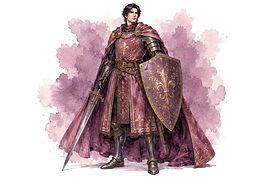
Sir Perimones is the third of four brothers encountered by Sir Gareth during his journey towards Castle Dangerous. Thomas Malory calls him the Red Knight and describes his horse, armour, shield, spear and other equipment as entirely red. Many later summaries distinguish him as the Puce Knight so that he is not confused with Sir Ironside, the separate Red Knight of the Red Launds.
Perimones is lord of a fortified white tower surrounded by two ditches. Fifty shields hang above its gate, and knights and squires have assembled in the meadow below for a tournament planned for the following morning.
Seeing Gareth wearing Sir Percard’s black armour, Perimones initially mistakes him for his brother. When Dame Lynette explains that Gareth killed Percard and defeated Pertolepe, Perimones challenges him. After a two-hour battle, Perimones yields and promises Gareth the service of his knights. He later submits to King Arthur, becomes a Knight of the Round Table and serves as chief butler at Gareth’s wedding.