Arthurian Mythology List


Welcome to the Mythopouch list of Arthurian Legend mythology entries! We also delve into the early history of Britain, Wales, and the Celtic and medieval traditions that shaped the Arthurian world. From kings, queens, knights and mages to castles, quests, monsters, artefacts, weapons, enchanted objects, creatures and more, this collection will continue to grow over time. Mythopouch provides real-world background and mythological information drawn from early chronicles, Welsh tales and medieval romances such as: the Welsh Triads, Culhwch and Olwen, the Historia Brittonum, the Annales Cambriae, Geoffrey of Monmouth, Chrétien de Troyes, the Lancelot-Grail or Vulgate Cycle, Sir Gawain and the Green Knight, and Thomas Malory’s Le Morte d’Arthur. Arthurian legend carries powerful ideas about courage, honour, loyalty, temptation, sacrifice, prophecy, betrayal and the dream of a better kingdom - messages passed from storyteller to storyteller for centuries, many of which still speak to modern life. Our unique imagery is meant to capture the imagination and ignite the Arthurian spark within us all. Our “token mark” coin symbol assigned to each record is a visual representation of the entity, for use in Mythopouch learning modules and games.
"Nothing is given, everything is earned" at Mythopouch!
Learn - Earn - Play
Arthurian Entity Quick Index
Our current list of ancient British mythology (Arthurian Legend) and ancient history entities are here - which are growing day by day!
Search by using the:
-
"Search Mythology Records" function to browse all mythology records and blog pages;
-
Browse the visual cards with overviews by clicking "Go to Visual A-Z";
-
Or just browse and click the A-Z entries below....
See more list entries
Read Arthurian Legend Insights
Click below to view our Arthurian Legend (ancient British) mythology blog article insights, where we delve into the current Mythopouch Tier regions and what we think you should know!


Arthurian Entity Card Index
See more card entries

Constantine (King)
King Constantine is the successor who inherited the ruins of Camelot, the kinsman to whom Arthur passed the crown of Britain as the king lay dying from Mordred's treachery at the battle of Camlann. He is the historical king of Dumnonia whom the monk Gildas called the tyrannical whelp of the unclean lioness, a man who disguised himself in an abbot's robes to murder two royal youths at the altar of a church. He is the avenger who hunted down the two sons of Mordred after they fled to sanctuaries in London and Winchester, killing them before the altars and sealing his own doom in the same act. He is the restorer whom Thomas Malory calls a good king, the man who brought the Archbishop of Canterbury back to his diocese and tried to hold Britain together after the Round Table had shattered. And he is the double-faced figure of Arthurian endings, the kinsman who received the greatest kingdom in Christendom from a dying hero and who proved, within three years, that no crown could survive the sins of the man who wore it.

Coraniaid
The Coraniaid are the invading people who form the first plague in the Middle Welsh tale Lludd and Llefelys. Their defining power is extraordinary knowledge: no conversation spoken anywhere in Britain can remain secret if the wind reaches it. Because every plan against them becomes known, King Lludd cannot defeat them through ordinary counsel or surprise. His brother Llefelys devises a way to speak beyond their hearing and gives him insects whose crushed mixture is deadly to the Coraniaid but harmless to Lludd's own people. The Welsh Triads also remember the Coraniaid as the first of the Three Oppressions that came to Britain. Their exact origin has attracted many later theories, but the medieval texts present them primarily as a legendary invading people rather than a securely identifiable historical nation.

Corineus
Corineus is the Trojan champion who accompanies Brutus to Britain and becomes the legendary ruler of Cornwall. Geoffrey of Monmouth introduces him as the leader of a community descended from Trojan exiles, a man whose strength makes him a formidable opponent even for giants. After joining Brutus, he fights in Gaul and shares the search for a new homeland. In Britain he receives the south-western region that Geoffrey connects with his name, and there his wrestling match with Gogmagog becomes his best-known adventure. The giant breaks his ribs, but Corineus lifts him and throws him from a cliff into the sea. He also belongs to the royal family story through his daughter Gwendolen, whose marriage to Brutus's son Locrinus becomes a source of conflict. Corineus is a figure of Britain's medieval foundation legend, not a securely documented ancient settler. His adventures explain a people's origins through ancestry, strength, territorial settlement and the defeat of the giants said to have occupied the land before them.
Cornwall
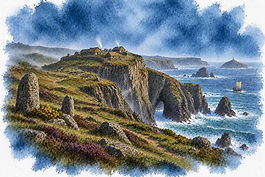
Cornwall is the historic region at the south-western end of Britain that forms one of the principal landscapes of Arthurian tradition. Known as Kernow in Cornish and Cernyw in Welsh, it is associated with Arthur's conception at Tintagel and with the romance of Tristan, Isolde and King Mark. Its actual history includes prehistoric settlement, mining, maritime connections and a distinctive language and culture. These features give the stories a recognisable setting, but archaeological evidence and romance do not establish the same kinds of facts. Tintagel's early medieval settlement is real; the identification of its inhabitants with Arthur's family belongs to legend. Castle Dore is an Iron Age hillfort, while its reputation as Mark's palace remains an interpretation. Cornwall's importance lies in the meeting of these different histories. Medieval writers, later storytellers and readers have repeatedly attached extraordinary lives to its cliffs, rivers and settlements, creating an Arthurian landscape whose imaginative force does not depend on proving that every legendary event occurred.
Creiddylad
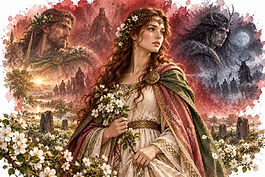
Creiddylad is the daughter of Lludd Llaw Eraint in the Welsh Arthurian tale Culhwch and Olwen. Arthur's court list places her among the gold-torqued women of Britain and calls her the maiden of greatest majesty in the Three Islands of Britain and their adjacent islands. A later episode says she is with Gwythyr son of Greidawl before Gwyn ap Nudd carries her away by force, provoking a violent feud. After Gwyn defeats Gwythyr and mistreats his captives, Arthur intervenes, frees the prisoners and returns Creiddylad to her father's house. Gwyn and Gwythyr are then required to fight for her every May Day until Judgement Day, when the final victor will receive her. The tale gives Creiddylad no speech or choice in the settlement, and later readings of her as a flower goddess or embodiment of summer are interpretations rather than statements made by the medieval text.

Culhwch
Culhwch is the hero of the oldest Arthurian story in the world, the Welsh prince of Culhwch and Olwen, who was born in a pig run, cursed by a stepmother, and set forty impossible tasks to win the most beautiful maiden in Britain. He is the son of Cilydd and of Goleuddydd, Fair Daylight, who bore him among the swine in her madness, and the cousin of King Arthur through his mother's house. He is the radiant youth who rode to Arthur's court in gold and scarlet, demanded that the king trim his hair as the pledge of a gift, and asked for Olwen, daughter of Ysbaddaden the Chief Giant, whose fate it was to die the day she wed. He is the suitor who faced the giant's propped-open eyelids and poisoned spears, and accepted the anoethau, the wonders no man could do: the comb and shears between the ears of the enchanted boar Twrch Trwyth, the cauldron of Diwrnach, the blood of the Black Witch, the finding of Mabon who was stolen at three days old. And he is the hero who does almost none of it himself, winning his bride through the fellowship of Arthur's court, the oldest image we have of what Camelot was for.
Culhwch and Olwen
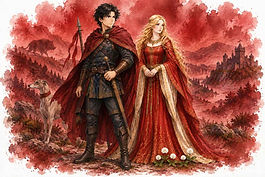
Culhwch and Olwen is a medieval Welsh prose tale in which a young man's search for a bride draws King Arthur's extraordinary household into a sequence of dangerous tasks. The title names the lovers, but the work itself is a surviving literary text, not a single person or a group of characters. Culhwch must win Olwen, daughter of the giant Ysbaddaden, and seeks help from Arthur, his kinsman. The ensuing adventures include the rescue of Mabon, encounters with ancient animals and the hunt for the boar Twrch Trwyth. The tale survives in the White Book of Rhydderch and the Red Book of Hergest, and became familiar to English readers through The Mabinogion. It is separate from the Four Branches of the Mabinogi. Often described as the oldest surviving Arthurian prose tale, it preserves an early Welsh presentation of Arthur's world, although the date of composition is debated. The manuscripts are historical evidence for the text; their existence does not make its supernatural adventures historical events.
Cunomorus
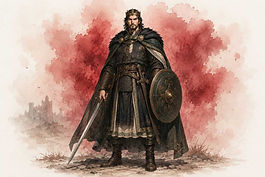
Cunomorus is the historical king of Dumnonia whose name, carved into a 6th-century memorial stone near Fowey in Cornwall, became the foundation of the entire Tristan and Isolde legend, the father whose gravestone reads "Here lies Drustanus, son of Cunomorus" and who was later remembered as King Mark of Cornwall. He is the Hound-of-the-Sea, the ruler whose Brittonic name Cynfawr spoke of power drawn from the waters that surrounded his kingdom of Dumnonia, a realm that stretched across Cornwall and Devon. He is the king whose court at Castle Dore was so vast that four languages were spoken within its walls, a man whose influence reached from the Channel to the Celtic Sea. He is the father - not the uncle, as the later French romances would have it - of Drustanus, the figure who became Tristan, as the 9th-century monk Wrmonoc confirmed when he wrote that "King Marc, whose other name is Quonomorus," ruled the Cornish and Breton nations. And he is the bridge between sub-Roman Britain and medieval romance, a 6th-century warlord whose real name survived for twelve centuries only because it was carved into granite beside the road to his stronghold.
Custennin the Shepherd
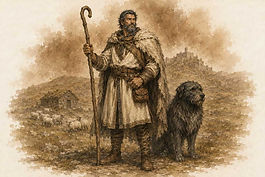
Custennin the Shepherd is the giant vassal of Ysbaddaden Chief Giant who tends the greatest flock of sheep in Britain from a mound before an impregnable fortress, the uncle of King Arthur and Culhwch whose family was destroyed by the very giant he served. He is the man of the jerkin of skins, a figure of such immense size that a gold ring given by Culhwch would not fit his finger and had to be tucked into a glove instead. He is the father of twenty-four sons, twenty-three of whom were murdered by Ysbaddaden out of cruelty, leaving only Goreu hidden in a stone chest at the end of the hearth. He is the ally who arranged the first meeting between Culhwch and Olwen, who gave his last son to Arthur's quest, and who watched from the plain as the nephew he had never known grew into the hero who would destroy his master. And he is the reminder that in Welsh Arthurian legend, even the most broken man may be the uncle of a king, and that the shepherd who buries his children one by one may still live to see the last of them behead a giant.
Cŵn Annwfn
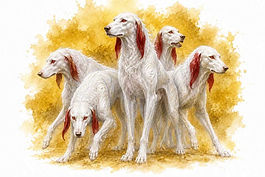
Cŵn Annwfn are the spectral hounds of Annwn, the Welsh Otherworld, a pack of white dogs with red ears and glowing eyes whose howling across the Welsh mountains has been a death omen for more than a thousand years. They are the fairy hounds that Pwyll, Prince of Dyfed, encountered on his first hunt, driving off Arawn's pack from a stag and earning the enmity of the King of Annwn before the two men became sworn friends. They are the soul-hunters who ride with the Wild Hunt, presided over first by Arawn and later by Gwyn ap Nudd, the king of the fair folk, chasing wrongdoers through the night until they can run no longer and escorting the newly dead across the threshold into the Otherworld. They are the pack whose bark defies every law of nature, growing louder the farther away they are and fading to a whisper as they close in on their prey, a sound that has driven shepherds from their flocks and sent travellers running for the nearest church. And they are the hounds that Christians called the Dogs of Hell, though Annwn was never a place of torment but a paradise of eternal youth, and the Cŵn Annwfn were never demons but the guardians of the boundary between the living and the dead, the white teeth that remind every mortal that the Otherworld is never more than a breath away.
Dallwyr Dallben
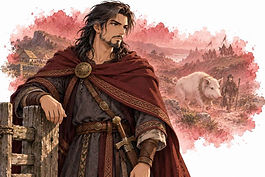
Dallwyr Dallben is the little-known owner of Hen Wen, the sow whose journey across Britain produces grain, bees and dangerous animals. Welsh Triad 26 says that Coll son of Collfrewy tends the swine of Dallwyr Dallben in Glyn Dallwyr in Cornwall. Dallwyr himself does not follow Hen Wen or perform the famous swineherd's deeds; nearly every action in the journey belongs to Coll. A figure called Datweir Dallpenn also appears in the court list of Culhwch and Olwen and is generally identified with Dallwyr, though the court list gives him no independent action. The medieval evidence therefore supports a sparse but distinctive identity: owner of the extraordinary sow and probable member of Arthur's wider legendary world, not the powerful magician later fiction made from the name Dallben.

Demon of the Perilous Chapel
The Demon of the Perilous Chapel is the supernatural guardian that has slaughtered three thousand knights in a haunted chapel in the forest, the black hand that appears from nowhere to extinguish the light and strike down any warrior who dares spend the night within its walls. It is the devil in full form who seized Perceval before the altar, only to vanish at the sign of the Cross, breaking an enchantment that had held for generations. It is the demonic force that turned a chapel built by Queen Brangemore of Cornwall into a charnel house, where marble tombs stand ready each day with the names of the victims already carved upon them. It is the guardian of the bloody shroud that covered the corpse of Sir Gylbert the Bastard, the cloth that Sir Lancelot risked his life to retrieve. And it is the threshold between the mortal world and the Otherworld, the place where knights discover that courage alone is not enough, and that only faith can defeat the darkness that waits in sacred places gone wrong.