Le Morte d'Arthur
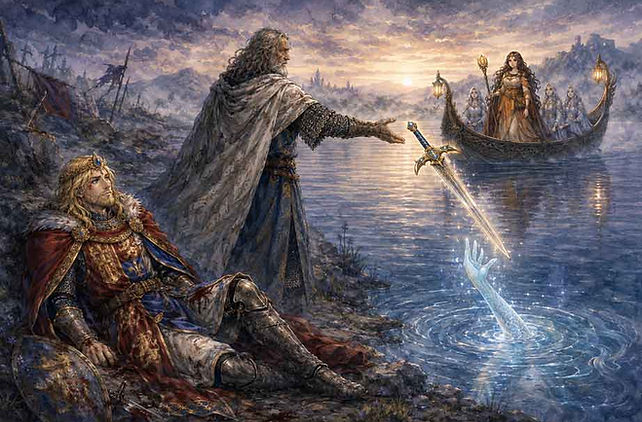
Le Morte d'Arthur

Arthurian
Le Morte d'Arthur
Name in Non-English, or Alternative Name/s
Le Morte Darthur; Le Morte D'Arthur; Morte Darthur; The Death of Arthur
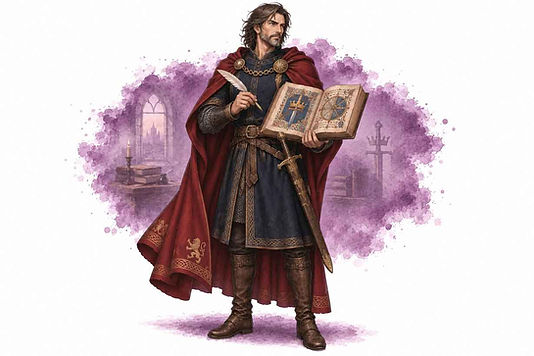
Mythopouch artistic interpretations
English Edition Translation used on this Page
Edited by Ernest Rhys · 1906 · J. M. Dent & Sons Ltd. / E. P. Dutton & Co.
Time Period
Composed c. 1469-1470; first printed by William Caxton in 1485. Reading witness: Everyman's Library edition first issued in 1906, with Volume II reprinted in 1923.
Introduction - Overview
Le Morte d'Arthur is Sir Thomas Malory's 15th-century English compilation of Arthurian romance, composed around 1469-1470 and first printed by William Caxton in 1485. It brings together the rise of Arthur, the fellowship of the Round Table, the adventures of major knights, the Grail quest, and the final collapse of Arthur's kingdom.
Malory drew on earlier French and English Arthurian traditions rather than creating the cycle from nothing. His work became one of the most influential English forms of the legend, but the text itself is not completely fixed. The surviving Winchester manuscript differs significantly from Caxton's printed version.
Mythopouch uses Le Morte d'Arthur as a major source for Arthurian records. This Sources page identifies the medieval work and the public-domain Everyman's Library edition used as a practical reading witness for checking episodes, names and chapter references.
The Work...
Le Morte d'Arthur
Malory's work is both a source and a synthesis. It gathers material about Arthur, Merlin, Lancelot, Guinevere, Gawain, Tristram, the Holy Grail and the destruction of the Round Table into one large English prose cycle. For Mythopouch, that makes it especially useful when a record appears across several earlier traditions but Malory supplies a clear English narrative form.
The British Library dates the composition of the surviving work to between March 1469 and March 1470. William Caxton printed the earliest known edition in 1485. The unique Winchester manuscript was copied shortly before Caxton's printing and differs significantly from it, so modern editions can vary in wording, organisation and readings.
The public-domain witness used here is the Everyman's Library edition of Le Morte d'Arthur by Sir Thomas Malory, edited by Ernest Rhys with an introduction by John Rhys. It was first issued in 1906 by J. M. Dent & Sons in London and E. P. Dutton & Co. in New York. The uploaded Volume II copy is a later reprint dated May 1923.
The two-volume arrangement is useful for reference. Volume I carries the story from the opening of Arthur's reign through the first nineteen chapters of Book X. Volume II resumes at Book X, Chapter XX and continues through the later adventures, the Grail material, the conflict around Lancelot and Guinevere, and the ending of Arthur's fellowship.
This edition preserves an older English style and should be read as a historical witness, not as modern explanatory prose. Spellings, editorial choices and some language belong to its period. Mythopouch may compare Malory with earlier or parallel sources where traditions differ rather than treating every detail in Malory as the only Arthurian version.
Use this Sources page when you want the historical text behind a Mythopouch citation. Use the Mythopouch retelling when you want a modern narrative written for today's readers. The medieval stories are public domain; Mythopouch's retelling, commentary, layout and original imagery are separate modern work.
Summary
Le Morte d'Arthur is Sir Thomas Malory's major English compilation of Arthurian legend, composed around 1469-1470 and first printed by Caxton in 1485. Mythopouch uses it as a key source for Arthur, Lancelot, Guinevere, the Grail quest and the fall of the Round Table.
Source Note
Sir Thomas Malory's medieval text is public domain. The 1906 Everyman's Library edition used as the reading witness is also public domain in Australia and the United States. Mythopouch's modern retelling, commentary and original imagery are © Mythopouch.