Greek Mythology List


Welcome to the Mythopouch list of Greek mythology entries! We also delve into the ancient history of Greece and the surrounding areas. From heroes to goddesses, places. monsters, artifacts, weapons, creatures and more - which will only grow over time. Mythopouch provides real-world information extracted from the original source material such as that from: Homer, Hesiod, Apollodorus, Ovid, Pausanias, Pindar, Aeschylus, Sophocles, Euripides, Hyginus, Diodorus Siculus and Apollonius of Rhodes. Words and stories carry powerful messages that were passed down from one generation to the next, many of which are still very applicable to modern times. Our unique imagery is meant to capture the imagination and ignite the magic mythology spark within us all. Our "token mark" coin symbol that is assigned to each record is a visual representation of the entity, for use in Mythopouch learning modules and games.
Earn - Learn - Play
Greek Entity Card Index
See more entries

Talos
Talos is the bronze giant who circled the island of Crete three times each day, hurling boulders at any ship that approached its shores, the last survivor of the bronze race of men and the most terrifying guardian in all of Greek mythology. He is the automaton forged by Hephaestus, the divine smith whose forge lay beneath a volcano and whose skill with hammer and anvil could craft wonders beyond mortal imagination, or given by Zeus, the king of the gods and wielder of the thunderbolt, to his lover Europa, the Phoenician princess whom the god had carried to Crete in the form of a white bull, to protect her and her descendants. He is the giant whose body was made entirely of bronze, impenetrable to sword or spear, and whose single vein of ichor, the golden blood of the gods, ran from his neck to his ankle, sealed at the end by a bronze nail or a membrane of skin. He is the sentinel who was finally destroyed by the witch-goddess Medea, the sorceress princess of Colchis who had helped Jason steal the Golden Fleece and who used her magic to drive Talos mad or to remove the nail that sealed his lifeblood, causing the ichor to drain out and the giant to fall dead upon the Cretan rocks. He is the ancestor of every robot and automaton in Western imagination, the first artificial being in literature, a creature of metal and divine craft that walked, thought, and died like a man. And he is the symbol of the boundary between the age of bronze and the age of heroes, the last remnant of an older world that the gods had replaced with flesh and blood.

Taraxippus
Taraxippus is the horse-frightening demon that haunted the race-courses of ancient Greece, the invisible presence that sent chariot horses into sudden, inexplicable panic at the most dangerous moment of the race, causing crashes, injuries, and deaths that the Greeks attributed to supernatural terror rather than mere chance. He is not a single creature but a multitude of spirits, each major festival site having its own resident Taraxippus, the most notorious being the Taraxippos Olympios at Olympia, where the greatest athletic games of the Greek world were held in honor of Zeus, the king of the gods and wielder of the thunderbolt. He is the ghost of murdered heroes, the vengeful spirit of charioteers who died in competition, or the angry soul of suitors who lost their lives and their loves on the race-track. He is the altar-shaped presence that stood at the turning-post of the hippodrome, where the chariots made their sharpest turn and the horses were most vulnerable to sudden fear. He is the deity that charioteers propitiated with sacrifices before every race, begging for safe passage around the curve where so many had crashed before. And he is the most practical ghost in Greek mythology, a supernatural explanation for the very real dangers of high-speed chariot racing, where a spooked horse at the wrong moment meant death for driver and beast alike.

Tartarus
Tartarus is the primordial god who is the abyss itself, the deepest and darkest point of the cosmos, born from Chaos before the world had shape or light. He is the third of the first beings to exist, emerging after Chaos and Gaia and before Eros, a cosmic force so ancient that he predates the Titans, the Olympians, and even the concept of time. He is the father of Typhon, the most terrible monster ever born, a creature with a hundred serpent heads and eyes of fire, whom Gaia the Earth Mother bore to challenge the rule of Zeus. He is the inverted dome beneath the flat earth, the opposite of the sky, forming the lower half of an egg-shaped cosmos that encloses all existence between heaven above and the pit below. And he is the living prison, a being so vast that his own body is the dungeon into which the gods cast their greatest enemies, a place so remote that a bronze anvil dropped from the heavens would fall for nine days to reach the earth, and then fall for nine more days before it touched his floor.

The Dioscuri
The Dioscuri are the inseparable twin brothers Castor and Pollux, one mortal and one divine, whose devotion to each other became so legendary that the gods themselves rewrote the rules of life and death to keep them together. They are the Spartan horsemen who rescued their sister Helen from the hero Theseus, storming Attica with an army to bring her back before she ever saw the walls of Troy. They are the Argonauts who sailed with Jason on the quest for the Golden Fleece, saving the ship Argo from a crushing storm when all other heroes despaired. They are the warriors who fell in love with their cousins, abducted them from their betrothed, and fought a fatal feud that ended in blood and thunder. And they are the constellation Gemini, two bright stars that appear in the winter sky as a promise that brotherhood can outlast even death itself, and that the love between two people can be stronger than the boundary between mortality and immortality.

Theseus
Theseus is the greatest Athenian hero and the legendary king who unified Attica. Traditionally considered the son of Aegeus (king of Athens) and Aethra (daughter of Troezen's king), though some myths claim Poseidon as his true father. He embodies the Athenian ideals of intelligence, political unity, and democratic governance, distinguishing himself from brute-force heroes through cunning and strategic thinking.

Titans
The Twelve Titans are the first generation of gods born from the union of Uranus, the primordial sky, and Gaia, the broad-bosomed Earth. They are the elder gods who ruled the cosmos before the Olympians existed, a family of twelve siblings who divided the world among themselves and governed its fundamental forces. They are the parents of the second generation of gods and the ancestors of almost every deity in the Greek pantheon. They are the defeated army who fought the ten-year Titanomachy against Zeus and the young Olympian gods, a war that shook the cosmos to its foundations. They are the prisoners cast into the dark pit of Tartarus after their defeat, where some remain in chains while others were later freed. And they are the namesakes of the planet Saturn's largest moon, the chemical element titanium, and the word "titanic" itself, a legacy that has made their name synonymous with immense size and power for three thousand years.
Tityos
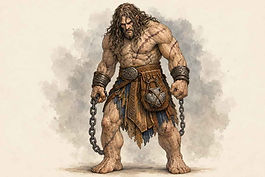
Tityos is the giant son of Zeus who grew so large he split his mother's womb and was carried to term by the earth goddess Gaia herself. He is the monstrous figure who attempted to assault Leto, the mother of Apollo and Artemis, as she travelled through the lovely spaces of Panopeus on her way to Delphi. He is the creature who was struck down by the arrows of the twin gods, Apollo and Artemis, who came to their mother's defense with deadly precision. He is the prisoner stretched across nine acres in the deepest pit of Tartarus, where two vultures descend upon him every day to tear out his liver, which grows back each night to be eaten again. He is the father of Europa, who bore Euphemus to Poseidon, making him an ancestor of the Argonauts. And he is the namesake of a hero cult at Panopeus, where ancient Greeks once honoured the very giant whom Olympian mythology condemned, a reminder that the line between monster and hero was never as clear as the gods wanted it to be.
Typhon
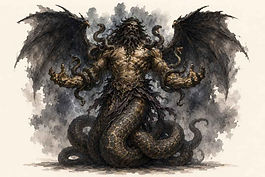
Typhon is the greatest monster ever born in Greek mythology, a hundred-headed serpent giant with fire blazing from his eyes and a body so vast his head touched the stars. He is the final child of Gaia and Tartarus, born to challenge the rule of Zeus after the Titanomachy had ended and the Olympian gods thought themselves secure. He is the creature who made the gods flee in terror to Egypt, where they hid themselves as animals to escape his wrath. He is the monster who captured Zeus himself, cut the sinews from his hands and feet, and left him immobilized in a Cilician cave. He is the father of the most terrible monsters in all Greek myth: Cerberus, the Hydra, the Chimera, the Sphinx, and the Nemean Lion, all born from his union with the she-dragon Echidna. And he is the prisoner buried beneath Mount Etna in Sicily, where his struggles still cause the volcano to erupt and thunder, a reminder that the earth itself holds a monster that once nearly overthrew the king of the gods.

Uranus
Uranus is the primordial god of the sky, the vast brass dome of heaven that stretched over the earth and held the stars in place. He is the first ruler of the cosmos, the father who created the Titans, the Cyclopes, and the Hecatoncheires upon the body of the earth goddess Gaia. He is the tyrant who locked his own monstrous children inside the earth, causing such pain that Gaia herself turned against him. He is the god castrated by his own son Cronus with a sickle of adamant, an act so violent that it birthed new gods from his spilled blood and the sea foam of his severed genitals. He is the grandfather of Zeus, the king of the Olympian gods, and the ancestor of almost every deity in the Greek pantheon. And he is the namesake of the seventh planet from the sun, a distant ice giant that carries his name into the modern age, a reminder that the sky itself was once a living god.

Zeus
Zeus is the king of the Olympian gods, the wielder of the thunderbolt who rules the sky and commands the storms. He is the son who escaped his father Cronus's belly to lead a ten-year war against the Titans and seize control of the cosmos. He is the husband of Hera who fathered gods and heroes across the Greek world, from Athena who sprang fully armed from his forehead to Heracles, the greatest of mortal heroes. He is the god who sits in judgment upon Mount Olympus, whose nod shakes the earth and whose will none may defy. He is the patron of kings and lawgivers, the guardian of oaths and the protector of strangers. And he is the namesake of the planet Jupiter, the Roman Jupiter, and countless words from "zealous" to "zenith," a legacy that has shaped Western civilization for three millennia.