Greek Mythology List


Welcome to the Mythopouch list of Greek mythology entries! We also delve into the ancient history of Greece and the surrounding areas. From heroes to goddesses, places. monsters, artifacts, weapons, creatures and more - which will only grow over time. Mythopouch provides real-world information extracted from the original source material such as that from: Homer, Hesiod, Apollodorus, Ovid, Pausanias, Pindar, Aeschylus, Sophocles, Euripides, Hyginus, Diodorus Siculus and Apollonius of Rhodes. Words and stories carry powerful messages that were passed down from one generation to the next, many of which are still very applicable to modern times. Our unique imagery is meant to capture the imagination and ignite the magic mythology spark within us all. Our "token mark" coin symbol that is assigned to each record is a visual representation of the entity, for use in Mythopouch learning modules and games.
Earn - Learn - Play
Greek Entity Card Index
See more entries
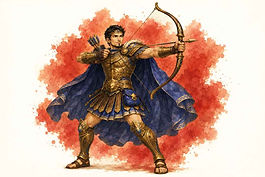
Paris
Paris is the Trojan prince whose choice of the most beautiful goddess set in motion the greatest war in Greek mythology, the ten-year siege of Troy that consumed heroes, kingdoms, and the age of bronze itself. He is the shepherd who was raised on Mount Ida, the mountain near Troy where he herded sheep and dreamed of glory, unaware that he was the son of King Priam, the ruler of Troy, and Queen Hecuba, who had abandoned him as an infant because of a prophecy that he would destroy the city. He is the judge who awarded the golden apple to Aphrodite, the goddess of love and beauty born from the foam of the sea, when Hera, the queen of the gods, and Athena, the goddess of wisdom born fully armed from the head of her father Zeus, the king of the gods and wielder of the thunderbolt, also claimed it, and in doing so won the love of the most beautiful woman in the world but earned the eternal hatred of the two most powerful goddesses on Olympus, the sacred mountain where the twelve great Olympian gods made their eternal home. He is the abductor who sailed to Sparta and carried away Helen, the wife of King Menelaus, a princess whose face was said to have launched a thousand ships and whose beauty was so great that every prince of Greece had once competed for her hand. He is the archer who killed Achilles, the greatest warrior of the Trojan War, by shooting him in the heel, the one weak spot where his mother Thetis, the sea-nymph, had held him when she dipped him in the River Styx to make him invulnerable. And he is the man who, in the tenth year of the war, faced Menelaus in single combat to decide the fate of Troy, only to be saved by Aphrodite when defeat was certain, and who later died by the bow of Philoctetes, the Greek archer whom the gods had forced to join the war at the last hour.

Pegasus
Pegasus is the winged horse born from the blood of the severed Gorgon Medusa, a creature so terrible that one look at her face turned living things to stone, the most magnificent steed in all of Greek mythology and the only beast whose flight carried a mortal man to the realm of the gods. He is the offspring of Poseidon, the god of the sea who ruled the oceans from his underwater palace of coral and pearl, and the cursed Medusa, one of three Gorgon sisters who had once been beautiful maidens before Athena, the goddess of wisdom born fully armed from the head of her father Zeus, the king of the gods and wielder of the thunderbolt, transformed her into a monster as punishment for a desecration in her temple. He is the mount of Bellerophon, the Corinthian hero who tamed him with a golden bridle given by Athena and who rode him to slay the Chimera, a fire-breathing monster with the body of a lion, the tail of a serpent, and the head of a goat that terrorized the kingdom of Lycia. He is the steed who struck the rock of Mount Helicon with his hoof and brought forth the Hippocrene, the sacred spring of the Muses, the nine daughters of Zeus and Memory who inspired poets and musicians, whose waters granted poetic inspiration to all who drank them. He is the horse who carried Bellerophon too close to Olympus, the sacred mountain where the twelve great Olympian gods made their eternal home, and was stung by a gadfly sent by Zeus to throw his rider, for no mortal was permitted to enter the realm of the gods alive. And he is the constellation that still gallops across the northern sky, his wings spread forever among the stars, a reminder that the Greeks believed wonder could be born from horror and that even monsters could father beauty.

Persephone
Persephone is the goddess whose abduction from a flowering meadow created winter itself, the daughter whose disappearance turned the world barren and whose return made the earth bloom again. She is the maiden who became queen of the dead, ruling beside her husband Hades in the shadowy kingdom beneath the earth. She is the girl who ate six pomegranate seeds in the Underworld, a bite that bound her to the realm of the dead for a portion of every year. She is the Kore, the maiden whose name was whispered in the secret rites of Eleusis, where initiates believed her story held the promise of life after death. And she is the dual-natured goddess who walks both worlds, springing up with flowers in one hand and commanding the spirits of the departed with the other, a figure who embodies the cycle of death and rebirth that governs every seed buried in the ground.
Perseus
Perseus is the hero who beheaded the Gorgon Medusa, a creature so terrible that one look at her face turned living things to stone, and lived to tell the tale, the only mortal to survive a direct encounter with that monstrous sisterhood and the founder of a dynasty that would shape the Greek world for generations. He is the son of Zeus, the king of the gods and wielder of the thunderbolt, who came to his mother Danae in a shower of golden rain, a union that her father King Acrisius of Argos had tried to prevent by locking her in a bronze tower because of a prophecy that his grandson would kill him. He is the exile who was cast into the sea in a wooden chest with his mother, only to wash ashore on the island of Seriphos and be raised by a fisherman, Dictys, while the island's cruel king Polydectes plotted to force Danae into marriage. He is the champion who slew Medusa using the polished shield of Athena, the goddess of wisdom born fully armed from the head of her father Zeus, the curved sword Harpe given by Hermes, the messenger god whose swift feet carried him between Olympus and the earth below, and the cap of invisibility borrowed from Hades, the god of the dead who ruled from the darkness beneath the earth. He is the rescuer who saved Andromeda, a princess chained to a rock as sacrifice to a sea-monster, and made her his queen. And he is the man who fulfilled the prophecy that began his story, killing his grandfather Acrisius not with sword or spear but with a discus thrown at a funeral games, an accident that satisfied fate without intent.

Poseidon's Trident
Poseidon's Trident is the three-pronged spear forged by the Cyclopes in the fires beneath the earth, the weapon that shook mountains and summoned tidal waves with a single strike. It is the gift that won a war, given to Poseidon by Brontes, Steropes, and Arges, the one-eyed giants who also forged Zeus's thunderbolts and Hades's helmet of darkness. It is the spear that could split rock to create springs, turn fertile valleys into salt marshes, and call forth earthquakes that toppled cities. It is the weapon Poseidon used to contest the patronage of Athens against Athena, striking the Acropolis to produce a salt spring while Athena offered the olive tree. And it is the sceptre that made Poseidon lord of the sea, the earth-shaker, and the god whom sailors prayed to with trembling hands before every voyage across the wine-dark Aegean.

Priam
Priam is the last king of Troy, the aged monarch who watched his city burn after ten years of war, the father of the greatest Trojan hero and the man whose grief moved even his enemies to pity. He is the king of the wealthy and powerful city of Troy, which stood on the northwestern coast of modern Turkey and controlled the trade routes between Europe and Asia, a kingdom of golden walls and broad streets that the gods themselves had helped to build. He is the father of Hector, the greatest Trojan warrior, a man of such nobility that even the Greeks honored him, and of Paris, the prince whose abduction of Helen, the most beautiful woman in the world, launched the thousand ships that brought destruction to Troy's gates. He is the husband of Hecuba, the queen who dreamed of burning torches before Paris's birth, and the father of fifty sons and many daughters, a patriarch whose family was both the glory and the doom of his kingdom. He is the old man who crossed the battlefield alone at night, guided by Hermes, the messenger god whose swift feet carried him between Olympus and the earth below, to kneel before Achilles, the greatest Greek warrior, and beg for the body of his dead son Hector. And he is the king who died at the altar of Zeus, the king of the gods and wielder of the thunderbolt, butchered by Neoptolemus, the son of Achilles, as the Greeks sacked his city and put his grandchildren to the sword.

Prometheus
Prometheus is the Titan who stole fire from the gods and gave it to humanity, the act that transformed naked, shivering mortals into builders, smiths, and thinkers. He is the forethinker who tricked Zeus at the feast of Mecone, hiding the best meat inside an ox's stomach while wrapping the bones in glistening fat, a deception that established the rules of sacrifice for all time. He is the creator who shaped the first humans from clay and water, breathing life into them with the help of the goddess Athena, the goddess of wisdom and war who sprang fully grown from the head of Zeus. He is the prisoner chained to a rock in the Caucasus Mountains, where an eagle sent by Zeus devoured his immortal liver every day, the organ growing back each night only to be torn out again. And he is the eternal symbol of rebellion against tyranny, the figure who chose the suffering of mortals over the comfort of Olympus and paid for that choice with endless torment.

Rhea
Rhea is the Titaness who saved the king of the gods from being swallowed by his own father, the mother whose cunning preserved the child who would overthrow the old order and establish the reign of Olympus, the sacred mountain where the twelve great Olympian gods made their eternal home. She is the daughter of Gaia, the earth goddess, and Uranus, the sky god who was castrated by his son Cronus, and she is the sister and wife of Cronus, the Titan who ruled the cosmos before the Olympians and who devoured his own children to prevent a prophecy of his downfall. She is the mother of six gods who would reshape the world, Hestia, Demeter, Hera, Hades, Poseidon, and Zeus, the last-born and the one she saved by trickery and sacrifice. She is the goddess who gave Cronus a stone wrapped in swaddling clothes to swallow instead of the infant Zeus, and who hid her son in a cave on Crete, the large island south of the Greek mainland, where the nymphs of Mount Ida nursed him on the milk of the goat Amalthea and the Kouretes, the armed young men, clashed their spears on their shields to drown out the baby's cries so that Cronus would not hear him. She is the deity whose worship spread across the ancient world, from the mountains of Crete to the plains of Phrygia, where she was honored as the Great Mother, a goddess of fertility and wild nature whose rites were celebrated with drums and ecstatic dancing. And she is the Titaness who, after the war between the old gods and the new, stepped aside and let her children rule, a rare figure in mythology who surrendered power without being destroyed, and who was remembered not as a warrior or a ruler but as the mother whose love was stronger than a king's tyranny.

Satyr
Satyr is the wild spirit of the forest who dances through the night with wine in one hand and a flute in the other, half-man and half-beast, driven by appetites that civilization cannot tame. He is the creature who chases nymphs through the moonlit groves, his laughter echoing between the trees, never quite catching what he desires. He is the chorus of the satyr play, the bawdy comedy that followed the tragedies at Athens, where men dressed in horse-tails and padded phalluses mocked the very gods they had just worshipped. He is the companion of Dionysus, the god of wine and ecstatic madness, riding in the wine god's wild procession through the mountains of Thrace and the vineyards of Nysa. And he is the living reminder that beneath every ordered society lies the wilderness, the drunkenness, and the music that refuses to be civilised.

Scylla
Scylla is the six-headed sea monster who lurks in a cave on the Italian side of the Strait of Messina, snatching sailors from passing ships with jaws that close like traps. She is the creature with twelve dangling feet and six long necks, each topped with a ravenous head lined with three rows of sharp teeth, whose voice sounds like the yelping of hounds. She is the beautiful nymph who was transformed into a monster by the jealous sorceress Circe, the goddess of magic and transformation who turned men into beasts, because the sea god Glaucus loved her instead of Circe. She is the nightmare that forces every captain to choose between her rocks and the whirlpool Charybdis, the monster who swallows water three times a day and spits it out again in a deadly vortex. And she is the origin of the phrase between Scylla and Charybdis, the impossible choice between two evils that has haunted decision-makers for three thousand years.

Selene
Selene is the goddess of the moon, the Titaness who drives her silver chariot across the night sky and bathes the sleeping world in pale light, the most beautiful of the night deities and the only goddess whose love for a mortal man was so great that she asked Zeus, the king of the gods and wielder of the thunderbolt, to grant him eternal youth in endless sleep. She is the daughter of the Titans Hyperion and Theia, the sister of Helios, the sun god who drives his blazing chariot across the sky by day, and Eos, the dawn goddess who paints the eastern horizon rose and gold each morning. She is the charioteer who rises from the Ocean, the river that encircles the world, and climbs the dome of heaven, her two white horses drawing the crescent moon behind her, their hooves treading the paths of the stars. She is the lover of Endymion, the shepherd prince of Mount Latmus in Caria, a youth of such extraordinary beauty that Selene looked down from the sky, saw him sleeping in a cave, and descended to kiss him, returning night after night to watch over him while the world below lay in darkness. She is the mother of fifty daughters, the Menae, the months of the lunar calendar, born of her union with Endymion in his eternal slumber. And she is the goddess whose face is the moon itself, whose waxing and waning mark the passage of time, and whose silver light has guided travellers, lovers, and poets since the earliest ages of Greece.

Siren
Siren is the bird-woman whose song is so beautiful that no sailor who hears it can resist steering toward her island, even knowing that the shore is lined with the rotting bones of those who came before. She is the creature with the head and breasts of a woman and the body, wings, and talons of a bird, a hybrid that the Greeks understood as a creature of hidden knowledge rather than mere seduction. She is the daughter of the river god Achelous and the Muse Terpsichore, or perhaps Melpomene, born from the music of the world itself. She is the handmaiden who failed to save Persephone, the maiden who became queen of the dead, and was transformed into a bird by Demeter, the goddess of grain, so that she could search the skies for the lost girl. And she is the origin of the word siren itself, the wailing sound that warns of danger while drawing the ear toward it, a paradox that has echoed through three thousand years of language.