Greek Mythology List


Welcome to the Mythopouch list of Greek mythology entries! We also delve into the ancient history of Greece and the surrounding areas. From heroes to goddesses, places, monsters, artifacts, weapons, creatures and more - which will only grow over time. Mythopouch provides real-world information extracted from the original source material such as that from: Homer, Hesiod, Apollodorus, Ovid, Pausanias, Pindar, Aeschylus, Sophocles, Euripides, Hyginus, Diodorus Siculus and Apollonius of Rhodes. Words and stories carry powerful messages that were passed down from one generation to the next, many of which are still very applicable to modern times. Our unique imagery is meant to capture the imagination and ignite the magic mythology spark within us all. Our "token mark" coin symbol that is assigned to each record is a visual representation of the entity, for use in Mythopouch learning modules and games.
Learn - Earn - Play
Greek Entity Quick Index
Our current list of ancient Greek mythology and ancient history entities are here - which are growing day by day!
Search by using the:
-
"Search Mythology Records" function to browse all mythology records and blog pages;
-
Browse the visual cards with overviews by clicking "Go to Visual A-Z";
-
Or just browse and click the A-Z entries below....
See more list entries
Read Ancient Greek Insights
Click below to view our ancient Greek mythology blog article insights, where we delve into the current Mythopouch Tier regions and what we think you should know!


Greek Entity Card Index
See more card entries

Stheno
Stheno is the immortal Gorgon, the mighty sister whose strength and ferocity outmatched both of her siblings combined, and the one monster in the triad who could never be killed. She is the eldest daughter of Phorcys, the old man of the sea who dwells in a cave at the ocean's bottom, and Ceto, the primordial goddess of the sea's monstrous depths, born alongside Euryale, the wide-leaping sister whose cry could shatter stone, and Medusa, the mortal sister whose beauty was cursed by Athena. She is the Gorgon who killed more men than Euryale and Medusa put together, whose brazen hands and serpent hair made her the most dangerous of the three, and whose immortal blood meant that no hero could ever claim her head as a trophy. She is the sister who woke to find Medusa beheaded by Perseus, the demigod son of Zeus who had stolen upon them in their sleep, and who rose with Euryale to pursue the killer across the western sky, her wings beating the air and her shrieks echoing over the ocean as the invisible hero fled. And she is the eternal survivor, the one Gorgon who never died, who returned to her island beyond the river Oceanus to guard the empty rock where her sister had slept, an immortal monument to a grief that could never end.

Syrinx
Syrinx is the nymph of Arcadia who fled from Pan, the goat-footed god of the wild, and was transformed into reeds at the very moment his grasping hands would have seized her. She is the daughter of Ladon, the river-god whose waters flow through Arcadia, a follower of Artemis, the virgin huntress who protects young maidens and drives her golden chariot across the wild hills. She is the maiden whose beauty caught the eye of Pan as she hunted on the slopes of Mount Lycaeus, and whose escape was so complete that not even the gods could restore her human form. She is the cluster of reeds from which Pan fashioned the first panpipes, cutting seven stalks of unequal length and binding them with wax to create the instrument that bears her name. And she is the origin of the word syrinx, which still means a pipe or a flute in Greek and has given its name to a medical term for the fluid-filled cavity of the spinal cord, a nymph who became both music and anatomy.

Talos
Talos is the bronze giant who circled the island of Crete three times each day, hurling boulders at any ship that approached its shores, the last survivor of the bronze race of men and the most terrifying guardian in all of Greek mythology. He is the automaton forged by Hephaestus, the divine smith whose forge lay beneath a volcano and whose skill with hammer and anvil could craft wonders beyond mortal imagination, or given by Zeus, the king of the gods and wielder of the thunderbolt, to his lover Europa, the Phoenician princess whom the god had carried to Crete in the form of a white bull, to protect her and her descendants. He is the giant whose body was made entirely of bronze, impenetrable to sword or spear, and whose single vein of ichor, the golden blood of the gods, ran from his neck to his ankle, sealed at the end by a bronze nail or a membrane of skin. He is the sentinel who was finally destroyed by the witch-goddess Medea, the sorceress princess of Colchis who had helped Jason steal the Golden Fleece and who used her magic to drive Talos mad or to remove the nail that sealed his lifeblood, causing the ichor to drain out and the giant to fall dead upon the Cretan rocks. He is the ancestor of every robot and automaton in Western imagination, the first artificial being in literature, a creature of metal and divine craft that walked, thought, and died like a man. And he is the symbol of the boundary between the age of bronze and the age of heroes, the last remnant of an older world that the gods had replaced with flesh and blood.

Taraxippus
Taraxippus is the horse-frightening demon that haunted the race-courses of ancient Greece, the invisible presence that sent chariot horses into sudden, inexplicable panic at the most dangerous moment of the race, causing crashes, injuries, and deaths that the Greeks attributed to supernatural terror rather than mere chance. He is not a single creature but a multitude of spirits, each major festival site having its own resident Taraxippus, the most notorious being the Taraxippos Olympios at Olympia, where the greatest athletic games of the Greek world were held in honor of Zeus, the king of the gods and wielder of the thunderbolt. He is the ghost of murdered heroes, the vengeful spirit of charioteers who died in competition, or the angry soul of suitors who lost their lives and their loves on the race-track. He is the altar-shaped presence that stood at the turning-post of the hippodrome, where the chariots made their sharpest turn and the horses were most vulnerable to sudden fear. He is the deity that charioteers propitiated with sacrifices before every race, begging for safe passage around the curve where so many had crashed before. And he is the most practical ghost in Greek mythology, a supernatural explanation for the very real dangers of high-speed chariot racing, where a spooked horse at the wrong moment meant death for driver and beast alike.

Tartarus
Tartarus is the primordial god who is the abyss itself, the deepest and darkest point of the cosmos, born from Chaos before the world had shape or light. He is the third of the first beings to exist, emerging after Chaos and Gaia and before Eros, a cosmic force so ancient that he predates the Titans, the Olympians, and even the concept of time. He is the father of Typhon, the most terrible monster ever born, a creature with a hundred serpent heads and eyes of fire, whom Gaia the Earth Mother bore to challenge the rule of Zeus. He is the inverted dome beneath the flat earth, the opposite of the sky, forming the lower half of an egg-shaped cosmos that encloses all existence between heaven above and the pit below. And he is the living prison, a being so vast that his own body is the dungeon into which the gods cast their greatest enemies, a place so remote that a bronze anvil dropped from the heavens would fall for nine days to reach the earth, and then fall for nine more days before it touched his floor.

Tartarus the Pit
The Pit of Tartarus is the deepest prison in the universe, a pit so far beneath the earth that it lies below even the realm of the dead, a place of eternal punishment where the gods cast their most terrible enemies and where the most wicked mortals suffer torments that never end. It is the dungeon that swallowed the Titans after Zeus and the young Olympian gods defeated them in the Titanomachy, the war that shook the cosmos to its pillars, imprisoning Cronus and his brothers behind bronze gates guarded by the hundred-armed Hecatoncheires. It is the torture chamber where Sisyphus rolls his boulder uphill for eternity, where Tantalus stands in a pool of water that recedes whenever he bends to drink, where Ixion is bound to a burning wheel that spins forever, and where the Danaides endlessly pour water into leaking vessels. And it is the place that gave its name to the Christian concept of Hell, a legacy so powerful that the word Tartarus still means the deepest abyss of punishment in every language that inherited the Greek imagination, a reminder that some crimes are so great that no death can fully atone for them.

Telamon
Telamon is the son of Aeacus, the king of the island of Aegina in the Saronic Gulf and one of the three judges of the dead in the Underworld, and the brother of Peleus, the mortal father of Achilles, the greatest warrior of the Trojan War. He is the hero who sailed with Jason on the Argo, the ship built from the sacred oak of Dodona, as one of the fifty Argonauts who sought the Golden Fleece in distant Colchis on the Black Sea. He is the companion of Heracles who helped sack Troy long before the Trojan War, joining the greatest hero in the assault on King Laomedon's city and receiving Hesione, the Trojan princess, as his prize. He is the king of Salamis, the island off the coast of Attica near Athens, where he established a kingdom after being exiled from Aegina for the murder of his half-brother Phocus. And he is the father of Ajax the Great, the mighty warrior who was second only to Achilles at Troy, and of Teucer, the finest archer in the Greek army, a legacy of strength and war that made his name one of the most honoured in all Greece.

Telemachus
Telemachus is the son of Odysseus, the cunning king of Ithaca who devised the wooden horse that breached the walls of Troy, and Penelope, the queen whose faithfulness to her absent husband became the standard by which all wives were measured. He is the boy who grew to manhood in a palace overrun by suitors, the young prince who watched his mother's suitors consume his father's wealth and insult his house for twenty years while he waited for a father who might never return. He is the traveller who sailed to Pylos and Sparta in search of news of Odysseus, guided by Athena, the grey-eyed goddess of wisdom, who appeared to him in the form of Mentor, an old friend of the family, and who taught him the arts of kingship and war. He is the son who stood beside his father in the slaughter of the suitors, drawing the bow and wielding the spear against the men who had eaten his inheritance and dishonoured his mother. And he is the prince who learned that a king is made not by birth but by action, the boy who became a man the moment he stopped waiting for his father and went to find him.
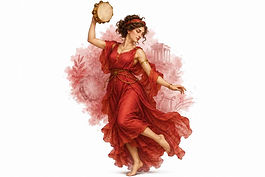
Terpsichore
Terpsichore is one of the nine Muses, daughters of Zeus and Mnemosyne, and later tradition makes her the Muse of dance and choral song. Hesiod lists her fifth among the nine, between Melpomene and Erato. Her name means delight in the chorus or dance, and later art commonly gives her a lyre. Ancient genealogies occasionally connect her with figures such as Linus or the Sirens, but these parentages vary between sources. Her strongest identity is therefore the later artistic one: the Muse who personifies coordinated song and movement.

Tethys
Tethys is the Titaness of the sources of fresh water, the wife of Oceanus and the mother of the three thousand rivers and the countless Oceanid nymphs who personify every spring, well, and fountain in the Greek world. She is the daughter of Ouranos, the primordial Sky, and Gaia, the primordial Earth, born in the first generation of divine beings before Zeus and the Olympian gods ever claimed Olympus. She is the great nurse who raised Hera, the queen of the gods, in secret during the war between the Titans and the Olympians, hiding the infant goddess from her father Kronos, the Titan king who swallowed his own children to prevent a prophecy that one of them would overthrow him. She is the mother whose children include the Nile, the Alpheus, the Scamander, and every other river that ever watered the earth, each one a god in his own right with power over the lands he flowed through. She is the grandmother of Achilles through her daughter Styx, the river of the underworld whose waters bound the most solemn oaths of the gods. And she is the namesake of the Tethys Sea, the vast prehistoric ocean that existed before the continents drifted apart, a legacy that has outlasted every temple and every hymn, proving that the ancient Greeks named their primordial deities with an intuition that modern science would only confirm millennia later.

Thalia
Thalia is one of the nine Muses, daughters of Zeus and Mnemosyne, and later tradition makes her the Muse of comedy and pastoral poetry. Hesiod lists her third among the nine named Muses, after Clio and Euterpe. Her name is connected with flourishing and abundance, while later art gives her the comic mask and shepherd's staff. Pseudo-Apollodorus preserves a myth in which Thalia and Apollo are parents of the Corybantes, but other traditions distinguish or rearrange the armed dancers associated with Crete. Her familiar identity as the smiling Muse of comedy is therefore a later specialisation built onto the older collective world of the Muses.

Thamyris
Thamyris is the legendary Thracian bard who boasts that he can defeat the Muses and loses his musical gift in punishment. Homer gives the oldest surviving version: at Dorion the Muses meet Thamyris, stop his song and make him forget his minstrelsy after his boast. Later mythographers add that he is the son of Philammon and the nymph Argiope, that he is blinded, and that he loves Hyacinthus. Some genealogies further connect Philammon with Apollo, but that divine ancestry belongs to later tradition rather than Homer's brief account. Thamyris became one of Greek mythology's classic warnings about artistic pride and the danger of challenging the divine source of song.