Greek Mythology List


Welcome to the Mythopouch list of Greek mythology entries! We also delve into the ancient history of Greece and the surrounding areas. From heroes to goddesses, places, monsters, artifacts, weapons, creatures and more - which will only grow over time. Mythopouch provides real-world information extracted from the original source material such as that from: Homer, Hesiod, Apollodorus, Ovid, Pausanias, Pindar, Aeschylus, Sophocles, Euripides, Hyginus, Diodorus Siculus and Apollonius of Rhodes. Words and stories carry powerful messages that were passed down from one generation to the next, many of which are still very applicable to modern times. Our unique imagery is meant to capture the imagination and ignite the magic mythology spark within us all. Our "token mark" coin symbol that is assigned to each record is a visual representation of the entity, for use in Mythopouch learning modules and games.
Learn - Earn - Play
Greek Entity Quick Index
Our current list of ancient Greek mythology and ancient history entities are here - which are growing day by day!
Search by using the:
-
"Search Mythology Records" function to browse all mythology records and blog pages;
-
Browse the visual cards with overviews by clicking "Go to Visual A-Z";
-
Or just browse and click the A-Z entries below....
See more list entries
Read Ancient Greek Insights
Click below to view our ancient Greek mythology blog article insights, where we delve into the current Mythopouch Tier regions and what we think you should know!


Greek Entity Card Index
See more card entries
Nereids
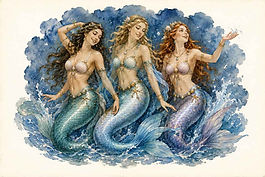
The Nereids are the fifty daughters of Nereus, the Old Man of the Sea, and they are the most beloved sea-nymphs in all of Greek mythology, graceful spirits who danced upon the waves and guided sailors through storm and calm. They are the attendants of the sea-god Poseidon, who ruled the oceans from his underwater palace of coral and pearl, and they are the companions of the hero Achilles, the greatest warrior of the Trojan War, who was born of a Nereid mother and mourned by his sea-nymph kin when he fell. They are the rescuers of the Argonauts, the crew of heroes who sailed in search of the Golden Fleece, when their ship was trapped between the crushing rocks of the Symplegades. They are the weepers at the funeral of Patroclus, Achilles' dearest friend, whose death drove the hero to a rage that nearly turned the tide of the Trojan War. And they are the eternal spirits of the Mediterranean itself, the silver shapes that ancient sailors glimpsed in the foam and mist, a reminder that the sea was never empty but always alive with divine presence.

Nereus
Nereus is the Old Man of the Sea, the gentle primordial god who dwells in a cave beneath the Aegean waves with his fifty daughters, the Nereids, the sea nymphs whose dance upon the water is the most beautiful sight a sailor can witness. He is the son of Pontus, the personification of the sea itself, and Gaia, the earth-goddess whose body is the soil of the world, a being older than the Olympian gods and more ancient than the Titans who ruled before them. He is the shape-shifter who can transform into any creature of the deep, from a lion to a serpent to a torrent of water, and who tells the truth to any mortal brave enough to wrestle him through every form. He is the father of Thetis, the sea nymph who married the mortal Peleus and became the mother of Achilles, the greatest warrior of the Trojan War. And he is the god whom Heracles, the hero forced to complete twelve impossible labours, wrestled for three days to learn the way to the garden of the Hesperides, proving that even the oldest power of the sea must yield to a man who refuses to let go.

Nessus
Nessus is the centaur whose dying trick killed the greatest hero who ever lived, a ferryman whose lust for a single woman set in motion a chain of poison and fire that ended the mortal life of Heracles. He is the son of Ixion, the Lapith king who was bound to a burning wheel in Tartarus for lusting after Hera, and of the cloud-phantom Nephele, a creature of mist shaped by Zeus to deceive Ixion, a parentage that made Nessus half divine and half monstrous from the moment of his birth. He is the survivor of the Centauromachy, the battle between the centaurs and the Lapiths at the wedding of Pirithous and Hippodamia, where most of his kind were slaughtered by the very hero he would one day destroy. He is the ferryman of the River Evenus who offered to carry Deianira across the rapids, then tried to abduct her in mid-stream, only to be struck by an arrow dipped in the poisonous blood of the Lernaean Hydra, the many-headed serpent whose venom no mortal could survive. He is the dying trickster who, with his last breath, convinced Deianira that his blood-soaked shirt was a love charm that would keep Heracles faithful forever, a lie so cunning that it outlasted his own death by years. And he is the agent of the hero's apotheosis, for without Nessus's poisoned gift, Heracles would never have climbed the burning pyre on Mount Oeta, never have shed his mortal flesh, and never have ascended to Olympus as a god.
Nestor
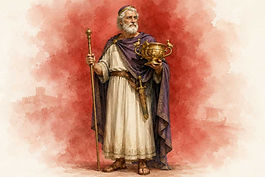
Nestor is the old king of Pylos whose voice was the sound of wisdom and whose speeches were so long that even the heroes of Troy grew restless beneath their weight. He is the son of Neleus, the founder of Pylos, and Chloris, the daughter of the great king Amphion, and the only one of twelve brothers to survive the war that destroyed his father's house. He is the Argonaut who sailed with Jason in search of the Golden Fleece, the warrior who fought the Centaurs beside the Lapiths, and the veteran who lived long enough to see three generations of heroes rise and fall. He is the counselor whose advice was sought by Agamemnon, the high king of the Greeks, and by Achilles, the greatest warrior of the age, and whose warnings were always wise and almost always ignored. He is the father of Antilochus, the swift-footed youth who died at Troy defending his father from the Trojan Memnon, and of Pisistratus, the charioteer who drove Telemachus to Sparta in search of news of Odysseus. And he is the only major hero of the Trojan War who survived both the war and the voyage home and died in his own bed, an old man in a palace by the sea, the last witness to an age of giants.

Niobe
Niobe is the queen of Thebes whose pride in her children brought the arrows of Apollo and Artemis down upon her house, leaving her the most mournful figure in Greek mythology. She is the daughter of Tantalus, the king of Sipylus who was condemned to eternal hunger and thirst in Tartarus, the deepest pit of the Underworld, for serving his own son to the gods at a feast. She is the wife of Amphion, the king who built the walls of Thebes with the music of his lyre, and the mother of seven sons and seven daughters, the Niobids, whose beauty and number were the envy of every mother in Greece. She is the woman who dared to boast before the temple of Leto, the Titan goddess of motherhood, that she was superior because she had fourteen children while Leto had only two. She is the mother who watched every one of her children fall to divine arrows, the sons cut down by Apollo and the daughters by Artemis, until the bodies lay piled in the palace and the streets ran with blood. She is the weeping stone on Mount Sipylus in Lydia, the rock formation that weeps eternally, where she was turned to stone by the gods but not silenced, her tears still flowing for her dead children. Every statue of grief, every mother who outlives her children, and every warning against the sin of pride carries her memory.

Nonnus
Nonnus is the most important Greek epic poet of late antiquity and the author of the two largest surviving works attributed to him, the Dionysiaca and the Paraphrase of the Gospel according to John. He is the native of Panopolis in Upper Egypt known from manuscripts and an epigram in the Palatine Anthology, whose personal life remains almost entirely obscure. He is the poet who composed the Dionysiaca, a forty-eight-book epic of more than twenty thousand lines that makes the life and Indian conquest of Dionysus the centre of the longest surviving poem from classical antiquity. He is the mythographer whose epic gathers Zeus's battle with Typhon, Europa and Cadmus, the birth of Dionysus from Semele, the god's childhood among the Nymphs, his love for Ampelus, the death of Ampelus, the transformation of the youth into the vine, the Indian War against King Deriades, the defeat of Pentheus and the final birth of Iacchus. He is the Christian poet who transformed the prose Gospel of John into twenty books of Nonnian hexameter, expanding the sacred text with exegesis, theology and epic colour. He is the writer whose two works were once assigned to different poets on the assumption that no one could sing both Dionysus and Christ, but whose shared metre, diction, imagery and cross-references now establish the unity of his authorship. He is the founder of a late antique poetic school whose regulated hexameter, lush compounds, visual imagery and encyclopedic mythology influenced Musaeus, Colluthus, Christodorus, John of Gaza, Agathias and later Greek Christian poets. He is the poet who proves that in fifth-century Egypt the worlds of classical myth and Christian Scripture could coexist in the same learned imagination. And he is the author of two works and no others: no third poem, treatise, letter collection or lost work can be securely attributed to him.

Nymph
The Nymph is the spirit of the wild place made flesh, a maiden of eternal youth who dwells in the springs, trees, caves, and mountains of the Greek world, as much a part of the landscape as the water she guards or the grove where she dances. She is the companion of the gods, the attendant of Artemis, the goddess of the hunt, who roamed the wilderness with a band of nymphs at her side, and the lover of Hermes, the messenger god, whose swift feet carried him to secret glades where nymphs bathed in silver pools. She is the mother of heroes, the bride of mortal men who stumbled upon her beauty and were never the same again, and the weeping figure who fades into her tree or spring when love is lost or youth departs. She is the voice that echoes in caves, the shimmer on a forest pool, the rustle in leaves that has no wind to cause it, and the reason the ancient Greeks believed that no wild place was ever truly empty but always alive with presence, watching, waiting, and dancing just beyond the edge of sight.
Nyx
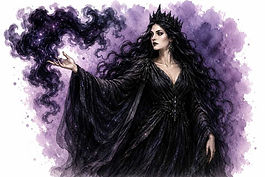
Nyx is Night herself, not a goddess who rules the night but the night made divine, one of the first beings to rise out of Chaos. She is older than the Titans, older than the sky, older than Olympus itself: from the yawning emptiness of Chaos came black Erebus and Nyx, and all the rest of creation stands downstream of her. She is the mother of the dark brood, for alone, without any mate, she bore the hardest powers that touch a human life: Doom and violent Death, gentle Sleep and the tribe of Dreams, Old Age and Strife, Deceit and Blame, Nemesis who pays what is owed, and the three Fates themselves, who spin and measure and cut the thread of every life. Yet with Erebus, her brother Darkness, she also bore Brightness and Day, for the Greeks knew that light is born of the dark. And she is the one power before whom Zeus himself draws back: when the king of gods woke in a fury and would have hurled Sleep from heaven, Sleep fled to his mother Night, and Zeus held his hand, unwilling to offend her.

Oceanids
The Oceanids are the three thousand daughters of Oceanus, the Titan god of the world-encircling river, and Tethys, his sister and wife, the Titaness of the fertile waters. They are the nymphs of every spring, fountain, well, and freshwater stream that flows from the earth, and the guardians of the liquid boundary that separates the known world from the lands of the dead. Every mortal who draws water from a sacred spring speaks to the Oceanids whether they know the names or not. The eldest among them, Styx, the nymph of the river that borders the underworld, is so sacred that the gods themselves swear their most binding oaths upon her waters, and any god who breaks such an oath is cast into a coma for nine years. Other famous daughters include Metis, the first wife of Zeus who was swallowed whole while pregnant with Athena, and Doris, the mother of the fifty sea-nymphs called the Nereids. The Oceanids are not merely decorative spirits of nature; they are the mothers of gods, the witnesses of divine treaties, and the living network of freshwater that makes civilization possible.

Oceanus
Oceanus is the eldest of the Titans and the great river that flows around the entire world, the boundless stream from which every river, every sea, every spring and every deep well draws its waters. He is the son of Uranus, the starry Sky, and Gaia, the broad Earth, and the only one of the Titans who raised no hand against his father and no spear against Zeus, the king of the Olympian gods, keeping his place when all the others lost theirs. He is the husband of Tethys, his sister and queen of the waters, and the father of three thousand river gods and three thousand water nymphs, the Oceanids, among them Styx, the river by which the gods swear their most terrible oaths, and Metis, the first wife of Zeus. He is the white-bearded lord whom the poet Homer named the begetter of the gods, and who sheltered the young goddess Hera in his halls while the heavens were at war. And he is the namesake of every ocean on earth, from the Atlantic to the Pacific, a word that has sailed further than any ship.

Odysseus
Odysseus is the hero who spent ten years fighting at Troy and another ten years trying to get home, the most cunning man in all of Greek mythology and the only warrior whose wits were sharper than his sword. He is the architect of the Trojan Horse, the giant hollow wooden horse that the Greeks hid inside to infiltrate and destroy the city of Troy, ending a war that had lasted ten years. He is the wanderer who faced the Cyclops Polyphemus, a one-eyed giant who devoured his men, and escaped by tricking the monster into drunkenness and blinding him with a sharpened stake. He is the castaway who survived the wrath of Poseidon, the god of the sea, who pursued him across the Mediterranean with storms and shipwrecks for the crime of blinding his son Polyphemus. He is the husband who resisted the nymph Calypso, who offered him immortality and eternal youth on her island for seven years, because his heart belonged to Penelope, his wife waiting in Ithaca. And he is the king who returned in disguise, strung the bow that no other man could bend, and slaughtered the suitors who had invaded his house, reclaiming his throne through blood and cunning.

Oedipus
Oedipus is the riddle-solver who became the most cursed king in Greek mythology, the man who killed his father and married his mother without knowing either crime, and who tore out his own eyes when the truth finally reached him. He is the son of Laius, the king of Thebes, and Jocasta, his queen, who was exposed on a mountainside as an infant because an oracle had prophesied that he would destroy his parents. He is the young man who fled Corinth to escape a similar prophecy, only to meet his real father at a crossroads and kill him in a quarrel over the right of way. He is the hero who solved the riddle of the Sphinx, the winged monster who devoured every traveller who failed to answer her question, and who was rewarded with the throne of Thebes and the hand of the widowed queen. And he is the blind wanderer who spent his last years on the road, led by his daughter Antigone, until he reached the grove of the Furies at Colonus near Athens, where the earth opened and received him as a guardian hero of the city.