Greek Mythology List


Welcome to the Mythopouch list of Greek mythology entries! We also delve into the ancient history of Greece and the surrounding areas. From heroes to goddesses, places, monsters, artifacts, weapons, creatures and more - which will only grow over time. Mythopouch provides real-world information extracted from the original source material such as that from: Homer, Hesiod, Apollodorus, Ovid, Pausanias, Pindar, Aeschylus, Sophocles, Euripides, Hyginus, Diodorus Siculus and Apollonius of Rhodes. Words and stories carry powerful messages that were passed down from one generation to the next, many of which are still very applicable to modern times. Our unique imagery is meant to capture the imagination and ignite the magic mythology spark within us all. Our "token mark" coin symbol that is assigned to each record is a visual representation of the entity, for use in Mythopouch learning modules and games.
Learn - Earn - Play
Greek Entity Quick Index
Our current list of ancient Greek mythology and ancient history entities are here - which are growing day by day!
Search by using the:
-
"Search Mythology Records" function to browse all mythology records and blog pages;
-
Browse the visual cards with overviews by clicking "Go to Visual A-Z";
-
Or just browse and click the A-Z entries below....
See more list entries
Read Ancient Greek Insights
Click below to view our ancient Greek mythology blog article insights, where we delve into the current Mythopouch Tier regions and what we think you should know!


Greek Entity Card Index
See more card entries
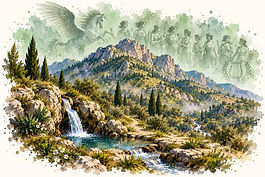
Mount Helicon
Mount Helicon is the real Boeotian mountain made sacred in Greek tradition by the Muses, Hesiod and a network of springs and sanctuaries. Hesiod opens the Theogony with the Heliconian Muses bathing in the mountain's waters and dancing on its heights, then tells how they taught him song while he was tending sheep below the mountain. Later tradition connected Hippocrene with the hoof of Pegasus, while Pausanias described Aganippe, the Muse sanctuary, statues of poets and musicians, dedicated tripods and the Museia games. Callimachus set the blinding of Tiresias at Hippocrene on Helicon, and Corinna's surviving poetry presents a musical contest involving Helicon and neighbouring Cithaeron. The mountain is therefore both a historical landscape and one of the principal sacred geographies through which Greek poetry explained its own inspiration.

Mount Olympus
Mount Olympus is the sacred mountain where the twelve great Olympian gods made their eternal home, a place so high that its peaks pierced the clouds and its summit lay beyond the reach of mortal men. It is the throne room of Zeus, the king of the gods, from whose seat he hurled thunderbolts and governed the affairs of heaven and earth. It is the site of the divine council, where the gods gathered to debate the fates of heroes and nations, their voices echoing through halls of gold and marble. It is the fortress that withstood the assault of the monstrous Typhon, a creature of a hundred serpent heads who tried to storm the heavens and overthrow the gods. It is the place where Hera, queen of the gods, plotted and schemed from her own golden chambers, and where Athena, the goddess of wisdom, was born fully armed from the head of her father. And it is the mountain that still stands today in northern Greece, its summit wreathed in clouds, a landmark that has inspired pilgrims, poets, and adventurers for nearly three thousand years.

Muses
The Muses are the nine divine sisters who breathe inspiration into every poet, musician, historian, and astronomer who ever sought to capture truth in words or song. They are the daughters of Zeus, the king of the gods, and Mnemosyne, the Titaness of memory, born from nine nights of union so that mortals might never forget what the gods have revealed. Each sister governs a single art: Calliope commands epic poetry, Clio chronicles history, Euterpe fills the air with flute music, Thalia inspires comedy, Melpomene wears the mask of tragedy, Terpsichore leads the dance, Erato whispers love poetry, Polyhymnia raises sacred hymns, and Urania maps the wandering stars. They appear to the desperate and gifted alike, and once they seize a mortal mind they do not let go until the work is finished. Homer, the blind poet who composed the Iliad and the Odyssey, begged them to sing through him. Hesiod, the shepherd who became the father of Greek cosmology, met them on Mount Helicon and received the order of the universe in a single vision. Every library still bears their signature, for the Muses are the reason human beings do not merely live but remember, celebrate, and understand.

Myrtilus
Myrtilus is the charioteer who betrayed his king for a kingdom and a night with a princess, and who died cursing the man who had promised him both. He is the son of Hermes, the messenger god whose winged sandals carried him faster than the wind, and the charioteer of Oenomaus, the king of Pisa who murdered eighteen suitors rather than give his daughter Hippodamia to any man. He is the mechanic who replaced the bronze linchpins of his master's chariot with pins of wax, knowing that the heat of the race would melt them and send the king to his death. He is the man who helped Pelops, the Phrygian prince, win the hand of Hippodamia by treachery, and who was rewarded with a broken promise and a fall from a cliff into the sea that would bear his name forever. And he is the source of the curse that destroyed the house of Pelops for four generations, the words spoken in mid-air that condemned Agamemnon, Menelaus, and Orestes to the tragedies that would make Greek drama immortal.

Narcissus
Narcissus is the beautiful youth of Greek mythology who fell in love with his own reflection and wasted away beside a pool, becoming the namesake of the narcissus flower that grew from his corpse. He is the son of the river-god Cephissus and the nymph Liriope, born so lovely that every mortal who saw him desired him. He is the boy who spurned the nymph Echo, a maiden cursed by the goddess Hera to repeat only the last words spoken to her, leaving her to fade until only her voice remained. He is the youth whom the goddess Nemesis, the spirit of righteous indignation, punished for his cruelty to lovers by leading him to a still pool where he saw his own face and was consumed by desire for himself. He is the corpse around which the pale narcissus flower sprang up, its white petals and yellow cup marking the spot where self-love became self-destruction. And he is the origin of the word "narcissism," the psychological term for excessive self-admiration that has shaped modern understanding of personality for over a century.

Nausicaa
Nausicaa is the young princess of the Phaeacians who finds the shipwrecked Odysseus on the shore of Scheria and becomes the first person to help him after his final disaster at sea. She is the daughter of King Alcinous and Queen Arete, rulers of a peaceful island whose people sail with miraculous speed and possess a palace compared to the dwellings of the gods. She is the maiden Athena sends to the river through a dream about washing her wedding clothes, placing her precisely where Odysseus has crawled ashore, naked and exhausted. She is the girl who stands her ground while her maids flee from the stranger, gives him oil, food and clothing, and tells him how to win passage home. She is the bride-to-be whose thoughts turn to marriage when she sees Odysseus restored by his bath, yet never forgets her reputation in the eyes of her people. She is the final human temptation before Odysseus returns to Penelope, because King Alcinous openly offers her as a bride and a life of wealth and ease in Phaeacia. And she is the compassionate stranger whose brief appearance changes the course of the Odyssey, giving Odysseus his way back into human society and a ship for the last voyage home.

Necklace of Harmonia
The Necklace of Harmonia is the cursed wedding gift that brought ruin to every woman who ever fastened it around her throat and to every man who ever laid eyes upon its golden gleam. It is the jewel that Hephaestus, the lame god of the forge, crafted in bitterness to punish Ares, the Olympian god of war, and Aphrodite, the goddess of love, for their adulterous affair, a gift so beautiful that no mortal could resist it and so cursed that no mortal could survive it. It is the chain that passed from Harmonia, the wife of Cadmus, to Semele, the mother of Dionysus, to Jocasta, the mother of Oedipus, and to Eriphyle, the wife of the seer Amphiaraus, each woman meeting a death more terrible than the last. It is the treasure that Alcmaeon, the son of Eriphyle, murdered his own mother to possess, only to be driven mad by the Furies and killed in turn. And it is the ancestor of every cursed jewel in the history of storytelling, from the ring of the Nibelungs to the necklace of Marie Antoinette, the original proof that beauty forged in anger carries a debt that no generation can pay.

Nemean Lion
The Nemean Lion is the invulnerable monster whose slaughter by Heracles became the first of his twelve labours. It is the beast raised by Hera to devastate Nemea, a lion whose hide no spear, arrow, sword or stone can pierce. It is the descendant of Orthrus and the Chimera in Hesiod, the son of Typhon in Apollodorus and the offspring of Selene, the Moon, in a more poetic tradition. It is the terror of Tretos, Apesas and the fields of Nemea, a creature that devours herds and men and turns the land around its cave into a desert of fear. It is the opponent whose weapons cannot wound it but whose throat Heracles can still crush, proving that the hero's greatest weapon is his strength guided by intelligence. It is the origin of Heracles' most famous attribute, the impenetrable lion skin worn over his shoulders for the rest of his career. It is the beast placed among the stars as the constellation Leo, where its shape still prowls the summer sky. And it is the first test in the great cycle of labours, the monster that transforms Heracles from a polluted killer into a hero whose deeds protect the Greek world.

Nemean Lion's Pelt
The Nemean Lion's Pelt is the impenetrable hide of the monstrous lion slain by Heracles, the hero forced to complete twelve impossible labors, and the armour he wore for every labor that followed. It is the skin that no weapon could pierce, not the bronze arrowheads of mortal smiths nor the club of Heracles himself, a beast so terrible that it had reduced the land of Nemea to ashes and made the people hide behind triple-locked gates. It is the trophy that Heracles won by strangling the lion with his bare hands, the first proof that his strength was greater than any monster born of the earth. It is the cloak he fashioned by skinning the beast with its own claws, the only edge sharp enough to cut what no mortal blade could touch. And it is the symbol that became inseparable from the hero's image, the lion's head worn as a helmet and the golden fur draped across his shoulders, so that every statue, every coin, and every story of Heracles shows him in the pelt of the beast he conquered on the first day of his servitude.

Nemesis
Nemesis is the implacable goddess of retribution, the winged daughter of Night who measures out fortune to mortals and punishes with absolute precision anyone who dares to believe that their happiness is permanent. She is the force that balances the scales when a man grows too proud, too rich, or too beautiful, the divine answer to hubris, the dangerous pride that leads mortals to challenge the gods. She is the goddess whom Zeus, the king of Olympus, pursued across the earth in a chase that lasted through a dozen transformations, until she became a goose and he a swan, and from their union came the egg that would hatch Helen, the most beautiful and most destructive woman in the world. She is the deity whose temple at Rhamnous in Attica housed one of the greatest statues in Greece, a colossal image carved by Agoracritus, the rival of Phidias, that stared out across the sea with eyes that saw every ship and every sin. And she is the oldest principle of justice in Greek religion, older than the law courts, older than the city-state, the goddess who does not need a jury because she is the verdict itself.

Nephele of Athamas
Nephele of Athamas is the cloud-nymph of Orchomenus, the mist-born wife of King Athamas who bore him two children and was cast aside for a mortal woman, only to send a golden ram from heaven to save her twins from the sacrificial knife. She is the daughter of the sky itself, a nymph formed from the vapours that gather above the Boeotian plain, given life by Zeus and sent to earth to marry a mortal king. She is the mother of Phrixus and Helle, the twins who rode the flying ram across the sea until the girl fell from its back into the water that would bear her name forever, the Hellespont, the sea of Helle. She is the abandoned wife who watched from the sky as Athamas took Ino, the daughter of Cadmus, as his new queen, and who saw her children marked for sacrifice by a stepmother's jealousy. And she is the proof that in Greek mythology, the divine does not forget its own, and that a cloud can weep, can rage, and can send a golden beast to snatch two children from the altar of death.

Nephele the Phantom of Ixion
Nephele the Phantom of Ixion is the cloud-woman whom Zeus shaped from mist and air to deceive Ixion, the king who lusted after the queen of Olympus and paid for that lust with an eternity on a burning wheel. She is not a goddess born but a goddess made, a construct of vapor and divine craft who was so perfect in her imitation that Ixion, the guest of Zeus, could not tell the difference between the phantom and the real Hera. She is the mother of Centaurus, the first of the horse-men who mated with the mares of Mount Pelion and produced the race of Centaurs, the wild creatures who were half-human and half-horse and who would one day nearly destroy the civilised world. She is the proof that the gods do not merely punish the guilty but turn their crimes into new forms of life, that a king's lust can become a cloud, and that a cloud can become a race of monsters. And she is the only being in Greek mythology who was created specifically to be deceived with, a divine tool who outlived her purpose and became the ancestor of one of the most famous tribes of creatures the Greeks ever imagined.