Greek Mythology List


Welcome to the Mythopouch list of Greek mythology entries! We also delve into the ancient history of Greece and the surrounding areas. From heroes to goddesses, places, monsters, artifacts, weapons, creatures and more - which will only grow over time. Mythopouch provides real-world information extracted from the original source material such as that from: Homer, Hesiod, Apollodorus, Ovid, Pausanias, Pindar, Aeschylus, Sophocles, Euripides, Hyginus, Diodorus Siculus and Apollonius of Rhodes. Words and stories carry powerful messages that were passed down from one generation to the next, many of which are still very applicable to modern times. Our unique imagery is meant to capture the imagination and ignite the magic mythology spark within us all. Our "token mark" coin symbol that is assigned to each record is a visual representation of the entity, for use in Mythopouch learning modules and games.
Learn - Earn - Play
Greek Entity Quick Index
Our current list of ancient Greek mythology and ancient history entities are here - which are growing day by day!
Search by using the:
-
"Search Mythology Records" function to browse all mythology records and blog pages;
-
Browse the visual cards with overviews by clicking "Go to Visual A-Z";
-
Or just browse and click the A-Z entries below....
See more list entries
Read Ancient Greek Insights
Click below to view our ancient Greek mythology blog article insights, where we delve into the current Mythopouch Tier regions and what we think you should know!


Greek Entity Card Index
See more card entries

Erichthonius
Erichthonius is the earth-born king of Athens, the child who had no mother but was born from the seed of a god and the body of the earth itself, and who grew up to become the ancestor of every Athenian who ever claimed to be autochthonous, born from the soil of Attica rather than from any immigrant stock. He is the son of Hephaestus, the lame smith-god whose forge burned beneath the volcanoes of the Aegean, and Gaia, the earth-goddess whose body received the divine seed when Athena, the virgin goddess of wisdom, refused to submit to the smith's advances. He is the infant whom Athena hid in a chest and gave to the daughters of Cecrops, the first king of Athens, with a strict command never to open the lid, a command they disobeyed at the cost of their sanity and their lives. He is the king who invented the chariot to hide his serpentine lower body, who founded the Panathenaea, the great festival of Athens, and who was buried within the city he ruled, a privilege granted to no other mortal. And he is the ancestor of Erechtheus, the later king who gave his name to the Erechtheion, the most sacred temple on the Athenian Acropolis, so that the two names and the two kings became one in the memory of the city.

Eridanus
Eridanus is the river god who became the greatest geographical mystery in Greek mythology, a stream that could lie in the far north, the distant west or beneath the feet of Orion. He is the son of Oceanus and Tethys, primordial powers of the world-encircling sea, and one of the divine rivers born to feed the earth. He is the god whose waters received the blazing body of Phaethon after Zeus struck the youth from the chariot of the sun. He is the river bordered by the Heliades, the grieving sisters of Phaethon, whose tears hardened into amber and fell shining into his current. He is a waterway sought by heroes, identified with real rivers such as the Po and Rhone, and dismissed as poetic invention by sceptical geographers. And he is the celestial river whose winding stars begin near Orion and vanish towards the southern horizon, preserving the memory of a fall that burned the earth and drowned in tears.

Erinyes
The Erinyes are the formidable goddesses of vengeance whose power falls most heavily upon murder within a family, violations of sacred bonds and the breaking of solemn oaths. Hesiod traces them to the blood of Uranus falling upon Gaia, while Aeschylus presents them as daughters of Nyx, the ancient goddess of Night, and has them identify themselves beneath the earth as Arae, or Curses. They pursue Orestes after he kills his mother Clytemnestra to avenge his murdered father, confronting Apollo at Delphi before following their quarry to Athens. There Athena establishes a trial on the Areopagus, and Orestes' acquittal provokes a confrontation between inherited rights of vengeance and the city's need for lawful judgement. Rather than destroying the ancient goddesses, Athena persuades them to accept honour and a protecting role among the Athenians. Their story preserves both the terror of a curse that cannot easily be escaped and the possibility of transforming destructive anger into guardianship of the community.

Eriphyle
Eriphyle is the Argive queen whose acceptance of a golden necklace sent her husband Amphiaraus to certain death and made her name a byword for betrayal. She is the daughter of King Talaus and sister of Adrastus, the king who gathered the Seven against Thebes to restore the exiled prince Polynices. She is the wife of Amphiaraus, the great seer who knew the expedition was doomed but was bound by an oath to obey her judgement. She is the woman who took the Necklace of Harmonia from Polynices and persuaded her husband to march against Thebes despite the omens of Zeus. She is the mother of Alcmaeon and Amphilochus, whose father charged them to avenge him if the war ended as he had foreseen. She is the queen who accepted a second cursed gift from the Theban royal house, this time the robe of Harmonia, and helped send her own sons into a second war. And she is the woman killed by Alcmaeon for her double treachery, then carried into Homer and Virgil as the eternal image of a wife who sold her husband's life for gold.

Eros
Eros is the Greek god who strikes the heart with irresistible desire, the winged archer whose golden arrows make gods and mortals fall in love against their will. He is the primordial force who emerged from Chaos at the dawn of creation, a cosmic power that bound the elements together and brought order to the universe before the first mountain rose. He is the mischievous child of Aphrodite, the goddess of love and beauty, and Ares, the god of war, who tormented his mother with pranks and disobedience. He is the lover of Psyche, the mortal woman whose name means "soul," whose beauty rivaled the goddess herself and who endured impossible trials to win his forbidden love. He is the torch-bearer who lights the flame of passion in the heart, and the namesake of every romantic impulse that has ever shaken a human being. And he is the ancestor of the modern Cupid, the chubby cherub on Valentine's cards, whose ancient origins stretch back to the very birth of the cosmos.

Erysichthon
Erysichthon is the Thessalian king or prince who earned the hatred of Demeter by cutting down her sacred grove to build a banquet hall and was punished with a hunger no amount of food could satisfy. He is the son of Triopas who raised his axe against a tree beloved by the grain goddess, ignoring the warning she delivered in mortal disguise. He is the man whose hunger became a burning disease, growing stronger with every feast and consuming his strength, his wealth and his household. He is the father of Mestra, the shapeshifting daughter whom he sold again and again to turn her body into food for his belly. He is the ruler whose appetite swallowed everything until, in Ovid's terrible ending, he fed upon his own limbs. And he is the myth's enduring image of consumption turned against the consumer, a man who violated the source of nourishment and became his own final meal.

Erytheia
Erytheia is the sea-girt western island where Geryon keeps the cattle taken by Heracles in his tenth labour. Hesiod places Geryon, Orthrus and the herdsman Eurytion on water-washed Erytheia beyond Ocean, while Herodotus later locates the island near Gadeira outside the Pillars of Heracles. Pseudo-Apollodorus identifies Erytheia with Gadeira and describes Geryon's herd as red cattle. As Mediterranean knowledge of Iberia expanded, writers tried to fit the old mythic island onto the real geography around Gades, Tartessus and the Atlantic coast. The changing map is part of Erytheia's history: it begins as a place at the sunset edge of the world and becomes increasingly attached to southern Iberia without ever losing its mythological character.

Eteocles
Eteocles is the Theban son of Oedipus who dies in single combat with his brother Polynices during the war of the Seven Against Thebes. A prominent later tradition says the brothers agreed to alternate the kingship year by year, although ancient sources disagree over which brother ruled first and how the breach occurred. Aeschylus makes Eteocles the defender who assigns a champion to each of Thebes' seven gates and finally chooses to face Polynices at the seventh. Other tragedies and mythographers connect their war with the curse of Oedipus and with competing claims to the Theban throne. The brothers kill one another, and later drama turns the treatment of their bodies into the crisis that drives Antigone's story.

Euripides
Euripides is the youngest of the three great Athenian tragedians and the one whose plays survive in the greatest number. He is the poet born on Salamis around 480 BCE, traditionally on the day of the naval victory over Persia, the son of Mnesarchus, a merchant, and Cleito, a woman of aristocratic descent. He is the dramatist who first competed at the City Dionysia in 455 BCE, the year after Aeschylus died, and who endured decades of professional frustration before winning the top prize only four times during his life. He is the author of Medea, Hippolytus, The Bacchae, The Trojan Women, Hecuba, Heracles, Orestes and the only complete satyr play to survive from antiquity, Cyclops. He is the dramatist remembered for speaking prologues that explain the situation, for bringing ordinary human motives into myth, for placing women, slaves, foreigners and the powerless at the centre of tragedy and for ending plays with divine epiphanies that critics later called deus ex machina interventions. He is the intellectual poet whose works reflect the arguments of the Sophists, the scientific speculations of Anaxagoras and the unsettled religious climate of late 5th-century Athens. He is the dramatist who left Athens in old age for the Macedonian court of King Archelaus, where he died, and whose Bacchae and Iphigenia in Aulis were produced posthumously in Athens and won first prize. And he is the playwright whose ancient corpus contained between ninety-two and ninety-five plays, of which nineteen survive more or less complete if the disputed Rhesus is included, along with substantial fragments from many of the lost works.

Europa
Europa is the Phoenician princess whose abduction by Zeus, the king of the gods, in the form of a magnificent white bull gave her name to the continent of Europe and set in motion her brother Cadmus's founding of Thebes. She is the daughter of King Agenor of Tyre and Queen Telephassa, the sister of Cadmus who sowed the dragon's teeth to found Thebes, of Cilix who gave his name to Cilicia, and of Phoenix who gave his name to the Phoenicians. She is the mother of Minos, the king of Crete whose labyrinth held the Minotaur, a creature half man and half bull; of Rhadamanthus, who would become one of the three judges of the dead in the underworld; and of Sarpedon, the Lycian prince who would fall at Troy. She is the maiden who rode the bull across the Mediterranean Sea from the shores of Tyre to the island of Crete, where Zeus revealed his true form beneath a cypress on Mount Ida. And she is the namesake of an entire continent, the word "Europe" deriving from her name, a legacy that has outlasted every empire that rose and fell upon the land.
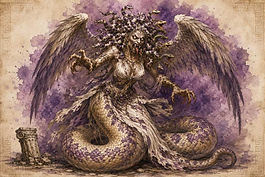
Euryale
Euryale is one of the three Gorgons, the immortal daughters of the ancient sea gods Phorcys and Ceto, whose glance turned living flesh to stone and whose serpent hair hissed across the western ocean. She is the middle sister, born between Stheno, the eldest and most ferocious, and Medusa, the youngest and the only one of the three who could die. She is the Gorgon who woke from sleep to find her sister beheaded by Perseus, the hero who flew in on winged sandals and took Medusa's severed head as a weapon, and who pursued the murderer across the sky with Stheno at her side, shrieking so loudly that the heavens shook, only to watch him escape into the east. She is the immortal monster who could not be killed, who could only grieve and rage, and who in some traditions bore the giant Orion to Poseidon, the god of the sea, a child who would one day challenge the gods themselves. And she is the half-remembered sister in every image of the Gorgon head, the one whose face did not become a shield but whose fury still echoes in stories told of the west where the sun goes down.
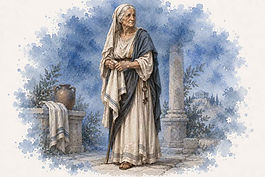
Eurycleia
Eurycleia is the loyal slave and nurse of Odysseus whose knowledge of his body reveals him before his wife, his father or his kingdom can recognise him. She is the daughter of Ops and granddaughter of Peisenor, bought in her youth by Laertes and treated with an honour almost equal to that of a wife. She is the woman who nursed Odysseus from infancy, knew the sound of his voice, the shape of his hands and the mark on his leg and kept his household through twenty years of war, wandering and invasion by suitors. She is the confidante of Telemachus, who receives from her the provisions for his secret voyage to Pylos and Sparta and makes her swear not to tell Penelope until twelve days have passed. She is the old servant chosen by the disguised Odysseus to wash his feet because she has suffered enough to understand suffering. She is the woman whose hands find the scar left by the boar's white tusk on Parnassus and know, before anyone else in the palace, that the beggar is Odysseus. She is the witness threatened by her own nursling and silenced by oath while Athena turns Penelope's thoughts aside. She is the guardian of household memory who knows which maids have betrayed Penelope and which servants remain faithful. She is the old nurse who helps prepare the hall for the bow contest, reports the death of the suitors and wakes Penelope to tell her that Odysseus has come home. And she is the silent participant in the final recognition, when Penelope orders her to move the immovable olive-wood bed and Odysseus reveals the secret only husband and wife can know.