Egyptian Mythology List


Welcome to the Mythopouch list of Ancient Egyptian mythology entries! We also delve into the ancient history of Egypt, the Nile Valley and the wider world shaped by its gods, temples, tombs and pharaohs. From gods, goddesses, queens, pharaohs and sacred animals to monsters, symbols, artefacts, creatures, places, funerary objects and more - this collection will only grow over time. Mythopouch provides real-world information extracted from original source material and ancient records such as the Pyramid Texts, Coffin Texts, Book of the Dead, temple and tomb inscriptions, the Rosetta Stone, the Memphis Decree, the Metternich Stele, and classical accounts such as Plutarch's writings on Isis and Osiris. Ancient Egyptian words, symbols and stories carried powerful messages about life, death, truth, balance, magic, kingship, resurrection and the journey into the afterlife - many of which still resonate deeply in modern times. Our unique imagery is meant to capture the imagination and ignite the magic mythology spark within us all. Our "token mark" coin symbol that is assigned to each record is a visual representation of the entity, for use in Mythopouch learning modules and games.
"Nothing is given, everything is earned" at Mythopouch!
Learn - Earn - Play
Ancient Egyptian Entity Quick Index
Our current list of ancient Egyptian mythology and ancient history entities are here - which are growing day by day!
Search by using the:
-
"Search Mythology Records" function to browse all mythology records and blog pages;
-
Browse the visual cards with overviews by clicking "Go to Visual A-Z";
-
Or just browse and click the A-Z entries below....
See more list entries
Read Ancient Egyptian Insights
Click below to view our ancient Egyptian mythology blog article insights, where we delve into the current Mythopouch Tier regions and what we think you should know!


Egypt Entity Card Index
See more card entries

Neith
Neith is the primordial creator goddess who wove the world into existence on her loom, one of the oldest deities ever worshipped in Egypt, her cult stretching back six thousand years to the Predynastic sands of the Nile Delta. She is the Mistress of the Bow and Ruler of Arrows, the war goddess whose crossed weapons became the emblem of her city Sais and the Red Crown of Lower Egypt itself. She is the Great Mother who gave birth to the sun god Ra from an egg and created the serpent Apep, the demon of chaos, from her own spittle, making her the mother of both order and destruction. She is the wise mediator who settled the dispute between Horus and Set, the divine tribunal that could not agree who should rule Egypt, threatening to unmake the sky itself if her judgment was ignored. She is the weaver of mummy wrappings who stands guard over the dead as one of the four goddesses of the canopic jars, protecting the stomach of the deceased through her ward Duamutef, the jackal-headed son of Horus. And she is the veiled mystery whose temple at Sais bore the inscription that no mortal has ever lifted her veil, a riddle that outlasted the pharaohs and still echoes across the millennia.

Neithhotep
Neithhotep is one of the earliest named royal women in Egyptian history, a First Dynasty queen whose surviving sealings and the enormous royal mastaba at Naqada place her close to the birth of the pharaonic state. Her conventional name, Neithhotep, invokes the goddess Neith and can be understood as 'May Neith be satisfied'. She is commonly reconstructed as the wife or consort of Narmer and the mother of Hor-Aha, although the evidence is fragmentary and those relationships cannot be treated as absolute fact. Objects bearing her name occur in royal contexts from the opening generations of the First Dynasty, including sealings dated to Aha's reign. Her name could be written in unusually prominent royal-style forms, evidence of status far beyond that of an ordinary court woman. Some scholars have proposed that she exercised authority as a regent during a royal succession, but the case is less secure than that for the later queen Merneith. What is certain is that Neithhotep belonged to the small circle of women whose names survive from the moment when Egypt's unified monarchy was taking shape.
Nekhakha
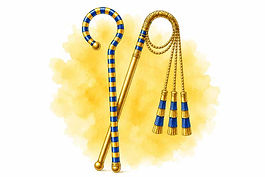
The nekhakha (nxA) - the flail - was one of the two supreme insignia of Egyptian kingship, paired with the heka (HqA, 𓋾) or crook. Together, the crook and flail formed the heka nekhakha, the complete regalia of pharaonic authority that every king carried crossed over the chest. The crook resembled a shepherd's staff and symbolized the pharaoh's role as protector and guide. The flail, a beaded or tasseled whip-like implement, represented agricultural fertility and disciplinary authority - the king's duty to ensure bountiful harvests and punish wrongdoers. Together they embodied the perfect balance of mercy and justice, the essence of ma'at (cosmic order) in human governance.
The regalia were inseparable from the concept of divine kingship. Every deceased pharaoh became Osiris in death, and the crook and flail ensured his continued sovereignty in the afterlife. The crossed position of the two items over the heart represented the eternal vigilance required to maintain cosmic order - both in this world and the next.
Nekhbet
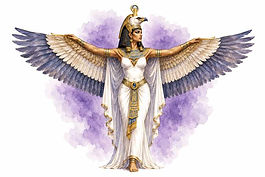
Nekhbet is the vulture goddess of Upper Egypt, the great white bird who spread her wings over the pharaoh and called him her child. She is one of the Two Ladies, the pair of goddesses who together embodied the united kingdom: Nekhbet the vulture of the Nile valley and Wadjet the cobra of the Delta, whose twin names were carved into the royal titulary of every king. She is the Mother of Mothers, the divine nurse who suckled the rulers of Egypt, for the Egyptians believed the vulture was the perfect image of motherhood. She is the protector who hovered above the king in battle, wings wide, holding the ring of eternity in her claws. She is the mistress of the White Crown of Upper Egypt, one of the oldest royal emblems on earth. And she is the goddess the Greeks called Eileithyia, their own divine midwife, for the people of her city knew her as the guardian of every birth.

Nephthys
Nephthys is one of the most subtly powerful yet frequently overshadowed figures in the Egyptian pantheon - the shadowy counterpart to her luminous sister Isis, the sister-wife of the chaotic Set, and the devoted guardian of Osiris and his son Horus. Her Egyptian name, Nebet-Het (literally "Lady of the House" or "Lady of the Temple"), is written with the hieroglyphs of a house and a basket upon her distinctive headdress - a temple-shaped emblem that identifies her as a protector of sacred spaces and, by extension, of the body itself. A member of the Great Ennead of Heliopolis, the nine primordial deities who established cosmic order, Nephthys is the daughter of the sky goddess Nut and the earth god Geb, sister of Osiris, Isis, and Set. While she lacks the widespread popular cult of Isis or Hathor, her role in funerary religion and the Osirian myth cycle is absolutely essential - without Nephthys, the resurrection of Osiris would have been impossible, and the lineage of divine kingship would have been extinguished.
Nephthys embodies the liminal, hidden dimensions of existence - the night, the darkness of the tomb, the mysteries of death and decay, and the protective powers that operate unseen. She is the goddess of mourning and lamentation, her sorrow for the slain Osiris establishing the pattern for all Egyptian funerary grief. Yet she is also a goddess of healing, childbirth, and protection, capable of incinerating the enemies of the pharaoh with her fiery breath. Her dual nature - darkness and protection, grief and healing, hiddenness and vigilance - makes her one of the most psychologically complex deities in Egyptian religion.
Nubia
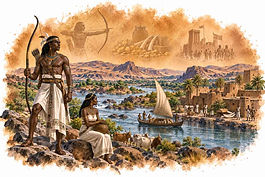
Nubia is the Nile region extending south from Aswan through much of present-day Sudan, a landscape of cataracts, settlements and desert routes that supported its own powerful kingdoms. It is the homeland of Kerma, whose rulers built monumental mud-brick structures and buried their dead beneath great mounds. It is the region of Napata and Meroe, centres of Kushite power whose kings and queens maintained their own traditions while exchanging people, goods and religious ideas with Egypt. It is the land from which Piye and his successors extended their rule into Egypt as the Twenty-Fifth Dynasty. And it is a living cultural homeland, not merely a collection of ruins: the flooding caused by the Aswan High Dam transformed part of Lower Nubia, displacing communities and prompting an international campaign to save threatened monuments. Nubia's history belongs to the whole Nile valley, but it cannot be reduced to Egypt's southern frontier.

Nut
Nut is the sky itself, the star-covered goddess who arches her naked body over the earth and holds up the roof of the world. She is the mother of the five greatest gods of Egypt, Osiris, Isis, Set, Nephthys, and Horus the Elder, born on five stolen days that Thoth, the god of wisdom, won from the moon in a game of draughts, because the sun god Ra had cursed her to give birth on no day of the year. She is the lover torn from her husband, separated from Geb, the earth god, by their own father, who still stands between them holding her up. She is the mouth that swallows the sun every evening and the womb that bears it every dawn, the body through which the dead sun travels all night to be reborn. She is the celestial cow who carried the ageing Ra up into heaven when mankind rebelled against him. And she is the goddess painted inside the coffins of Egypt, her arms spread wide to gather the dead back into the darkness from which all life first came.
Osiris
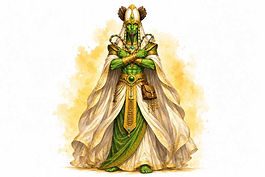
Osiris is the central figure of the most important mythological narrative in Egyptian civilization - the god whose murder, dismemberment, resurrection, and transformation into lord of the dead established the theological foundations for Egyptian beliefs about mummification, the afterlife, and the possibility of eternal life. His Egyptian name, Wsir, first appears in the Pyramid Texts toward the end of the Fifth Dynasty (c. 2500-2400 BCE), though the epithet "Khenti-Amentiu" ("Foremost of the Westerners") is attested from the First Dynasty, suggesting that his cult absorbed and transformed much older funerary traditions. Osiris is classically depicted as a green-skinned deity with a pharaoh's beard, partially wrapped in mummy bandages from the chest downward, wearing the distinctive atef crown (a white crown of Upper Egypt flanked by two curling ostrich feathers), and holding the crook and flail - the instruments of kingship. His green or black skin symbolizes the vegetation that springs to life after the Nile's annual inundation and the fertile black silt that enables Egyptian agriculture, making him simultaneously a god of death and of life's eternal renewal.
The Osiris myth is not merely a theological abstraction but the narrative bedrock upon which Egyptian civilization constructed its understanding of mortality, justice, and cosmic order. Every pharaoh, from the Old Kingdom onward, was understood to become an Osiris upon death - to undergo the same transformation from mortal king to eternal lord of the underworld, guaranteeing the cycle of death and rebirth that sustained both the cosmos and the nation. The annual festivals of Osiris, celebrated across Egypt with dramatic reenactments of his passion, death, and resurrection, were the most emotionally powerful religious events in the Egyptian calendar, engaging entire communities in a shared experience of mourning and triumphant joy.
Ptah
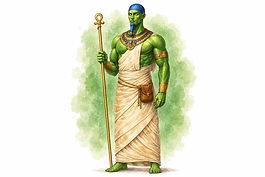
Ptah is one of the most intellectually profound and theologically significant deities in the Egyptian pantheon - the creator god of Memphis who brought the world into existence not through physical action or violent struggle but through the creative power of thought and word. His Egyptian name, Ptah, is interpreted as "the Opener" or "He Who Fashioned," reflecting his identity as the divine craftsman who sculpted the cosmos with the precision of a master artisan. Unlike other Egyptian creator gods who fashioned the world from primordial matter or emerged from chaos through mysterious processes, Ptah conceived the universe in his heart (ib - the seat of thought and intellect) and spoke it into being through the power of his tongue. This concept, preserved on the Shabaka Stone (c. 716-702 BCE) and in hymns from the Twenty-second Dynasty, represents one of the most sophisticated theological achievements of ancient Egypt - a philosophical understanding of creation through divine logos that anticipates later concepts by over a millennium.
Ptah's importance extends far beyond theology. As the patron deity of craftsmen, architects, builders, sculptors, metalworkers, and artisans of all kinds, Ptah was the divine exemplar of human creativity. Every human act of making - from the construction of a temple to the carving of a statue to the forging of a tool - was understood as an imitation of Ptah's original creative act, a participation in the divine craftsmanship that sustained the ordered world. The very name of Egypt in Greek, Aigyptos, is believed to derive from the Middle Egyptian Hwt-Ka-Ptah ("House of the Soul of Ptah"), the name of one of Ptah's shrines at Memphis - a testament to the god's centrality in Egyptian identity. His sacred animal, the Apis bull, was one of the most important oracular cults in Egypt, with each successive bull believed to be a living manifestation of Ptah's creative power on earth.
Ptolemy I Soter
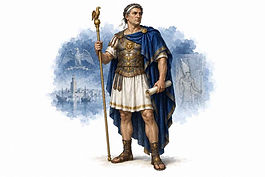
Ptolemy I Soter was a Macedonian officer in Alexander the Great's army who became ruler of Egypt after the conqueror's death. His career joined military service, the wars between Alexander's successors and the establishment of a new royal dynasty on the Nile. He secured Alexander's body for Egypt, making the dead king's memory part of the authority of his own court. He took the royal title in 305/304 BCE and became associated with the epithet Soter, meaning Saviour. Under Ptolemy and his successors, Alexandria developed into a royal capital and a centre of Mediterranean scholarship and trade. His dynasty continued until the defeat of Cleopatra VII in 30 BCE. Ptolemy also wrote an account of Alexander's campaigns, now lost but used by the later historian Arrian, leaving a second kind of legacy: not only a kingdom, but a voice within the writing of Alexander's history.
Puduhepa
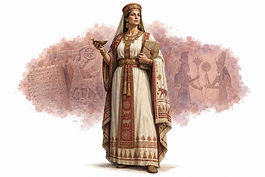
Puduhepa was the Great Queen of Hatti, a priest's daughter from Lawazantiya whose authority is preserved in royal letters, seal impressions and religious texts. She married Hattusili before he became Hattusili III, king of the Hittites, and his autobiography described their union as the work of a goddess. As queen, Puduhepa took part in diplomacy with Egypt, supported religious activity and helped maintain the royal household's international relationships. She corresponded with Ramesses II and his queen Nefertari, and a daughter of the Hittite royal couple became the Egyptian queen Maathorneferure. Puduhepa remained an influential figure after her husband's death, during the reign of their son Tudhaliya IV. Her surviving record shows a queen acting within an established office, not merely appearing beside a king in ceremonial art.

Pyramid Texts
The Pyramid Texts are ancient Egyptian funerary compositions first preserved on the inner walls of the pyramid of Unas at Saqqara. They form one of the earliest surviving large collections of religious writing, bringing together offerings, protection, resurrection and journeys among the gods. Later kings and queens placed different selections in their own pyramids, so the collection is not a single book copied identically from tomb to tomb. Its imagery includes the deceased rising to the sky, joining Ra and the imperishable stars, receiving the protection of Nut and being identified with Osiris. The forceful language of the Cannibal Hymn imagines the king absorbing divine powers. These inscriptions were part of the work of securing life beyond death, and their transmission contributed to the later Coffin Texts and Book of the Dead.