Egyptian Mythology List


Welcome to the Mythopouch list of Ancient Egyptian mythology entries! We also delve into the ancient history of Egypt, the Nile Valley and the wider world shaped by its gods, temples, tombs and pharaohs. From gods, goddesses, queens, pharaohs and sacred animals to monsters, symbols, artefacts, creatures, places, funerary objects and more - this collection will only grow over time. Mythopouch provides real-world information extracted from original source material and ancient records such as the Pyramid Texts, Coffin Texts, Book of the Dead, temple and tomb inscriptions, the Rosetta Stone, the Memphis Decree, the Metternich Stele, and classical accounts such as Plutarch's writings on Isis and Osiris. Ancient Egyptian words, symbols and stories carried powerful messages about life, death, truth, balance, magic, kingship, resurrection and the journey into the afterlife - many of which still resonate deeply in modern times. Our unique imagery is meant to capture the imagination and ignite the magic mythology spark within us all. Our "token mark" coin symbol that is assigned to each record is a visual representation of the entity, for use in Mythopouch learning modules and games.
"Nothing is given, everything is earned" at Mythopouch!
Learn - Earn - Play
Ancient Egyptian Entity Quick Index
Our current list of ancient Egyptian mythology and ancient history entities are here - which are growing day by day!
Search by using the:
-
"Search Mythology Records" function to browse all mythology records and blog pages;
-
Browse the visual cards with overviews by clicking "Go to Visual A-Z";
-
Or just browse and click the A-Z entries below....
See more list entries
Read Ancient Egyptian Insights
Click below to view our ancient Egyptian mythology blog article insights, where we delve into the current Mythopouch Tier regions and what we think you should know!


Egypt Entity Card Index
See more card entries

Andjety
Andjety is an ancient Egyptian god whose crook, flail and feathered crown connect a local Delta tradition with the wider language of divine kingship. Associated with the ninth nome of Lower Egypt, the district centred on Busiris, he appears in funerary texts concerned with authority and renewal after death. His importance lies partly in his close relationship with Osiris, whose familiar royal emblems resemble his own. Yet Andjety was not simply a forgotten name for another god. He shows how Egyptian religion could preserve local identities while combining their powers and images with a deity worshipped across the country.

Androsphinx
The androsphinx is the Egyptian sphinx with a human head - the form that most people envision when they hear the word "sphinx." The term itself is a modern scholarly designation derived from Greek anēr/andros ("man"), distinguishing this type from the criosphinx (ram-headed) and hieracosphinx (hawk-headed) variants. Every major human-headed sphinx in Egypt represents a pharaoh, making the androsphinx essentially a royal portrait in leonine form.
The most celebrated example is the Great Sphinx of Giza, believed to depict Pharaoh Khafre of the Fourth Dynasty (c. 2558-2532 BCE). With its human head bearing the royal nemes headdress atop a massive lion's body, the Giza androsphinx exemplifies the fusion of human wisdom and divine kingship with animal strength and protective power that defines the type.
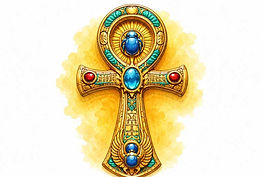
Ankh
The ankh (anx, 𓋹) is simultaneously a hieroglyphic sign, a divine attribute, a protective amulet, and one of the most enduring symbols ever created by human civilization. As a hieroglyph, it simply means "life" - but in Egyptian theology, it represented far more than biological existence. The ankh embodied the totality of life force, including the promise of eternal life in the afterworld. Gods were believed to possess ankhu (life-force) that they could transmit to mortals, and the ankh was the physical manifestation of that divine transmission.
The symbol appears on virtually every category of Egyptian artifact: temple reliefs, tomb paintings, royal regalia, jewelry, seals, pottery, and papyri. When a deity holds the ankh to a pharaoh's lips or nostrils in Egyptian art, this represents the "breath of life" - the divine vivification that sustains and renews. The ankh is one of humanity's oldest continuously recognized symbols, predating the Christian cross by millennia, and it remains one of the most widely recognized symbols from any ancient civilization today.

Ankhesenamun
Ankhesenamun is the Egyptian queen whose changing name reflects the upheaval of the Amarna Period. Born Ankhesenpaaten, the third daughter of Akhenaten and Nefertiti, she grew up within a royal family devoted to the Aten and later became the Great Royal Wife of Tutankhamun during the restoration of traditional worship. Objects from his tomb preserve her beside the young king, while the events after his death remain far less certain. She is often identified with the Egyptian widow who sought a husband from the Hittite royal family, but that identification is debated. Her history combines vivid surviving images with questions that the evidence has not settled.

Anubis
Anubis is one of the most ancient and visually distinctive gods of the Egyptian pantheon, depicted as a man with the head of a black jackal (or, in recent zoological understanding, the African golden wolf) or as a full jackal recumbent upon a shrine-shaped pedestal. His Egyptian name, Anpu or Inpw, may derive from a root meaning "to decay" or "to putrefy," linking him to the very process of bodily decomposition that mummification was designed to arrest. For millennia, Anubis stood as the paramount guardian at the boundary between life and death - the original psychopomp who escorted souls through the perilous transition into the afterlife. Before the rise of the Osiris cult during the late Old Kingdom (c. 2400-2200 BCE), Anubis was himself the chief god of the dead, retaining this primacy even in the earliest royal tombs of the First Dynasty.
Anubis's black coloration holds profound symbolic meaning in Egyptian thought. Rather than representing evil or malevolence, black signified the fertile black silt deposited by the Nile's annual inundation - a substance of renewal, regeneration, and transformation. It also alluded to the dark resins used in the embalming process, making Anubis a figure not of death's finality but of death as a transformative threshold. His role expanded across Egyptian history from sole lord of the dead to an essential collaborator in the Osirian drama: the divine embalmer who performed the first mummification, the impartial technician who operated the scales of judgement, and the compassionate guide who led justified souls into the presence of Osiris.

Anuket
Anuket is the Egyptian goddess of the Nile's First Cataract, where rocky channels and rushing water marked the southern approaches to Egypt. Also known as Anukis, she belongs to the divine triad of Elephantine alongside Khnum and Satis. Her feathered crown and association with the gazelle distinguish her from the other members of that group, while her connection with the river links her to nourishment, protection and renewal. Worshipped in the region of Elephantine and Sehel, she embodies a landscape in which the water sustaining Egypt also formed a difficult frontier between neighbouring lands.
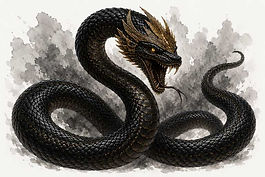
Apep
Apep is the serpent of chaos who attacks the sun boat of Ra every night, the eternal enemy who seeks to swallow the sun and plunge the world into darkness forever. It is the demon that lurks in the waters of Nun, the primordial ocean that surrounds the world, waiting for the moment when the sun god descends into the underworld at sunset. It is the creature against whom the Egyptians carved protective spells on every tomb and temple wall, the monster whose name was cursed in rituals designed to bind and destroy it. It is the serpent that Set, the red-haired god of storms and the wasteland, fought beside the barque of Ra with his iron spear, and that Horus, the falcon god who won the throne of Egypt from his uncle's grip, struck with his divine weapons. It is the embodiment of isfet, the force of disorder that threatened to unravel maat, the sacred balance that kept the cosmos alive. And it is the eternal adversary, the proof that creation is not a single event but a daily battle that must be won again every night.

Apis
Apis is the sacred bull of Memphis, the living god who walked the streets of Egypt for three thousand years, a black beast with a white diamond blazing upon its forehead that the Egyptians believed was the very soul of Ptah, the divine artificer who shaped the world on his heavenly potter's wheel. He is the oracle whose every movement was read as prophecy, whose stamp of the hoof or toss of the head decided the fate of armies and the fortune of merchants. He is the divine king who lived in a palace of his own, served by priests, fed on the finest grain, and given his choice of cows from the royal herds. He is the god who died like a pharaoh, mourned by the entire nation for seventy days, mummified with royal honours, and entombed in a granite sarcophagus weighing seventy tons beneath the desert at Saqqara. He is the creature who became Serapis in the Ptolemaic period, a fusion of the Egyptian bull and the Greek Zeus that conquered the Mediterranean world. And he is the proof that in Egypt, a god could be born, live, and die before your eyes, a legacy that outlasted every temple built for stone idols.

Apshait
The apshait is a malevolent creature of Egyptian funerary theology, appearing in Spell 36 of the Book of the Dead as a flesh-eating beetle or insect that threatens to consume the body of the deceased in the afterlife. Its Egyptian name, transliterated ꜥpšꜣyt, incorporates hieroglyphic determinatives depicting a beetle or insect, underscoring its identity as an entomological threat to postmortem preservation.
In Egyptian belief, the integrity of the physical body was essential for eternal survival. The deceased needed their body to be preserved in order for the ba (soul) and ka (life force) to reunite and achieve resurrection in the Field of Reeds. The apshait represented a direct attack on this necessity - a force of corruption and decay that could destroy the physical vessel upon which immortality depended.

Astarte Papyrus
The Astarte Papyrus is a fragmentary Egyptian manuscript in which a goddess of Levantine origin confronts a crisis involving the personified Sea. Known through Papyrus Amherst 9 and the related fragment pBN 202, it brings Astarte into the company of Egyptian gods and preserves a story of tribute, negotiation and threatened disorder. Its surviving opening refers to Amenhotep II, but the date of the physical manuscript remains debated. Much of the narrative is missing, including a secure conclusion. Its fascination lies both in the encounter between religious traditions and in the limits imposed by a damaged ancient text.

Aten
Aten is the sun disk itself, the blazing circle that rises each dawn and sets each evening, the only god ever to rule Egypt alone in a religious revolution that lasted barely seventeen years and changed the ancient world forever. He is the solar disc that Amenhotep III, the pharaoh of the Eighteenth Dynasty who built the temples of Luxor, elevated from a minor aspect of Ra to a force that would one day consume the entire pantheon. He is the sole deity of Akhenaten, the heretic king who changed his name from Amenhotep IV to Akhenaten, abandoned Thebes, and built a new capital called Akhetaten in the desert to worship nothing but the disk. He is the god who speaks through the Great Hymn to the Aten, carved in the tomb of Ay at Amarna, a poem of thirteen columns that praises the disk as creator of all life and giver of every breath. He is the deity who banished idols, closed the old temples, and declared that no image could capture the divine, a theological leap that some have compared to the religions of Moses. And he is the god who vanished as quickly as he rose, erased from memory by the boy king Tutankhamun, who changed his own name from Tutankhaten and restored the old gods, a legacy that outlasted every monument Akhenaten built.

Atum
Atum is the primordial creator god who made himself from nothing, the first being to emerge from the dark waters of chaos and stand upon the first dry land at Heliopolis. He is the father of the Ennead, the nine gods of Heliopolis, who created Shu, the god of air, and Tefnut, the goddess of moisture, from his own body to begin the population of the cosmos. He is the setting sun, the aged god who sails through the underworld each night in his night-bark, merging with Ra to become Atum-Ra, the complete cycle of solar power from dawn to dusk. He is the weeping creator whose tears of joy fell upon the primordial mound and became the first human beings. He is the finisher of the world, the god who promised Osiris that one day he would destroy everything he made and return the universe to the watery darkness of Nun, existing thereafter as serpents with the lord of the dead. And he is the eternal patron of kings, the deity who lifted the souls of pharaohs from their pyramids to the imperishable stars, a power that outlasted every dynasty.