Arthurian Mythology List


Welcome to the Mythopouch list of Arthurian mythology entries! We also delve into the early history of Britain, Wales, and the Celtic and medieval traditions that shaped the Arthurian world. From kings, queens, knights and mages to castles, quests, monsters, artefacts, weapons, enchanted objects, creatures and more, this collection will continue to grow over time. Mythopouch provides real-world background and mythological information drawn from early chronicles, Welsh tales and medieval romances such as: the Welsh Triads, Culhwch and Olwen, the Historia Brittonum, the Annales Cambriae, Geoffrey of Monmouth, Chrétien de Troyes, the Lancelot-Grail or Vulgate Cycle, Sir Gawain and the Green Knight, and Thomas Malory’s Le Morte d’Arthur. Arthurian legend carries powerful ideas about courage, honour, loyalty, temptation, sacrifice, prophecy, betrayal and the dream of a better kingdom - messages passed from storyteller to storyteller for centuries, many of which still speak to modern life. Our unique imagery is meant to capture the imagination and ignite the Arthurian spark within us all. Our “token mark” coin symbol assigned to each record is a visual representation of the entity, for use in Mythopouch learning modules and games.
"Nothing is given, everything is earned" at Mythopouch!
Learn - Earn - Play
Arthurian Entity Card Index
See more entries
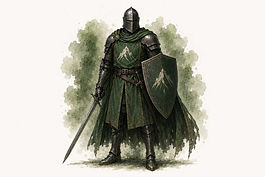
The Green Knight - Sir Pertolepe
The Green Knight is the second of the four colour-coded brothers who held the passages to Castle Dangerous, the warrior whose green armour matched the meadows he guarded and whose defeat proved that the kitchen knave called Beaumains was a knight of royal blood. He is Sir Pertolepe, the brother of Percard the Black Knight, Perimones the Red Knight, and Persant of Inde the Blue Knight, the four champions who had made the road to the besieged castle a gauntlet of death for every knight who came to rescue Dame Lionesse. He is the knight who rode out to avenge his brother Percard's death at Beaumains' hand, who fought a fierce battle with Gareth of Orkney, and who, when he was overcome, yielded with honour and swore fealty to King Arthur. He is the converted adversary who became a brother in arms to the very man who had defeated him, who fought beside Gareth at the tournament of Kink Kenadon, and who carved at the feast when Gareth married Lionesse. And he is the reminder that not every knight who bars the road is a villain, that some fight only for custom or for family honour, and that the truest test of a knight is not the enemies he kills but the enemies he turns into friends.
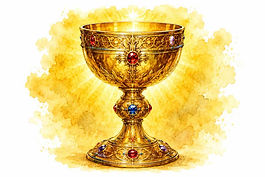
The Holy Grail
The Holy Grail is the most sacred object in Arthurian legend, the cup of the Last Supper in which Joseph of Arimathea caught the blood of the crucified Christ, and the shining vessel that appeared to the Round Table at Camelot and drew the whole fellowship of knights out upon the greatest and most ruinous quest of the age. It is the mysterious graal of Chretien de Troyes, a dish of gold carried in candlelight through the hall of the wounded Fisher King, and the strange stone of Wolfram von Eschenbach, guarded by virgin knights on the mountain of salvation. It is the prize that only the purest knight could achieve, the reward of Galahad, the stainless son of Lancelot, who looked into the vessel and saw what no tongue may tell. It is the quest that ended the golden age, for the knights who rode after it never returned whole in fellowship or number. And it is the enduring symbol of every human search for the divine, the vessel that feeds the soul, heals the wounded land, and vanishes the moment it is grasped by the unworthy.
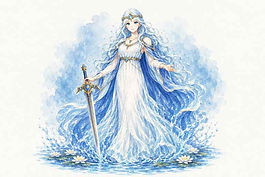
The Lady of the Lake
The Lady of the Lake is one of the most enigmatic figures in Arthurian legend, a supernatural being associated with bodies of water who serves as the guardian of Excalibur, the foster-mother of Lancelot, and the captor of Merlin. She is not a single, consistent character across the Arthurian tradition but rather an archetype that fulfills multiple functions depending on the source. The figure evolved from Celtic water fairy traditions, particularly the Welsh tradition of the lwyd and the Irish sídhe, supernatural beings who dwell in bodies of water and interact with mortals for their own purposes.
The Lady of the Lake first appears in Chrétien de Troyes's Le Chevalier de la Charrette (c. 1170s), where she is mentioned as having given Lancelot a magic ring that detects enchantment. The character was most fully developed in the Vulgate Cycle (c. 1215-1235), where she is named "Viviane" and given a detailed backstory as Merlin's pupil. Thomas Malory's Le Morte d'Arthur (1485) synthesizes the various traditions, referring to her primarily as "Nimue."
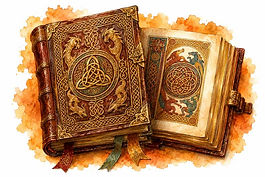
The Mabinogion
The Mabinogion is the treasure chest of Welsh mythology, a collection of eleven medieval prose tales that carries almost everything we know of the old gods, heroes, and enchantments of Wales. It is the home of the Four Branches of the Mabinogi, where Prince Pwyll swaps places with the king of the otherworld, where Rhiannon rides a horse no horse can catch, and where the flower-woman Blodeuwedd is punished by being turned into an owl. It is the book of Bran the Blessed, the giant king who wades across the sea to Ireland and whose buried head guards Britain from invasion. It contains Culhwch and Olwen, the oldest full Arthurian tale in any language, with its giant's forty impossible tasks. It holds the Welsh romances of Owain, Peredur, and Geraint, cousins of the knights of the Round Table. And its very name is a beautiful mistake: an English aristocrat, Lady Charlotte Guest, took the word mabinogi, meaning tales of a hero's youth, and turned it into a plural that the world has used ever since.
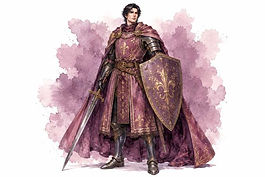
The Puce Knight - Sir Perimones
The Puce Knight is the third of the four colour-coded brothers who held the passages to Castle Dangerous, the tournament lord whose puce-red armour marked the last barrier before the final siege and whose defeat proved that the kitchen knave called Beaumains had the strength of a king's son. He is Sir Perimones, the brother of Percard the Black Knight, Pertolepe the Green Knight, and Persant of Inde the Blue Knight, the four champions who had turned the road to the besieged castle into a gauntlet of steel and pride. He is the knight who held a white tower near the perilous passages, who kept a tournament field where knights gathered to test their skill, and who wore puce-red harness from helm to heel so that he would not be confused with Sir Ironside, the Red Knight of the Red Lands, the tyrant who had hanged forty knights from the trees around Dame Lionesse's walls. He is the warrior who fought Beaumains in a joust that ended with his defeat and his pledge of fifty men to the kitchen knight's service. And he is the redeemed knight who carved at Gareth's wedding feast and fought beside him at the tournament of Kink Kenadon, the reminder that the third blow can be the one that turns an enemy into a brother.
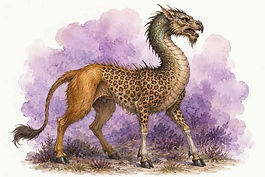
The Questing Beast
The Questing Beast (or Beast Glatisant, from Old French glapissant, "yelping" or "barking") ranks among the strangest and most symbolically charged creatures in Arthurian legend-a chimeric monster pursued endlessly by knights yet never captured, embodying the theme of unattainable quests that pervades the Matter of Britain. First appearing in the 13th-century French romances including the Prose Tristan, Perlesvaus, and the Post-Vulgate Cycle, the beast assumed its definitive form in Sir Thomas Malory's Le Morte d'Arthur. Malory describes it as "a beast with a head like a serpent's head, and a body like a leopard, buttocked like a lion and footed like a hart," with a noise emanating from its belly "as it had been the noise of thirty couple of hounds questing." This bizarre biology-part leopard, part lion, part hart, part serpent, with the sound of a hunting pack issuing from within its stomach-makes the Questing Beast unique even among the menagerie of Arthurian monsters.
The creature's origin story, related by Merlin in the Post-Vulgate Cycle, adds a layer of profound moral horror to its already disturbing appearance. The beast was born from a mortal woman who lusted after her own brother. When she accused her innocent brother of rape, their father King Hipomenes ordered the son torn apart by dogs. With his dying breath, the brother prophesied that his sister would give birth to a monster that would make the same sounds as the dogs that killed him. The birth killed most of the attending midwives, and the abomination escaped into the forest. Merlin later reveals to Arthur that the beast first appeared after Arthur's own unwitting incest with his half-sister Morgause-the act that conceived Mordred-making the Questing Beast a living symbol of that sin and the destruction it would bring upon Camelot.
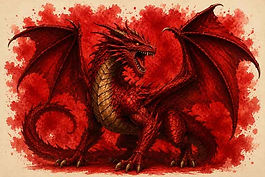
The Red Dragon
The Red Dragon-Y Ddraig Goch-ranks among the most enduring symbols to emerge from Arthurian legend, representing the native Britons in their eternal struggle against invasion and oppression. Its story begins in the same underground pool at Dinas Emrys where the young Merlin (then called Emrys) interpreted the battle between two dragons for the British warlord Vortigern. Where the White Dragon symbolized the invading Saxons, the Red Dragon embodied the Britons themselves-the Celtic peoples of Romano-British descent who resisted the Anglo-Saxon conquest and preserved their identity in Wales, Cornwall, and the north. The Red Dragon's eventual victory over the White Dragon in Merlin's prophecy became the foundation myth of Welsh national identity, a symbol so powerful that it adorns the Welsh flag to this day.
The color red carried specific symbolic weight in the dragon prophecy. In medieval Welsh tradition, warriors were often called "dragons" in reference to their fearsomeness in battle, and the red color associated the Britons with Roman military tradition-Roman commanders had worn the paludamentum, a cloak typically dyed red. The Red Dragon thus represented not merely the Celtic Britons but their claimed inheritance of Roman civilization and legitimacy, set against the barbarian invaders represented by the pale White Dragon. When Geoffrey of Monmouth recorded and expanded the Dinas Emrys legend in his Historia Regum Britanniae, he transformed a local Welsh folktale into a prophecy of national destiny, making the Red Dragon's triumph a promise that sustained Welsh resistance to English domination for centuries.
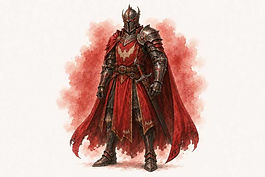
The Red Knight - Sir Ironside
The Red Knight is the most formidable adversary that Sir Gareth of Orkney, the youngest son of King Lot and the kitchen knight who had spent a year in Arthur's scullery, ever faced on his journey from kitchen boy to Round Table glory. He is Sir Ironside, the knight whose strength increased every morning until noon until he possessed the might of seven men, and whose red armour, red shield, and red harness made him look like a walking flame. He is the besieger of Castle Dangerous, the tyrant who trapped Dame Lionesse in her own tower and hanged nearly forty knights from the trees around her walls, the most shameful death that can be inflicted upon a knight of the Round Table. He is the warrior who fought Gareth from noon until evening, their swords notched and broken, their armour hacked to pieces, until Gareth saw the face of Lionesse at the window and found the strength to overcome him. And he is the redeemed knight who, after his defeat, became a brother in arms to the very man who had beaten him, a Knight of the Round Table who carved the meat at Gareth's wedding feast and rode to Maying with Queen Guinevere herself, the reminder that even the cruelest knight may be forgiven if he fights from a broken heart.
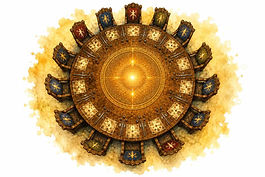
The Round Table
The Round Table is the great wheel of the Arthurian world, the vast circle at which King Arthur gathered the finest fellowship of knights the earth has seen, a table with no head and no foot where no man might boast that he sat above his brother. It is the table that first appears in Wace's Roman de Brut, made so that all should be equal, and the table that Merlin raised in the pattern of the table of the Last Supper and the table of Joseph of Arimathea, the third and last of the sacred tables of the world. It is the table that came to Arthur as the dowry of Guinevere, its seats lettered in gold with the names of the knights, and its single empty place, the Siege Perilous, fatal to every man but the destined Grail knight, whose name appeared there on the day he came to court. It is the order that swore the Pentecostal oath each year, to flee treason, to show mercy, and to succour every damsel in distress. And it is the fellowship that broke under the sin it could not survive, the circle that was never whole again after the Grail quest, the dream of equality that died with the king at Camlann.
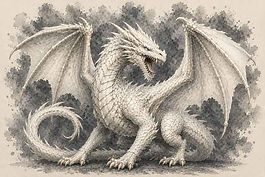
The White Dragon
The White Dragon of Dinas Emrys stands as one of the foundational symbols of Arthurian Britain-a supernatural creature whose battle beneath Vortigern's doomed tower set in motion the prophecies that would elevate Merlin from fugitive child to the greatest wizard of medieval legend. Its story first appears in Nennius's Historia Brittonum (c. 829), one of the earliest surviving sources for Arthurian material, where the boy Emrys (later identified with Merlin) interprets the combat between two dragons for the British warlord Vortigern. The White Dragon represents the invading Saxons-those Germanic peoples who, invited into Britain by Vortigern himself as mercenaries under Hengist and Horsa, gradually seized territory until they threatened to consume the island. Its whiteness symbolizes the pale complexion of the northern invaders and the cold, destructive force of conquest that would reshape Britain.
The setting of the White Dragon's battle is Dinas Emrys, a hillfort rising 250 feet above the Gwynant valley in northwestern Wales. According to the Historia Brittonum, Vortigern retreated to Wales after inviting the Saxons to Britain and attempted to build a fortress on this strategic height. But the tower's foundations collapsed each night, no matter how diligently the builders worked by day. Vortigern's magicians advised him that the structure could only stand if he sacrificed a boy born without a father-blood sprinkled on the stones would secure the foundations. The boy they found was Myrddin Emrys (Merlin Ambrosius), who, when brought before Vortigern, revealed that the tower collapsed not because of any magical requirement for sacrifice, but because two dragons fought in a pool beneath the hill. Excavations in the 1950s revealed an actual cistern beneath Dinas Emrys, confirming the ancient association between the site and underground water.
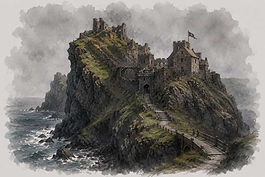
Tintagel
Tintagel is the castle where the Arthurian age was conceived, the sea-girt fortress on the north coast of Cornwall where Gorlois locked away his wife Igraine and where Merlin's craft admitted a king in a borrowed face. It is the impregnable rock of Geoffrey of Monmouth, ringed by the sea but for one narrow way, that no army could take and one enchantment entered without a blow. It is the castle of King Mark in the Tristan legend, the seat from which the sorrow of Isolde was ruled, and the shore where one tradition has Merlin find the infant Arthur, cast up naked by the waves. It is also a real place: a citadel of the Dark Age kings of Dumnonia, rich with wine and oil from the Mediterranean, where archaeologists have uncovered the grandest stronghold of Arthur's century. And it is a castle built backwards: the ruins that crown the headland today were raised in the 13th century by an earl who wanted to own the legend, making Tintagel that rare thing, a fortress that became real because of its story.
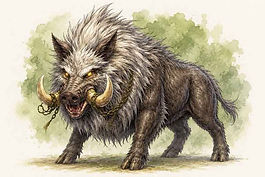
Tro the Boar
Twrch Trwyth is an enchanted monstrous boar from Welsh Arthurian legend, the greatest monster in the early Welsh Mabinogion and the earliest named adversary associated with King Arthur in written literature. The boar's name literally means "the boar, Trwyth" in Welsh - the creature was originally a king named Trwyth, son of Taredd Wledig, who had been transformed into a swine by divine punishment. He appears first in Nennius's Historia Brittonum (c. 829 CE) in the De Mirabilibus Britanniae ("Wonders of Britain") appendix, where the footprint of Arthur's dog Cabal (Cavall) is described as having been made while chasing the great boar Troynt. The full narrative of the hunt appears in Culhwch and Olwen (c. 1100), the earliest Arthurian tale in the Mabinogion collection and the first written record of King Arthur in a narrative context.
Twrch Trwyth is a monster of terrifying proportions: a gargantuan boar whose poisonous bristles, supernatural speed, and enormous strength make him nearly invincible. Between his ears are hidden three magical implements - a comb, a pair of scissors, and a razor - which are the object of the heroes' quest and the key to completing the impossible tasks set by the giant Ysbaddaden Bencawr.