
Details
British
Region Additional (if applicable)
Arthurian
Region
Category
Hero
Gender
Male
Time Period
5th-6th centuries CE (mythic period); literary tradition c. 1469-1485 CE
Symbol
Shield gate
Tags
arthurian, black-knight, percard, hero, gareth, beaumains, lynette, castle-dangerous, round-table
Introduction
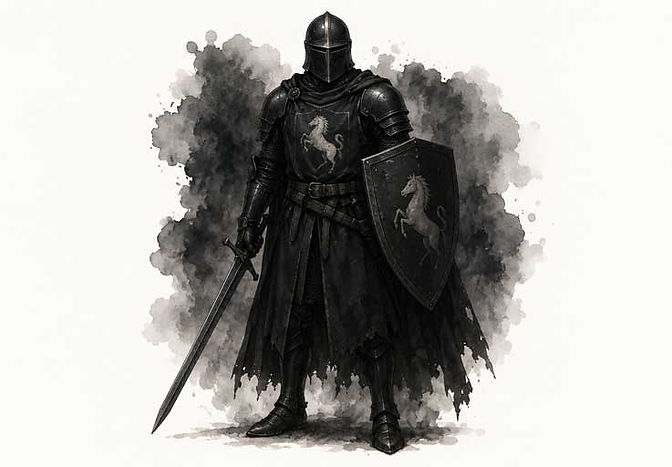
The Black Knight is the first trial that Sir Gareth of Orkney faced on his journey from kitchen knave to Round Table glory, the armoured toll-keeper who demanded payment from every traveller on the road to Castle Dangerous and who died proving that the boy from Arthur's scullery was no scullion at all. He is Sir Percard, the eldest of four brothers who held the passages to the besieged castle, the knight who wore all-black harness from helm to heel and who rested beneath a tree with his shield beside him, waiting for the next challenger. He is the warrior who asked Beaumains if he was the damsel's chosen champion, who laughed when Lynette called him a kitchen boy, and who fought a fierce duel that ended only when Gareth's spear found his heart. He is the brother of Perimones the Green Knight, Pertolepe the Red Knight, and Persant of Inde the Blue Knight, the four knights who guarded the approaches to the castle where Dame Lionesse was trapped by the Red Knight of the Red Lands. And he is the first of many knights who would yield or die before Gareth's rising star, the dark figure on the forest road who proved that the kitchen knight had the strength of a king's son.
Gallery
Who or What was...
The Black Knight - Sir Pecard
Sir Percard was the eldest son of a noble house, one of four brothers who had made their names as champions of the passages and roads that led to Castle Dangerous, the stronghold where Dame Lionesse was besieged by the Red Knight of the Red Lands, the tyrant who had hanged nearly forty knights from the trees around her walls. Percard held the Black Launds, the dark forest road that was the first of the perilous passages, and he had made it his custom to demand toll from every knight who passed, fighting those who refused and taking their horses and armour as his prize. He was a knight of great strength and reputation, known at Camelot as one of the most formidable warriors on the road, and when he saw Lynette, the sharp-tongued damsel who was sister to the besieged lady, riding with a tall young man in plain armour, he called out to know whether this was her champion.
Lynette answered with the scorn that had been her weapon since leaving Camelot. She told Percard that her champion was not this kitchen knave, this scullion called Beaumains who had spent a year in Sir Kay's kitchen, but that she had been forced to accept him because Arthur would send no better. Percard laughed at the name Beaumains, meaning Fair Hands, the nickname that Kay had given Gareth in mockery of his uncalloused palms, and he told the young man to turn back before he was shamed. But Beaumains answered only that he was a born gentleman and would prove it with his spear, and the two knights prepared to joust.
The duel was fierce and brief. They came together with spears, and Percard struck Beaumains a blow that would have unhorsed a lesser man, but Gareth held his seat and returned the stroke with such force that his spear found a gap in Percard's black harness and drove through the knight's body. Percard fell from his horse and died upon the ground, the first of the four brothers to fall before the kitchen knight's rising star. Gareth took Percard's black armour, his black shield, and his black horse, and rode on with Lynette, who still mocked him but who had begun to wonder if this kitchen boy might indeed be more than he seemed.
The death of Percard set in motion the vengeance of his brothers. When Perimones the Green Knight learned that his brother had been slain, he rode out to meet Beaumains and was defeated in turn, though Gareth spared his life and made him swear loyalty to King Arthur. Pertolepe the Red Knight and Persant of Inde the Blue Knight followed, and each in turn was overcome by the same young man who had killed Percard. The four brothers, who had held the road to Castle Dangerous as a single fortress of colour and steel, were broken by one kitchen knave in a single day, and their defeat proved to the world that Beaumains was no commoner but a knight of royal blood.
Percard's death was not treated as murder by the court at Camelot. When the Red Knight of the Red Lands, Sir Ironside, rode to Arthur's court after his own defeat and told the king of Beaumains' deeds, he spoke of Percard with respect, acknowledging that the Black Knight had been a formidable warrior and that his death in fair combat was the fortune of war. The court marvelled that a kitchen boy could have slain such a knight, and Sir Lancelot, the greatest knight in Christendom, who had himself knighted Beaumains, declared that he had known from the first that the young man was of noble blood. Percard's armour and shield were taken back to Camelot as trophies, and his name was added to the list of knights who had fallen before the sword of Sir Gareth of Orkney, the king's nephew who had proved his worth not by blood but by battle.
In the broader Arthurian tradition, the Black Knight is an archetype that appears in many tales, sometimes as a specific knight like Percard and sometimes as a mysterious challenger whose identity is hidden beneath black armour. But in Malory's Le Morte d'Arthur, Percard is the first of the colour-coded knights who test Gareth, the dark figure on the forest road who marks the beginning of the kitchen knight's legend. His death is the first blood on Gareth's sword, the first proof that the boy who had borne Kay's mockery for a year could bear the weight of a knight's destiny.
Summary
The Black Knight endures as the first obstacle in the most famous kitchen-to-knighthood tale in Arthurian legend, the dark-armoured toll-keeper who proved that Sir Gareth of Orkney was no scullion. From the Black Launds to the vengeance of his brothers, from the spear that broke against Beaumains to the black armour taken as trophy, Percard's story is the reminder that every great knight must first defeat a knight greater than himself. He is the brother whose death set four colours against one white hand, and the first name on the list of those who fell before the Round Table's most unexpected champion.
Tags: black-knight, percard, arthurian, hero, gareth, beaumains, lynette, castle-dangerous, round-table
References
Validation References:
- Thomas Malory, Le Morte d'Arthur, Book VII, Chapters VI-VII, c. 1469-1470 (printed 1485) - primary source; the Knight of the Black Launds, the duel with Beaumains, and Percard's death
- Vulgate Lancelot, 1215-1230 - the colour-coded knight motif and the tradition of knightly guardians on the road
- Post-Vulgate Suite du Merlin, 1230-1240 - the Fair Unknown tradition and the testing of the disguised knight
- Loomis, Roger Sherman, The Development of Arthurian Romance (Hutchinson, 1963) - scholarly analysis of the colour-coded knight motif in Arthurian romance
- Loomis, Roger Sherman, Arthurian Tradition and Chretien de Troyes (Columbia University Press, 1949) - scholarly examination of the guardian knight archetype
- Benson, Larry D., Malory's Morte Darthur (Harvard University Press, 1976) - scholarly analysis of Book 7 and the character of the Black Knight
- R.S. Loomis, "Malory's Beaumains" in PMLA, Vol. 54, No. 3 (1939) - scholarly examination of the adversaries in the Fair Unknown tale
- The New Arthurian Encyclopedia, ed. Norris J. Lacy et al. (Routledge, 2013) - entry on the Black Knight and the colour-coded knights in Malory
Meta Description: Discover the Black Knight, Sir Percard, the first trial that Sir Gareth faced on his journey from kitchen knave to Round Table glory, the dark-armoured toll-keeper of the Black Launds. | Mythopouch