Arthurian
The Holy Grail
Name in non-English
San Graal, Sangreal (Old French), Graal (Old French), y Greal (Welsh), the Santo Caliz (Valencia tradition)
Pronunciation
HOH-lee GRAYL
Also known as
The Cup of the Last Supper, the Chalice of Christ, the Dish of the Passion, the Vessel of the Saviour, the Grail of Corbenic, the Sangreal of Logres

Details
British/Celtic/French
Region Additional (if applicable)
Arthurian
Region
Category
Artifact
Gender
N/A
Time Period
1st century CE (the Passion relic); literary tradition c. 1180-present
Symbol
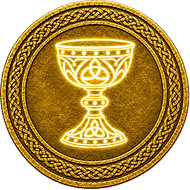
The chalice glowing beneath white samite, the bleeding lance, the candlelit procession, the single consecrated wafer
Tags
arthurian, holy-grail, artefact, sangreal, galahad, perceval, fisher-king, chretien-de-troyes, malory, joseph-of-arimathea, camelot, quest
Introduction
The Holy Grail is the most sacred object in Arthurian legend, the cup of the Last Supper in which Joseph of Arimathea caught the blood of the crucified Christ, and the shining vessel that appeared to the Round Table at Camelot and drew the whole fellowship of knights out upon the greatest and most ruinous quest of the age. It is the mysterious graal of Chretien de Troyes, a dish of gold carried in candlelight through the hall of the wounded Fisher King, and the strange stone of Wolfram von Eschenbach, guarded by virgin knights on the mountain of salvation. It is the prize that only the purest knight could achieve, the reward of Galahad, the stainless son of Lancelot, who looked into the vessel and saw what no tongue may tell. It is the quest that ended the golden age, for the knights who rode after it never returned whole in fellowship or number. And it is the enduring symbol of every human search for the divine, the vessel that feeds the soul, heals the wounded land, and vanishes the moment it is grasped by the unworthy.
Gallery
Who or What was...
The Holy Grail
The Grail enters literature around 1180 in Chretien de Troyes' last romance, Perceval, the Story of the Grail, and it is not a cup, and it is not yet holy. A graal in Old French was simply a wide, deep serving dish, and Chretien's graal is carried through the hall of a mysterious castle in a candlelit procession, after a bleeding lance and before a silver carving platter, borne by a beautiful maiden, made of pure gold and set with precious stones. The lord of the castle is the Fisher King, wounded through both thighs, and the land about him has fallen to waste. The visiting knight Perceval, raised in rustic ignorance, has been taught that knights must not ask questions, so when the procession passes him he holds his tongue, and wakes next morning to find the castle empty and his chance gone. Had he asked whom the grail serves, he would have healed the king and restored the land; the vessel, we learn later from a hermit, carried a single consecrated wafer to the Fisher King's father, hidden in an inner chamber. Chretien died with the tale unfinished, and that unexplained mystery is precisely why four centuries of writers could not leave it alone.
It was Robert de Boron, writing around 1200, who made the grail the Holy Grail. In his Joseph d'Arimathie, the vessel becomes the cup used at the Last Supper, in which Joseph of Arimathea caught the blood that flowed from the wounds of the crucified Christ. Imprisoned for burying Jesus, Joseph is sustained in his dungeon by the Grail for forty-two years until the emperor Vespasian frees him. Joseph and his kin then carry the vessel west, founding a line of Grail keepers, and the relic comes at last to Britain, to the vale of Avaron, binding the cup of Christ to the Arthurian world. From this point the two streams of the legend join: Chretien's mysterious dish in the castle of the wounded king, and Robert's sacred relic of the Passion. The result is the object that has haunted the Western imagination ever since, a vessel of grace that appears only to the worthy, feeds the faithful, and withdraws from the corrupt.
The strangest version belongs to the German knight Wolfram von Eschenbach, whose Parzival, composed in the first decade of the 13th century, makes the Grail not a vessel at all but a stone, lapsit exillis, kept on the mountain of Munsalvaesche and guarded by an order of chaste temple knights. The stone's power feeds the whole company with whatever food and drink each desires, and every Good Friday a dove descends from heaven to lay a consecrated wafer upon it, renewing its virtue. Wolfram's wounded king, Anfortas, suffers for a sin of love, and Parzival, arriving at the castle, fails out of misplaced courtesy to ask the healing question: dear uncle, what ails thee? He must wander for years in despair and defiance of God before returning to ask it and free the king. Wolfram's Parzival is the most human of Grail heroes, a man who achieves the Grail not by purity from birth but by error, grief and growth.
The version that fixed the Grail in the English imagination is the Queste del Saint Graal, composed around 1220 as part of the great Vulgate Cycle and steeped in Cistercian piety. Here the Grail knight is Galahad, son of Lancelot and Elaine, daughter of the Grail keeper King Pelles: a knight born to be perfect, virgin and fearless, whose coming was prophesied in letters of gold on the Siege Perilous at the Round Table. On the feast of Pentecost the Grail enters the hall at Camelot, covered in white samite; the hall fills with sweet odours, every knight is served the food he most desires, and then the vessel vanishes. The knights rise and swear to pursue the quest, and Arthur weeps, foreseeing that his fellowship will never meet whole again. What follows is a road of visions and tests. Lancelot, the greatest knight in the world, is humbled for his sin with Guinevere and granted only a glimpse through a door; the unworthy fail and fall; and at last Galahad, with Percival and Bors, comes to the Grail castle of Corbenic, sees the mysteries unveiled, and carries the vessel to the holy city of Sarras. There Galahad looks into the Grail, beholds what mortal tongue cannot tell, and gives up his soul to heaven; Percival follows him within the year, and Bors alone returns to Camelot to tell the tale.
Where the story came from has filled a library. The Welsh tale of Peredur, cousin to Chretien's Perceval, has no grail at all but a strange procession in which a bleeding spear and a severed head on a platter are carried through a hall, suggesting older Celtic wonder-tales behind the French romance. Scholars point to the magic vessels of Irish and Welsh myth: the cauldron of the Dagda from which no company ever went away unsatisfied, the cauldron of Annwn that Arthur himself raids in the early Welsh poem The Spoils of Annwn, and the cauldron of rebirth in the Mabinogion that restores the dead to life. Roger Sherman Loomis argued the Grail legend grew from such Celtic vessels of plenty; others trace it to Byzantine liturgy and the vessels of the Mass. Jessie Weston's From Ritual to Romance proposed that lance and cup were the surviving symbols of an ancient fertility rite, the wounded king the spirit of a barren land awaiting the question that would make it bloom again, a theory that marched straight into T.S. Eliot's The Waste Land and so into modern literature.
Like Avalon, the Grail has been given earthly addresses. Robert de Boron brought it to the vale of Avaron, and later medieval tradition, fattening on Glastonbury's fame, claimed that Joseph of Arimathea himself had come to Somerset bearing the vessel, or two cruets of the blood and sweat of Christ, and had planted his staff on Wearyall Hill, where it flowered into the Glastonbury Thorn. Valencia Cathedral in Spain displays the Santo Caliz, an agate cup venerated as the chalice of the Last Supper since the Middle Ages. And in Wales the Nanteos Cup, a battered wooden bowl kept for centuries at Nanteos House near Aberystwyth, drew pilgrims who believed it the true Grail and drank from it for healing, biting fragments from its rim. None of these claims stands before history, but all of them testify to the legend's strange gravity: an object from romance became so real to believers that it had to be housed somewhere on earth.
The modern Grail is everywhere. Wagner made it the bleeding chalice of his last opera, Parsifal, where the wound of Amfortas is healed by the compassion of the pure fool. Tennyson gave the quest its most ambivalent telling in the Idylls of the King, a vision that pulled the Round Table apart in chase of a dream. The 20th century sent Indiana Jones hunting the Grail in the Last Crusade and let Monty Python pursue it on imaginary horses; the 21st turned it, in Dan Brown's telling, from a cup into a bloodline, playing on the Old French words san greal and sang real, holy grail and royal blood. Through every transformation the meaning holds. The Grail is the one thing in the Arthurian world that cannot be won by force of arms. It appears freely, feeds freely, and is lost the moment the wrong hand reaches for it. It is the test that ended the age of Camelot, and the promise that beyond the fellowship of the sword there waits a fellowship of grace.
Summary
The Holy Grail endures as the supreme symbol of the spiritual quest, the cup of Christ that shone for one Pentecost in the hall of Camelot and unmade the Round Table by showing it a higher loyalty. From Chretien's unexplained golden dish to Robert de Boron's relic of the Passion, from Wolfram's mysterious stone to Malory's vision of the stainless Galahad, it has been reimagined by every age that inherited it. It is the reminder that the greatest prizes cannot be taken, only granted, and that the question asked at the right moment can heal a king, restore a wasteland, and open the door of heaven.
References
Validation References:
- Chretien de Troyes, Perceval, or The Story of the Grail (Le Conte du Graal), c. 1180-1191 - first appearance of the grail; the procession in the Fisher King's castle
- Robert de Boron, Joseph d'Arimathie (Roman de l'Estoire dou Graal), c. 1191-1210 - the Grail as the cup of the Last Supper; Joseph of Arimathea and the coming of the Grail to Britain
- Wolfram von Eschenbach, Parzival, c. 1200-1210 - the Grail as a stone; Munsalvaesche, Anfortas and the Grail knights
- Peredur son of Efrawg, c. 13th century (Welsh, Mabinogion tradition) - the procession with the bleeding spear and the severed head
- Lancelot-Grail (Vulgate Cycle), the Queste del Saint Graal, c. 1215-1235 - Galahad, the Grail at Camelot, the great quest and Sarras
- Thomas Malory, Le Morte d'Arthur, c. 1470 (Caxton edition 1485) - The Tale of the Sankgreal; the English synthesis
- Tennyson, Alfred Lord, Idylls of the King, "The Holy Grail", 1869 - the Victorian quest
- Wagner, Richard, Parsifal, 1882 - the operatic Grail of compassion
- Weston, Jessie L., From Ritual to Romance (Cambridge University Press, 1920) - the fertility-ritual theory of the Grail legend
- Eliot, T.S., The Waste Land, 1922 - the modern poem built on Grail imagery
- Loomis, Roger Sherman, The Grail: From Celtic Myth to Christian Symbol (University of Wales Press, 1963) - the Celtic-origins argument
- Barber, Richard, The Holy Grail: Imagination and Belief (Allen Lane, 2004) - comprehensive modern study of the legend