Arthurian Mythology List


Welcome to the Mythopouch list of Arthurian mythology entries! We also delve into the early history of Britain, Wales, and the Celtic and medieval traditions that shaped the Arthurian world. From kings, queens, knights and mages to castles, quests, monsters, artefacts, weapons, enchanted objects, creatures and more, this collection will continue to grow over time. Mythopouch provides real-world background and mythological information drawn from early chronicles, Welsh tales and medieval romances such as: the Welsh Triads, Culhwch and Olwen, the Historia Brittonum, the Annales Cambriae, Geoffrey of Monmouth, Chrétien de Troyes, the Lancelot-Grail or Vulgate Cycle, Sir Gawain and the Green Knight, and Thomas Malory’s Le Morte d’Arthur. Arthurian legend carries powerful ideas about courage, honour, loyalty, temptation, sacrifice, prophecy, betrayal and the dream of a better kingdom - messages passed from storyteller to storyteller for centuries, many of which still speak to modern life. Our unique imagery is meant to capture the imagination and ignite the Arthurian spark within us all. Our “token mark” coin symbol assigned to each record is a visual representation of the entity, for use in Mythopouch learning modules and games.
"Nothing is given, everything is earned" at Mythopouch!
Learn - Earn - Play
Arthurian Entity Card Index
See more entries

Sir Launfal
Sir Launfal is the Round Table knight whose generosity bankrupted him, the steward of King Arthur's court who was forgotten by his king and insulted by his queen. He is the lover of Tryamour, the daughter of the King of Faerie, a supernatural realm beyond the mortal world, who gave him a magical purse that never emptied, an invisible dwarf servant named Gyfre, a white fairy horse called Blaunchard, and armour that shone like crystal, on the single condition that he never reveal her existence. He is the broken knight who, provoked by Queen Guinevere's slander, boasted that his fairy lady's least attractive servant was more beautiful than the queen herself, and who lost everything the moment his secret slipped out. He is the accused man who stood trial for treason against the queen's honour, and who was saved at the last breath by Tryamour's arrival on a fairy horse, her beauty so blinding that it proved his words true and struck Guinevere blind in the same instant. And he is the knight who abandoned the mortal world for the fairy isle of Olyroun, returning once each year to joust with any challenger who dares face him.

Sir Palamedes
Sir Palamedes is the great Saracen knight of the Round Table, the noble pagan who won a place at the heart of Christian chivalry before he ever accepted its baptism. He is the son of King Esclabor, a royal exile from the East who came to Arthur's court, and the brother of the knights Safir and Segwarides. He is the second and most famous hunter of the Questing Beast, the impossible monster with the head of a serpent, the body of a leopard, the haunches of a lion, and the belly full of yelping hounds, which he swore to follow to the world's end. He is the hopeless lover of Isolde, the Irish princess whose heart belonged to Tristan, and the rival who fought Tristan at tournament after tournament, always honourably and always second. He is the knight who refused baptism until he had fought seven true battles for the faith, and who was christened at last with his greatest enemy standing as his friend. And he is the poet of loss, the author of the famous lament for Isolde after King Mark's treachery ended her and Tristan both.

Sir Valentyne of Lombardy
Sir Valentyne of Lombardy is the fifteen-foot giant knight whose challenge arrives at the exact centre of the romance of Sir Launfal, the moment when the fairy-touched steward must prove his knighthood all over again. He is the lord of Atalye, a terrifying figure from the Italian north who hears of Launfal's prowess and burns with envy, sending a messenger to Arthur's court to demand that the English knight travel to Lombardy and joust with him or else have his manhood shamed forever. He is the colossal adversary whose sheer size makes the contest grotesque rather than glorious, a giant who knocks Launfal's helmet from his head and shatters his shield with blows so mighty that only the invisible dwarf Gyfre, the fairy servant of Lady Tryamour, keeps the English knight from instant death by snatching up his fallen gear unseen. He is the knight whose name evokes the feast of lovers yet whose body embodies brute masculine potency, a deliberate contrast that turns the duel into a test of Launfal's honour combined. And he is the giant who dies on Lombard soil, slain by Launfal's sword after the invisible dwarf has tilted the combat, his death proving that fairy magic can defeat even the most monstrous mortal strength.

The Black Dog of Maelgwn
The Black Dog of Maelgwn represents one of the most spectral and historically grounded monsters of early Welsh Arthurian tradition-a creature that bridges the gap between folklore, historical chronicle, and the supernatural landscape of medieval Wales. To understand the Black Dog, one must first understand its master: Maelgwn Gwynedd (Maelgwn Hir, "Maelgwn the Tall"), a historical 6th-century king of Gwynedd whose court at Deganwy featured prominently in early Welsh Arthurian poetry and whose life was chronicled by the monk Gildas in his De Excidio et Conquestu Britanniae (c. 540 CE). Maelgwn's name itself carries canine associations: it translates as "Princely Dog" or "Warrior Hound" (mael "prince/warrior" + gwn "hound/dog"), connecting the historical king to the animal that would become his supernatural familiar. Gildas condemned Maelgwn as a tyrant who had once been a monk but abandoned his vows to seize power, describing him as the "dragon of the island" whose sins included murder, fornication, and the persecution of the church.
The spectral black dog enters Arthurian tradition through the fragmentary Welsh poetry and triads that preserved the legends of Maelgwn's court. In the Black Book of Carmarthen and related manuscripts, Maelgwn's court at Deganwy appears as a setting where Arthurian heroes interacted with historical Welsh kings, blurring the line between history and legend. The spectral hound associated with Maelgwn belongs to the widespread British tradition of the "black dog" as a death omen and guardian spirit-creatures known variously as the Black Shuck in East Anglia, the Barghest in Yorkshire, and the Gwyllgi in Wales. These dogs were typically described as enormous, shaggy, black hounds with glowing eyes that haunted roads, churchyards, and the estates of the powerful, serving as omens of death or as guardians of forbidden treasures. In Maelgwn's case, the dog may have represented the king's own moral corruption given supernatural form-a hellish familiar appropriate to a ruler Gildas portrayed as demonic.

The Black Knight - Sir Pecard
The Black Knight is the first trial that Sir Gareth of Orkney faced on his journey from kitchen knave to Round Table glory, the armoured toll-keeper who demanded payment from every traveller on the road to Castle Dangerous and who died proving that the boy from Arthur's scullery was no scullion at all. He is Sir Percard, the eldest of four brothers who held the passages to the besieged castle, the knight who wore all-black harness from helm to heel and who rested beneath a tree with his shield beside him, waiting for the next challenger. He is the warrior who asked Beaumains if he was the damsel's chosen champion, who laughed when Lynette called him a kitchen boy, and who fought a fierce duel that ended only when Gareth's spear found his heart. He is the brother of Perimones the Green Knight, Pertolepe the Red Knight, and Persant of Inde the Blue Knight, the four knights who guarded the approaches to the castle where Dame Lionesse was trapped by the Red Knight of the Red Lands. And he is the first of many knights who would yield or die before Gareth's rising star, the dark figure on the forest road who proved that the kitchen knight had the strength of a king's son.

The Blue Knight - Sir Persant
The Blue Knight is the fourth and final colour-coded brother who held the passages to Castle Dangerous, the eastern champion whose blue armour marked the last barrier before the siege of Dame Lionesse and whose defeat completed the transformation of a kitchen knave into a knight of legend. He is Sir Persant of Inde, the lord of a castle that lay beyond the Black, Green, and Red Launds, the knight who wore all-blue harness from helm to heel and who had made his name as a warrior of such renown that even Sir Lancelot, the greatest knight in Christendom, knew him by reputation. He is the brother of Percard the Black Knight, Pertolepe the Green Knight, and Perimones the Red Knight, the four champions who had turned the road to Castle Dangerous into a gauntlet of death. He is the knight who fought Beaumains with such fury that their battle shook the ground, and who, when he was overcome, yielded with such grace that he became the first to learn the kitchen knave's true name. He is the lord who promised a hundred men to Gareth's service, who fought beside him at the tournament of Kink Kenadon, and who carved at the feast when Gareth married Lionesse. And he is the eastern knight who brought the colour of distant lands to Arthurian romance, the reminder that the road to Camelot runs through every corner of the known world.
The Cath Palug
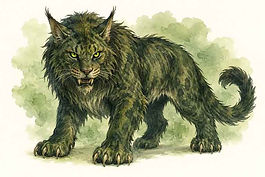
The Cath Palug stands as one of the most fearsome and distinctive monsters of Welsh Arthurian tradition-a gigantic feline born of supernatural origins that terrorized the Isle of Anglesey and tested the might of King Arthur's warriors. Unlike the courtly monsters of French romance, the Cath Palug belongs to the older, darker stratum of Welsh legend, preserved in fragmentary poems and triads that predate the continental Arthurian cycle. Its name, meaning "Palug's Cat" or possibly "Clawing Cat" (from Welsh palug/paluc, related to striking, scratching, or clawing), identifies it as a creature of specifically Celtic imagination-an aquatic demon-cat that haunted the boundaries between land and sea, domestic and wild, natural and supernatural. Its French counterpart, Chapalu (from chat "cat" + palu "bog"), demonstrates how widely the tale spread and how terrifying the concept of a monstrous cat proved across medieval Europe.
The origins of the Cath Palug reach back into Welsh mythology through its mother, the enchanted white sow Henwen ("Old White"), a creature associated with prophecy and fortune-telling, sometimes identified with the dark goddess Ceridwen. According to the Welsh Triads, Henwen gave birth to the cat as a tiny black kitten at the black rock in Llanfair, from which it was cast into the sea. The kitten crossed the Menai Strait and reached Anglesey, where the sons of Palug raised it without realizing it would become one of the three great plagues of the island. It grew to enormous size, developed a single glowing red eye (an unmistakable sign of the supernatural in Celtic folklore), and acquired an insatiable hunger for human flesh. By the time it reached maturity, the Cath Palug had become an aquatic predator of nightmare proportions, needing 180 warriors for every meal.

The Demon of the Perilous Chapel
The Demon of the Perilous Chapel stands as one of the most obscure yet symbolically potent supernatural guardians in Arthurian legend-a creature of hellish origin that defended a haunted chapel in the Perilous Cemetery, testing the courage and spiritual worth of knights during the Grail Quest and related adventures. Unlike the more famous monsters of Arthurian romance, the Demon of the Perilous Chapel emerges from the darker, more explicitly Christian strain of the Grail tradition, where supernatural evil takes demonic rather than merely bestial form. The chapel it guarded was no ordinary sacred building but a cursed site located in one of the Perilous Forests, surrounded by a haunted cemetery where the dead did not rest peacefully and where only the most worthy knights could enter without shame or destruction.
The Perilous Chapel appears in two distinct Arthurian contexts: first in the Grail romances Perlesvaus and the Post-Vulgate Queste del Saint Graal, where Gawain and Hector visited it during the Grail Quest; and second in Malory's Le Morte d'Arthur, where it became the setting for one of Lancelot's most harrowing adventures. In the Grail Quest episodes, both Gawain and Hector encountered visions at the chapel that portended the quest's completion by Galahad, Perceval, and Bors-the three pure knights who would achieve the Grail. These visions served to confirm the unworthiness of Gawain and Hector, demonstrating that their sins barred them from the highest spiritual achievement. The chapel thus functioned as a supernatural mirror, reflecting the inner state of those who dared enter.

The Fisher King
The Fisher King is the wounded keeper of the Holy Grail, the maimed lord of the Grail castle whose hurt has made his whole kingdom waste, and whose healing waits upon a stranger's question. He is the king whom Perceval found fishing from a boat upon the river, because the wound through his thighs let him take no other sport, and the silent host whose hall filled with candlelight and marvels the night the grail and the bleeding lance passed before his guest. He is the Rich Fisher of Robert de Boron, the first of his line, who caught the fish for the table of the Grail, and the Anfortas of Wolfram, whose sin of love festers until compassion asks what ails him. He is Malory's King Pelles of Corbenic, struck down by the Dolorous Stroke of the spear that pierced Christ, who engineered the birth of Galahad so that his wound and his country might be healed. And he is the deepest symbol in the Grail legend: the king and the land are one flesh, and when the king bleeds, the rivers fail.

The Giants of Mont-Saint-Michel
The Giants of Mont-Saint-Michel represent some of the most savage and folkloric adversaries faced by King Arthur-a pair of monstrous humanoids whose slaying demonstrated both Arthur's heroic prowess as a giant-killer and the brutal reality of his continental campaigns. The story originates with Geoffrey of Monmouth's Historia Regum Britanniae (c. 1136), the foundational text of Arthurian legend, which places the episode during Arthur's war against the Roman Emperor Lucius Hiberius. While preparing to march on Rome, Arthur received devastating news: a "giant of monstrous size" had emerged from Spain, kidnapped Helena-the niece of Duke Hoel of Brittany-and carried her to the summit of Mont-Saint-Michel, where he held her captive in a cave. The giant had already killed or captured numerous knights who attempted rescue, eating some alive, and spread such terror that the surrounding countryside lay deserted.
This giant of Mont-Saint-Michel is properly the second of two giants Arthur slew during his campaigns. Earlier in the Historia, Arthur had killed another giant (sometimes identified with the figure who became Ritho in later tradition) during his wars in the region. But the Helena kidnapping episode became the more famous narrative, elaborated by Wace, Layamon, and Malory into one of the most dramatic single-combat episodes in Arthurian literature. The giant's identification with Mont-Saint-Michel-a tidal island crowned by an eighth-century abbey that already possessed sacred associations with the archangel Michael-added layers of Christian resonance to a fundamentally folkloric tale of dragon-slaying and maiden-rescue transposed to a giant-killing context. Wace named the giant Dinabuc, while the Norse Tristrams Saga ok Ísöndar later placed Tristan's famous Hall of Statues in the giant's former cave.

The Green Chapel
The Green Chapel is the most frightening address in Arthurian legend, the place where Sir Gawain swore to stand bare-necked on New Year's Day and receive the return blow of the axe he had swung a year before. It is the destination the giant Green Knight gave to King Arthur's court at Camelot when he rode in at Christmas, green from hair to horse, and invited any knight to strike off his head on condition the striker seek him out for the same stroke in twelve months. It is the chapel that is no chapel at all: a grass-grown mound by a stream, hollow as a cave, with holes at its ends and sides, which Gawain names the most accursed church he ever entered. It is the place where the only bell is the rasp of a great axe being ground on a stone, sharpened for the neck of the arriving guest. And it is the one landmark of the poem that walkers can still hunt today, in the mossy gullies of the Staffordshire Peak District, where a hidden chasm called Ludchurch keeps the green light of the story.

The Green Knight
The Green Knight is a supernatural challenger who appears in Sir Gawain and the Green Knight (c. 1375), one of the masterpieces of Middle English literature. Written by an anonymous poet known as the "Pearl Poet" or "Gawain Poet," the poem survives in a single manuscript (Cotton Nero A.x) at the British Library. The Green Knight serves as a tester of virtue rather than a conventional villain - he challenges the knights of Camelot not to combat but to a "beheading game," a test of courage and honour that reveals the true character of Sir Gawain, the youngest knight of the Round Table.
The Green Knight's human identity is revealed later in the poem as Bertilak de Hautdesert, a lord who lives in a castle in the wilderness. His true nature remains ambiguous - he may be a shape-shifting supernatural being, an agent of Morgan le Fay (who, in the poem, sent him to test Arthur's court), or an embodiment of the "Green Man" folklore figure associated with vegetation and the cycle of death and rebirth. This ambiguity is central to the poem's enduring fascination.