Arthurian Mythology List


Welcome to the Mythopouch list of Arthurian mythology entries! We also delve into the early history of Britain, Wales, and the Celtic and medieval traditions that shaped the Arthurian world. From kings, queens, knights and mages to castles, quests, monsters, artefacts, weapons, enchanted objects, creatures and more, this collection will continue to grow over time. Mythopouch provides real-world background and mythological information drawn from early chronicles, Welsh tales and medieval romances such as: the Welsh Triads, Culhwch and Olwen, the Historia Brittonum, the Annales Cambriae, Geoffrey of Monmouth, Chrétien de Troyes, the Lancelot-Grail or Vulgate Cycle, Sir Gawain and the Green Knight, and Thomas Malory’s Le Morte d’Arthur. Arthurian legend carries powerful ideas about courage, honour, loyalty, temptation, sacrifice, prophecy, betrayal and the dream of a better kingdom - messages passed from storyteller to storyteller for centuries, many of which still speak to modern life. Our unique imagery is meant to capture the imagination and ignite the Arthurian spark within us all. Our “token mark” coin symbol assigned to each record is a visual representation of the entity, for use in Mythopouch learning modules and games.
"Nothing is given, everything is earned" at Mythopouch!
Learn - Earn - Play
Arthurian Entity Card Index
See more entries

Logres
Logres is the name of King Arthur's kingdom in medieval romance, the mythic heart of Britain ruled from Camelot by the once and future king and his knights of the Round Table. It is the land of the Holy Grail, for the romances call the wonders of that sacred quest the adventures of the kingdom of Logres, the enchanted marvels that drew every true knight out on the road. It is the land blasted by the Dolorous Stroke, when the knight Balin struck King Pellam with the very spear that had pierced Christ on the cross, and three kingdoms lay waste in a single blow. It is the realm the poet Chretien de Troyes called the old kingdom of ogres, a land prophesied to be destroyed by a lance that bleeds by itself. It is a name older than Arthur, drawn from Lloegr, the ancient Welsh word for England, which the chroniclers said was named for Locrinus, the eldest son of Brutus of Troy. And it is the name modern writers reached for when they wanted Britain at its most sacred, the hidden kingdom of the spirit behind the everyday world.
Merlin
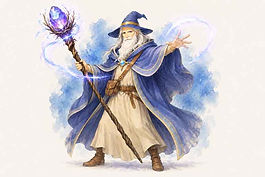
Merlin is the preeminent wizard of Arthurian legend, a figure of prophecy, magic, and tragedy who serves as the architect of King Arthur's destiny. Geoffrey of Monmouth created the literary Merlin in the 12th century by combining two earlier figures: the Welsh prophet Myrddin, a wild man of the woods associated with the town of Carmarthen, and Ambrosius, a boy-prophet from the Historia Brittonum. Geoffrey's Prophetiae Merlini (c. 1130) and Historia Regum Britanniae (c. 1136) established Merlin as a major character in British legend. Later traditions, particularly Robert de Boron's Merlin (c. 1200), added the famous story of his demonic parentage.
As Arthur's advisor, mentor, and the engineer of his conception and rise to power, Merlin occupies a unique position in the Arthurian cycle. He is simultaneously a bridge between the pagan and Christian worlds, a being of supernatural origin who uses his powers for benevolent ends, and a prophet who can see all of time yet is powerless to prevent his own destruction.
Merlin's Staff
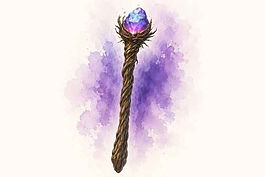
Merlin's staff is the magical implement through which the legendary wizard of Arthurian legend focuses and directs his supernatural powers. Unlike Excalibur, which is described in detail in medieval texts, Merlin's staff exists more in the realm of accumulated tradition, illustration, and modern interpretation. Medieval manuscript illuminations from the 13th to the 15th centuries frequently depict Merlin carrying a staff or wand, though no canonical description of its powers or origin appears in the primary Arthurian texts. The concept of the wizard's staff as a channel of magical power draws on deep roots in Germanic and Celtic tradition - the druidic staff (slat) was a recognized symbol of authority in ancient Britain.
In modern fantasy literature and gaming, Merlin's staff has become firmly established as a powerful artifact, the ancestor of Gandalf's staff in The Lord of the Rings, the wands of Harry Potter, and the magical implements of countless fantasy RPGs. The staff represents the idea that great magical power requires focus and direction - raw magical energy is dangerous without a wizard's discipline to channel it.
Mordred
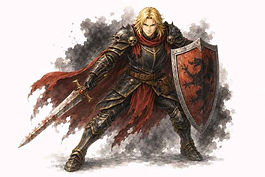
Mordred stands as the quintessential traitor of Arthurian legend-the illegitimate son of King Arthur who brought about the Battle of Camlann and the fall of Camelot. His earliest appearance comes not as a villain but as a figure of ambiguity: the 10th-century Annales Cambriae records simply that "the strife of Camlann, in which Arthur and Medraut fell," without indicating whether they fought together or against each other. Welsh tradition preserved this complexity-the Dream of Rhonabwy suggests Medrawd was one of Arthur's warriors, while certain triads describe him as a man of gentle words. It was Geoffrey of Monmouth, in his Historia Regum Britanniae (c. 1136), who transformed Mordred into the archetypal usurper, and later French romances who added the darkest element of his story: that he was Arthur's son by incest with his half-sister Morgause, making his betrayal a crime of flesh as well as treason.
The fully developed tradition, recorded in the Vulgate Cycle and Malory's Le Morte d'Arthur, presents Mordred as the product of a fateful union. Morgause, wife of King Lot of Orkney and Arthur's half-sister, visited Camelot on a diplomatic mission early in Arthur's reign. Unaware of their kinship, Arthur and Morgause conceived a child. Merlin prophesied that this child would grow to destroy Arthur's kingdom, prompting the king to order the drowning of all infants born on May Day. Mordred alone survived, washed ashore and raised by a fisherman until he eventually came to his father's court. This traumatic origin-survival of mass infanticide, hidden parentage, and a destiny foretold-shaped a character who moved from loyal service to utter destruction.

Morgan Le Fay
Morgan Le Fay stands as the most powerful sorceress in Arthurian legend-a figure of extraordinary complexity who evolved from benevolent healer to Arthur's chief antagonist across centuries of storytelling. Her first appearance, in Geoffrey of Monmouth's Vita Merlini (c. 1150), presents her in a surprisingly positive light: as Morgen, the eldest of nine enchantress sisters who rule the Isle of Avalon, where she heals the mortally wounded Arthur after Camlann. She is described as beautiful, knowledgeable in mathematics and astronomy, expert in medicinal herbs, and capable of shapeshifting and flight. This original Morgan was no villain but a divine healer-almost a goddess figure-who offered Arthur sanctuary and the possibility of restoration. Her name derives from Old Welsh Morgan, meaning "sea-born," and the French epithet la Fée ("the Fairy") identifies her with the Celtic Otherworld.
The transformation of Morgan from benevolent healer to antagonist represents one of the most striking character developments in medieval literature. Chrétien de Troyes and subsequent French romances began darkening her portrait, making her Arthur's half-sister (daughter of Igraine and Gorlois, Duke of Cornwall), a student of Merlin's magic, and increasingly hostile to Arthur and his queen. The Vulgate Cycle completed her villainous transformation: she became sexually promiscuous, schemed against Arthur's life, attempted to expose Lancelot and Guinevere's affair, and in some versions sought to steal Excalibur and its enchanted scabbard. Yet even in her antagonism, Morgan retained traces of her original power and ambiguity-she was never merely evil but dangerously autonomous, a woman whose magic made her equal to any man in the Arthurian world, including Merlin himself.
Queen Margawse
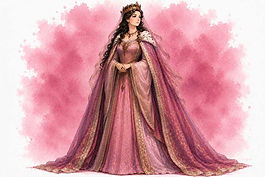
Queen Margawse is the most fateful mother in Arthurian legend, the woman whose five sons include the flower of chivalry and the man who destroyed it. She is the daughter of Gorlois, Duke of Cornwall, and the lovely Igraine, born at Tintagel before Uther Pendragon's deception made her the half-sister of a king she would never know as kin. She is the wife of King Lot of Orkney and Lothian, and the mother of his four splendid sons: Gawain, whose strength waxes with the sun; Agravain the Proud; Gaheris; and Gareth, the kitchen knight beloved of all. She is the queen who lay with her own half-brother Arthur without either knowing their blood, and who bore from that night Mordred, the child fated to strike his father down at Camlann. She is the indirect cause of the May Day massacre, when Arthur cast every noble newborn to the sea to kill the one he feared. And she is the queen beheaded in her own bed by her son Gaheris for the lover she took, a death that set the Orkney clan hunting blood until the Round Table bled with it.

Sir Agravain
Sir Agravain is the knight who spoke the truth that destroyed the Round Table, the second son of King Lot of Orkney and the nephew of King Arthur, whose hatred of Lancelot armed him with the one weapon no sword could parry. He is the brother of Gawain, Gaheris and Gareth, and the half-brother of Mordred, born into the blood-feud of the Orkneys, who rode with his brothers to the slaying of King Pellinore and stood in the press when Sir Lamorak fell. He is the whisperer at the king's ear, who named openly what all Camelot suspected and none would say: that the queen loved the greatest knight in the world. He is the leader of the twelve knights who surrounded the queen's chamber in the night and cried traitor at the door, and who died there by Lancelot's own hand, the first blood of the ending. And he is the most uncomfortable figure of the legend's last act, the villain who was right, whose malice proved more destructive than the sin it exposed.

Sir Bedivere
Sir Bedivere is the oldest companion of King Arthur still remembered by name, a knight whose story began in Wales centuries before Camelot was ever built. He is Bedwyr of the Welsh tales, the handsome one-handed warrior who fought beside the steward Cai in Arthur's first war-band, a man said to draw more blood with one hand than any three warriors with six. He is Beduerus the cup-bearer of Geoffrey of Monmouth's chronicle, made Duke of Normandy and killed with honour in Arthur's war against Rome. He is the last knight alive on the field of Camlann, the one who carried the dying Arthur on his back down to the water. He is the hand that threw Excalibur back into the lake after twice betraying his king's command, and the eyes that saw a woman's arm rise from the waves, catch the sword, and brandish it three times before drawing it under. And he is the witness who watched the black barge carry Arthur away to Avalon, the knight left behind to tell the tale.
Sir Ector
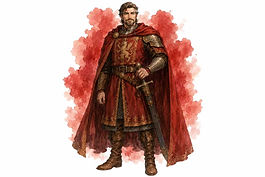
Sir Ector is the foster father of King Arthur, the honest knight chosen by Merlin to raise the future king in secret as his own son. He is the man who took the newborn prince from the enchanter's hands on the night of his birth, brought him to his own wife's breast, and kept the secret of the boy's blood for fifteen years. He is the true father of Sir Kay, the sharp-tongued foster brother who would become seneschal of all England, and the head of the household where Arthur learned humility before he ever heard a crown. He is the knight standing in the snowy London churchyard when the forgotten sword of his son Kay sends young Arthur to the stone in the yard, and the boy comes back holding the blade that proves him king. He is the man who made his own son swear upon a Bible to tell the truth about that sword, and who then knelt to his foster child and asked only one reward: a place for Kay. And he is the proof that the greatest king in legend was raised not by a king, but by a good man.
Sir Galahad
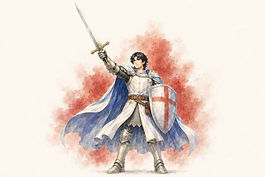
Sir Galahad stands as the supreme exemplar of purity and spiritual perfection in Arthurian legend-the only knight deemed worthy enough to achieve the Holy Grail. First emerging in the 13th-century Lancelot-Grail (Vulgate) Cycle, Galahad was conceived through a web of prophecy, deception, and divine purpose. He is the illegitimate son of Sir Lancelot du Lac, the greatest knight of the Round Table, and Elaine of Corbenic, daughter of the Fisher King. His very existence was orchestrated by King Pelles, who through magical foreknowledge understood that Lancelot would father a child destined to become the Grail Knight. The enchantress Dame Brusen provided Elaine with a magic ring that disguised her as Queen Guinevere, Lancelot's true love, making Galahad's conception both a betrayal and a fulfillment of destiny. Merlin himself had prophesied that Galahad would surpass his father in valor and complete the quest that all other knights would fail.
Galahad's arrival at King Arthur's court at Camelot was marked by supernatural portents. During the Pentecost feast, the young knight-barely fifteen years old-was led to the Siege Perilous, the forbidden seat at the Round Table reserved for the knight who would achieve the Grail. Where all others who had sat there perished, Galahad survived, the chair's inscription transforming to read: "This is the siege of Galahad the haut prince." He also drew a sword from a floating stone that no other knight could move, confirming his predestined role. His resemblance to his father Lancelot was unmistakable, yet where Lancelot embodied earthly chivalry compromised by his love for Guinevere, Galahad represented perfect spiritual purity-celibate, humble, and divinely favored.

Sir Gawain
Sir Gawain stands as one of the most ancient and transformed figures in Arthurian legend-a knight whose character evolved dramatically from his Welsh origins as Gwalchmei ap Gwyar to the celebrated but flawed hero of French and English romance. In Welsh tradition, Gwalchmei (meaning "Hawk of May," from gwalch "hawk" + mei possibly "May") was Arthur's nephew, son of Gwyar (meaning "gore" or "bloodshed," likely a matronym), and one of the greatest warriors of the British king's retinue. He appears in the early Welsh poem Pa Gur yv y Porthaur ("What man is the gatekeeper?") from the Black Book of Carmarthen as one of Arthur's companions, and in Culhwch and Olwen as a member of the warband seeking the giant's daughter. The Welsh Gwalchmei was noble, brave, and courteous-a paragon of knightly virtue whose grave was said to lie at Peryddon.
The transformation of Gwalchmei into the continental Gawain began with Geoffrey of Monmouth's Historia Regum Britanniae (c. 1136), where he appears as Gualguanus, Arthur's nephew and one of his most trusted commanders. Geoffrey established Gawain's reputation for courtesy and martial prowess that would persist throughout the medieval period. However, as the Arthurian legend passed into French hands and developed through Chrétien de Troyes and the Vulgate Cycle, Gawain's character underwent a fundamental shift. The French romances gradually diminished his stature: where he had been Arthur's greatest knight, he was increasingly surpassed by newcomers like Lancelot and Perceval. More significantly, his character accumulated flaws-he became associated with courtesy (gentillesse) rather than deep moral virtue, failed in the Grail Quest due to worldly sins, and his famous temper and vengefulness ultimately contributed to Camelot's fall.
Sir Lancelot
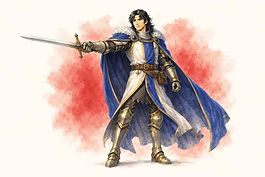
Sir Lancelot du Lac stands as the greatest knight of the Round Table, the central figure of the Vulgate Cycle, and the tragic protagonist of Arthurian chivalry. His story begins not in Britain but in France, first appearing in Chrétien de Troyes' Lancelot, or the Knight of the Cart (c. 1177-1181) as the perfect courtly lover whose devotion to Queen Guinevere drives him to extraordinary deeds. According to the Vulgate Cycle, Lancelot was born the son of King Ban of Benwick and Queen Elaine, orphaned when their kingdom was conquered by King Claudas. The enchantress known as the Lady of the Lake-the same mystical figure associated with Excalibur-rescued the infant Lancelot, raised him in her magical realm beneath the waters, and gave him his surname "du Lac" (of the Lake). There he received training in chivalry, magic, and warfare that would make him the supreme knight of Arthur's court.
Lancelot's arrival at Camelot marked a transformation in Arthurian legend. Where earlier tales celebrated King Arthur himself as the paramount warrior, the French romances elevated Lancelot to a position of almost superhuman prowess. He was never defeated in fair combat, rescued Guinevere from abduction by Meleagant, and inspired generations of knights through his example of martial perfection and romantic devotion. Yet this same devotion contained the seeds of destruction. His secret affair with Guinevere-an open secret at Camelot for years-violated the sacred bond between king and queen, undermining the very chivalric order Lancelot represented. The Vulgate Cycle makes explicit what Chrétien implied: Lancelot's earthly love for Guinevere barred him from achieving the Holy Grail, a role reserved for his pure son Galahad.