Arthurian Mythology List


Welcome to the Mythopouch list of Arthurian mythology entries! We also delve into the early history of Britain, Wales, and the Celtic and medieval traditions that shaped the Arthurian world. From kings, queens, knights and mages to castles, quests, monsters, artefacts, weapons, enchanted objects, creatures and more, this collection will continue to grow over time. Mythopouch provides real-world background and mythological information drawn from early chronicles, Welsh tales and medieval romances such as: the Welsh Triads, Culhwch and Olwen, the Historia Brittonum, the Annales Cambriae, Geoffrey of Monmouth, Chrétien de Troyes, the Lancelot-Grail or Vulgate Cycle, Sir Gawain and the Green Knight, and Thomas Malory’s Le Morte d’Arthur. Arthurian legend carries powerful ideas about courage, honour, loyalty, temptation, sacrifice, prophecy, betrayal and the dream of a better kingdom - messages passed from storyteller to storyteller for centuries, many of which still speak to modern life. Our unique imagery is meant to capture the imagination and ignite the Arthurian spark within us all. Our “token mark” coin symbol assigned to each record is a visual representation of the entity, for use in Mythopouch learning modules and games.
"Nothing is given, everything is earned" at Mythopouch!
Learn - Earn - Play
Arthurian Entity Card Index
See more entries

Green Knight's Axe
The Green Knight's Axe is the weapon at the centre of the beheading game in Sir Gawain and the Green Knight (c. 1375). Far more than a simple weapon, it serves as the instrument of judgment and the physical token of the covenant between the Green Knight and Sir Gawain. The anonymous Pearl Poet devotes extraordinary descriptive attention to this weapon - one of the most detailed weapon descriptions in all of Middle English poetry - suggesting that the axe is not merely a tool of violence but an object of symbolic and aesthetic significance.
The axe functions as the physical manifestation of the beheading game's rules. When the Green Knight offers it to Gawain, he is not merely lending a tool but transferring the power of judgment itself. Whoever accepts the axe accepts the contract, binding both parties to its terms. In the final act, when the Green Knight retrieves the weapon to deliver his return blow, the axe becomes an instrument of measured justice rather than execution.

Guinevere
Queen Guinevere stands as the most complex and consequential female figure in Arthurian legend-beloved queen of Camelot, wife to King Arthur, and lover of Sir Lancelot, whose illicit affair precipitated the fall of the Round Table. Her origins reach back to Welsh tradition, where the name Gwenhwyfar appears in the Mabinogion and early triads, meaning "white shadow" or "white fairy." In these earliest sources, she is already associated with betrayal and conflict, suggesting her tragic role predates the fully developed Arthurian cycle. By the time Geoffrey of Monmouth and Chrétien de Troyes shaped the legend, Guinevere had become the linchpin of Camelot's destiny-both its shining queen and the catalyst for its destruction.
Guinevere's literary prominence reached its fullest expression in Chrétien de Troyes' Lancelot, or the Knight of the Cart (c. 1177-1181), where her abduction by the knight Meleagant ignited Lancelot's obsessive devotion and established their passionate, adulterous romance as a defining narrative of courtly love. In this work, Lancelot endures profound humiliation-including riding in a cart reserved for criminals-to rescue her, a gesture that symbolized the ennobling power of love even as it strained his chivalric honor. The Vulgate Cycle and Malory's Le Morte d'Arthur expanded this affair into an open secret at Camelot, one that festered beneath the surface of Arthur's perfect kingdom until it erupted into civil war, Mordred's betrayal, and the Battle of Camlann.

Gyfre
Gyfre is the invisible servant given to Sir Launfal by Tryamour, the fairy queen of Olyroun, as one of three magical gifts that transformed a poor knight into the most celebrated champion in Britain. He is the unseen squire who restored Launfal's helmet in the midst of combat when the giant Sir Valentyne struck it from his head, leaping onto Blaunchard's back to set it fair and well-fitted before the knights met again. He is the shadow who caught Launfal's shield before it touched the ground, returning it to his master's arm in the same breath. He is the retainer who calculated Launfal's debts and paid them in full, who rode behind the pack horses bearing gifts through the streets of Caerleon, and who served as the only witness to Tryamour's nightly visits besides Launfal himself. He is the servant who vanished the instant Launfal broke his vow of secrecy, melting away like snow before the sun, and who reappeared from the forest at the hour of vindication to bring Blaunchard to his master one final time. And he is the only named invisible servant in the Breton lay tradition, a creature whose presence meant that the fairy queen's favour was absolute and whose absence meant that it was withdrawn.

Igraine
Igraine is the mother of King Arthur and the still centre of the storm that made him, the Duchess of Cornwall whose beauty drew the eye of Uther Pendragon and set a war, a death and an enchantment in motion. She is the wife of Gorlois, the proud duke who locked her in the sea-girt fortress of Tintagel to keep her from the king, and the widow of one night who woke to find her husband dead and herself already bound to the crown. She is the woman deceived by Merlin's craft, who received a king in her husband's likeness and conceived the greatest king in legend without knowing it, and who learned the truth from Uther's own lips and made great joy of it. She is the mother who gave up her son to Merlin's keeping, who lost him for years, and who was brought at last to her son's court to stand witness to his birth and be known. And she is the mother of the other line as well, of Morgause and Elaine and Morgan le Fay, the daughters through whom both Gawain and the shadow of Mordred entered the house of Arthur.

Inglewood Forest
Inglewood Forest is the wild hunting ground of King Arthur's northern court, the real Cumbrian forest that medieval romancers turned into the stage for ghosts, giants, and enchanted brides. It is the place where Arthur rode out to hunt beside the still water of Tarn Wadling, only for Queen Guinevere and Sir Gawain to watch a hideous ghost rise from the tarn, a corpse that had once been a beautiful queen and now came to warn the living about pride. It is the forest where Arthur, separated from his knights while chasing a hart, was ambushed by a monstrous knight and given one year to answer an impossible riddle: what do women most desire? It is the wood where the loathly lady Dame Ragnelle waited with the answer that would save the king's life and win her a wedding at Camelot. And it is the only Arthurian landscape you can still walk today, a surviving royal forest in north-west England where the tarn, the castle mounds, and the old oak bounds of the romances still mark the map.

Isolde
Isolde is the great lover of the medieval world, the Irish princess who drank the love potion meant for her wedding night and gave her heart, with one fatal cup, to the wrong man. She is the daughter of the King of Ireland and of a queen skilled in all healing and enchantment, the maiden who nursed a wounded stranger called Tantris back to life and found a notch in his sword that matched the splinter in her uncle's skull. She is the bride sailed across the sea to marry King Mark of Cornwall, and the queen who loved her husband's nephew with a love that no honour, no exile and no marriage vow could kill. She is the mistress of the forest of Morrois, of the tryst beneath the tree, of the sword laid between the sleepers, and of the midnight substitution that saved her wedding. And she is the lady of the last sail, who crossed the sea to heal her dying lover and arrived to find him dead of a lie told by her own name, dying herself upon his body, so that from their two graves grew the rose and the honeysuckle that no wind could part.

Joyous Gard
Joyous Gard is the castle of Sir Lancelot, the greatest knight of the Round Table, and the only stronghold in Arthurian legend that was renamed from grief to gladness by the man who conquered it. It is the fortress once called Dolorous Gard, the Castle of Sorrow, a place of enchantment and terror until the young Lancelot took it single-handed and discovered his own true name written on a tomb within its walls. It is the refuge where Lancelot carried Queen Guinevere after rescuing her from the fire, the act that shattered the Round Table and brought King Arthur's army to its gates. It is the shelter Lancelot lent to the lovers Tristan and Isolde while they fled the wrath of King Mark. It is the castle where Lancelot's body was brought for burial after he died of grief, mourned by the last knights of the broken fellowship. And it is the one Arthurian castle pinned to a real map, for the English romancer Malory wrote that men said it stood at Alnwick or at Bamburgh, on the wild coast of Northumberland.

Kay
Kay is the foster-brother of King Arthur and the sharp-tongued seneschal of Camelot, the man who held the keys to the king's household and who turned a kitchen into a testing ground for the noblest knight of the Round Table. He is the son of Sir Ector, the nobleman who raised Arthur in secret after Merlin, the wizard who placed the sword in the stone by which Arthur proved his right to the throne, spirited the infant away from the court of Uther Pendragon, Arthur's father. He is the boy who grew up beside Arthur, sharing lessons in swordcraft and horsemanship, never knowing that his foster-brother was the heir to all Britain. He is the knight who tried to claim credit for drawing the sword from the stone, the weapon embedded in an anvil outside St Paul's cathedral in London by Merlin for Uther Pendragon, and who was forgiven when the truth came out. He is the seneschal who managed the kitchens, the feasts, and the provisions of Camelot, and who nicknamed Gareth of Orkney Beaumains, meaning Fair Hands, in mockery of his uncalloused palms before that same kitchen knave proved himself the equal of any knight in Christendom. And he is the warrior who killed two kings with his own hand at the Humber River, the foster-brother whose loyalty outlasted his pride, and whose sharp tongue was the whetstone against which the virtue of the Round Table was sharpened.

King Arthur
King Arthur is the central figure of the Matter of Britain, a legendary monarch who, according to medieval chronicles and romances, united the British people against Saxon invaders and established a golden age of chivalry. The earliest references to Arthur appear in Welsh poetry, notably the Y Gododdin (c. 600 CE) and the Historia Brittonum (c. 829 CE) by Nennius, where he is described as a military leader rather than a king. Geoffrey of Monmouth's Historia Regum Britanniae (c. 1136) provides the first comprehensive biography, establishing many of the elements that would define Arthur's legend for centuries.
Arthur's significance extends beyond the historical question of whether a real person lies behind the legend. He embodies the ideal of rightful kingship, the dream of national unity, and the moral aspirations of the chivalric code. The stories of his birth, his sword Excalibur, the Knights of the Round Table, and his final battle at Camlann form one of the most enduring narrative cycles in Western literature.

King Lot
King Lot is the proud northern king whose marriage and whose death shaped the destiny of Camelot more deeply than almost any man who never sat at its table. He is the husband of Morgause, the half-sister of King Arthur, and through her the brother-in-law of the king himself. He is the father of four of the greatest knights of the Round Table: Sir Gawain, the courteous champion whose strength rose with the sun; Sir Agravain, the jealous accuser; Sir Gaheris, the loyal brother; and Sir Gareth, the kitchen knight beloved of all. He is the leader of the eleven rebel kings who refused to kneel to the boy Arthur and fought him across Britain in a war that lasted years. He is the king slain by Sir Pellinore in the press of battle, a death that lit a blood feud between two great houses and burned until it devoured the Round Table itself. And in the oldest tellings he is the father of Mordred, the traitor who would one day kill Arthur, making Lot the grandsire of Camelot's ruin.

Lady Lynette the Damsel
Lady Lynette the Damsel is the sharp-tongued heroine who rode from a besieged castle to Arthur's court and found herself a kitchen knave for a champion, the sister whose scorn turned to wonder and whose sorcery guarded her sister's honour more fiercely than any sword. She is the Damosel Savage, the haughty damsel who called Sir Gareth of Orkney a scullion and a kitchen page even as he defeated the Black Knight, the Green Knight, and the Red Knight of the Red Lands, the tyrant who had hanged every other champion who came against him. She is the surgeon who staunched the blood of the men her own enchanted knights had wounded, the sorceress who sent phantom attackers to prevent her sister from lying with Gareth before their wedding, and the woman who healed those same wounds with ointments that only she could make. She is the rider of the ambling mule who carried news between warring brothers and brought King Arthur to the mountain where Gareth and Gawain had fought each other to a standstill. And she is the bride of Gaheris, Gareth's brother, the woman who married into the house of Orkney and vanished from the chronicles as suddenly as she had arrived, leaving behind the most vivid portrait of a damsel in Arthurian romance: proud, practical, magical, and utterly unforgettable.
Lady Tryamour
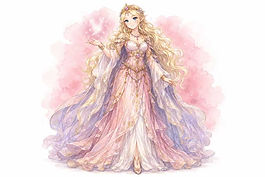
Lady Tryamour is the fairy princess whose beauty outshone Queen Guinevere so that a single breath from her lips struck the queen blind, a punishment delivered in the full sight of King Arthur and every knight of the Round Table. She is the daughter of the King of Olyroun, the sovereign of all the fairies of the Occident, the western realm beyond the mortal world, a kingdom of eternal summer where the wounded are healed and the old grow young. She is the mistress who rescued Sir Launfal, the impoverished steward of Arthur's court, from despair, offering him a magical purse that never emptied, a white horse named Blaunchard swifter than any mortal steed, an invisible dwarf servant named Gyfre, and armour that no weapon could pierce. She is the lover who demanded absolute secrecy as her price, warning that a single spoken word about her existence would shatter every enchantment forever. And she is the lady who rides out of the sky on a white palfrey to save her knight from the gallows, proving that in the fairy realm, love is a contract written in silence and sealed with power that no mortal court can match.