Arthurian Mythology List


Welcome to the Mythopouch list of Arthurian Legend mythology entries! We also delve into the early history of Britain, Wales, and the Celtic and medieval traditions that shaped the Arthurian world. From kings, queens, knights and mages to castles, quests, monsters, artefacts, weapons, enchanted objects, creatures and more, this collection will continue to grow over time. Mythopouch provides real-world background and mythological information drawn from early chronicles, Welsh tales and medieval romances such as: the Welsh Triads, Culhwch and Olwen, the Historia Brittonum, the Annales Cambriae, Geoffrey of Monmouth, Chrétien de Troyes, the Lancelot-Grail or Vulgate Cycle, Sir Gawain and the Green Knight, and Thomas Malory’s Le Morte d’Arthur. Arthurian legend carries powerful ideas about courage, honour, loyalty, temptation, sacrifice, prophecy, betrayal and the dream of a better kingdom - messages passed from storyteller to storyteller for centuries, many of which still speak to modern life. Our unique imagery is meant to capture the imagination and ignite the Arthurian spark within us all. Our “token mark” coin symbol assigned to each record is a visual representation of the entity, for use in Mythopouch learning modules and games.
"Nothing is given, everything is earned" at Mythopouch!
Learn - Earn - Play
Arthurian Entity Quick Index
Our current list of ancient British mythology (Arthurian Legend) and ancient history entities are here - which are growing day by day!
Search by using the:
-
"Search Mythology Records" function to browse all mythology records and blog pages;
-
Browse the visual cards with overviews by clicking "Go to Visual A-Z";
-
Or just browse and click the A-Z entries below....
See more list entries
Read Arthurian Legend Insights
Click below to view our Arthurian Legend (ancient British) mythology blog article insights, where we delve into the current Mythopouch Tier regions and what we think you should know!


Arthurian Entity Card Index
See more card entries

Hueil
Hueil mab Caw is the independent northern warrior whose feud with King Arthur survives in Welsh narrative, a saint's life and a later story attached to Ruthin. He is a son of Caw, known in Mythopouch as Caw of Pictland, and the brother of Gildas in the traditions that connect their family with Arthur. Culhwch and Olwen names him among the king's wider company but also remembers an injury that causes enmity between them. The Life of Gildas attributed to Caradoc of Llancarfan gives that conflict a larger scale: Hueil raids from the north, Arthur pursues him, and his death tests Gildas's willingness to forgive. A different account, recorded centuries later by Elis Gruffudd, makes a wounded knee and a broken promise the causes of his execution at Ruthin. These are alternative stories, not successive episodes ending in two deaths. Together they preserve a challenger whose reputation resists the usual image of an Arthurian world united beneath one king.

Hygwydd
Hygwydd is the cauldron-bearing servant whose practical strength gives him a distinctive place in Culhwch and Olwen. He shares a mother with Cacamwri, another of King Arthur's servants, and his regular work is to carry the king's cauldron and tend the fire beneath it. That household duty becomes part of a dangerous expedition when Arthur's company takes Diwrnach's cauldron from Ireland. Bedwyr puts the vessel on Hygwydd's back, turning a servant's familiar burden into one of the treasures required for Culhwch's wedding. Later, Hygwydd and Cacamwri enter the cave of the Very Black Witch and are badly beaten. Other servants fare no better, and Arthur must finish the encounter himself. Hygwydd receives neither a royal genealogy nor a long sequence of personal victories. His brief appearances instead show the labour, vulnerability and physical endurance of the people who accompany famous champions. The tale remembers not only the warrior who wins a prize, but also the man who has to carry it.

Hywel the Great
Hywel the Great, called Hywel Dda, Hywel the Good, is the lawgiver of Wales and the nearest thing the Welsh ever had to a king of all their country. He is the grandson of Rhodri the Great, who inherited Seisyllwg, gained Dyfed by marriage, and in 942 took Gwynedd and Powys, gathering almost the whole of Wales under one hand for eight years of famous peace. He is the king who summoned the wisest men of every commote to the White House on the River Taf and set them for forty days to the greatest work of Welsh law: to keep what was good, to amend what was doubtful, and to cast out what was bad, and to write it all down. He is the pilgrim who carried his book to Rome for the blessing of the Pope, the ruler who kept the friendship of the kings of England without surrendering his people's law, and the only Welsh king known to have struck a coin in his own name. And he is the good king by acclamation, whose law lived on for six hundred years after him, until a Parliament in London ended it, and whose name is still the Welsh shorthand for justice done well.

Igraine
Igraine is the mother of King Arthur and the still centre of the storm that made him, the Duchess of Cornwall whose beauty drew the eye of Uther Pendragon and set a war, a death and an enchantment in motion. She is the wife of Gorlois, the proud duke who locked her in the sea-girt fortress of Tintagel to keep her from the king, and the widow of one night who woke to find her husband dead and herself already bound to the crown. She is the woman deceived by Merlin's craft, who received a king in her husband's likeness and conceived the greatest king in legend without knowing it, and who learned the truth from Uther's own lips and made great joy of it. She is the mother who gave up her son to Merlin's keeping, who lost him for years, and who was brought at last to her son's court to stand witness to his birth and be known. And she is the mother of the other line as well, of Morgause and Elaine and Morgan le Fay, the daughters through whom both Gawain and the shadow of Mordred entered the house of Arthur.

Inglewood Forest
Inglewood Forest is the wild hunting ground of King Arthur's northern court, the real Cumbrian forest that medieval romancers turned into the stage for ghosts, giants, and enchanted brides. It is the place where Arthur rode out to hunt beside the still water of Tarn Wadling, only for Queen Guinevere and Sir Gawain to watch a hideous ghost rise from the tarn, a corpse that had once been a beautiful queen and now came to warn the living about pride. It is the forest where Arthur, separated from his knights while chasing a hart, was ambushed by a monstrous knight and given one year to answer an impossible riddle: what do women most desire? It is the wood where the loathly lady Dame Ragnelle waited with the answer that would save the king's life and win her a wedding at Camelot. And it is the only Arthurian landscape you can still walk today, a surviving royal forest in north-west England where the tarn, the castle mounds, and the old oak bounds of the romances still mark the map.
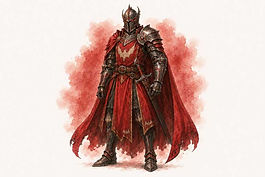
Ironside
Sir Ironside is the Red Knight of the Red Launds and the final opponent faced by Sir Gareth during his journey to rescue Dame Lionesse. He must not be confused with Sir Perimones, the red-armoured brother whom Gareth defeats earlier. Ironside is not one of the four brothers.
Ironside has besieged Castle Dangerous for nearly two years and has hanged almost forty defeated knights from the surrounding trees. His armour, shield, spear and horse are all blood-red, and his strength increases throughout the morning until he possesses the strength of seven men at noon.
Gareth fights Ironside through the height of his strength and continues until evening. After a brutal battle, Ironside yields. Gareth initially refuses to spare him because of the knights he has executed, but finally grants mercy under strict conditions: Ironside must submit to Lionesse, repair the damage caused by the siege, present himself to King Arthur and ask forgiveness from Sir Lancelot and Sir Gawain.
Ironside fulfils these conditions, abandons his murderous customs and enters Arthur’s service. He later becomes associated with the Round Table, serves as carver at Gareth’s wedding and fights alongside Arthur’s knights.

Isle of Lewis
The Isle of Lewis is the northern sentinel of the Outer Hebrides, the windswept island where the Callanish Stones have stood for five thousand years, older than Stonehenge, and where local people still call them the Fir Bhrèige, the False Men, believing they were giants turned to stone for refusing Christianity. It is the land where the Shining One walks down the stone avenue at midsummer sunrise, heralded by the cuckoo's call, a vision that has drawn pilgrims and poets for centuries. It is the shore where selkies shed their sealskins to become human, where fishermen hide the skins of seal-wives and where the children of such unions are born with webbed fingers and a longing for the sea. It is the island that gave the world the Lewis Chessmen, the walrus-ivory gaming pieces carved by Norse craftsmen in the 12th century, found buried in the sands of Uig, their faces frozen in snarls and wonder. And it is the place where Gaelic and Norse cultures collided and merged, where the blackhouses of the crofters stand against the Atlantic gales, and where the boundary between the mortal world and the Otherworld has always been thin enough to walk through on a misty morning.

Isolde
Isolde is the great lover of the medieval world, the Irish princess who drank the love potion meant for her wedding night and gave her heart, with one fatal cup, to the wrong man. She is the daughter of the King of Ireland and of a queen skilled in all healing and enchantment, the maiden who nursed a wounded stranger called Tantris back to life and found a notch in his sword that matched the splinter in her uncle's skull. She is the bride sailed across the sea to marry King Mark of Cornwall, and the queen who loved her husband's nephew with a love that no honour, no exile and no marriage vow could kill. She is the mistress of the forest of Morrois, of the tryst beneath the tree, of the sword laid between the sleepers, and of the midnight substitution that saved her wedding. And she is the lady of the last sail, who crossed the sea to heal her dying lover and arrived to find him dead of a lie told by her own name, dying herself upon his body, so that from their two graves grew the rose and the honeysuckle that no wind could part.

Isolde of the White Hands
Isolde of the White Hands is the Breton woman whom Tristan marries while still loving Isolde of Ireland. The two women share a name but are not the same character: the Irish Isolde is King Mark's wife, whereas the White Hands belongs to the family of Hoel and is the sister of Kahedin. Her marriage offers Tristan a household in Brittany without ending the attachment that drew him away from Cornwall. In the poetic tradition represented by Thomas of Britain, the unhappy union eventually becomes part of the lovers' fatal return voyage. When a ship brings the Irish Isolde to heal the wounded Tristan, his wife falsely reports that its sail is black rather than white. Other versions give her a different part, and Malory does not reproduce that ending. Her story therefore concerns more than a single act of jealousy. It follows a wife placed inside a divided marriage, with the causes, consequences and ending changing as the legend is retold.

Joseph of Arimathea
Joseph of Arimathea is the wealthy man from Judea who buried Jesus Christ in his own tomb and who, in Arthurian legend, became the first keeper of the Holy Grail, the cup from the Last Supper that caught the blood of the crucified Saviour. He is the prisoner who was sustained for forty years by the Grail in a dark dungeon, the patriarch who established the sacred lineage that would one day lead to Sir Galahad, the only knight pure enough to achieve the vessel. He is the founder of the first Christian church in Britain at Glastonbury, the man who planted his pilgrim staff on Wearyall Hill and watched it blossom into the Holy Thorn that flowers every Christmas. He is the creator of the Grail Table, the model upon which Merlin later based the Round Table of King Arthur, and the ancestor of the Fisher Kings who guarded the Grail Castle for generations. And he is the bridge between the biblical world and the Arthurian world, the figure who carried the most sacred relic in Christendom from Jerusalem to the western isles, making Britain the destined stage for the greatest quest in medieval literature.

Joyous Gard
Joyous Gard is the castle of Sir Lancelot, the greatest knight of the Round Table, and the only stronghold in Arthurian legend that was renamed from grief to gladness by the man who conquered it. It is the fortress once called Dolorous Gard, the Castle of Sorrow, a place of enchantment and terror until the young Lancelot took it single-handed and discovered his own true name written on a tomb within its walls. It is the refuge where Lancelot carried Queen Guinevere after rescuing her from the fire, the act that shattered the Round Table and brought King Arthur's army to its gates. It is the shelter Lancelot lent to the lovers Tristan and Isolde while they fled the wrath of King Mark. It is the castle where Lancelot's body was brought for burial after he died of grief, mourned by the last knights of the broken fellowship. And it is the one Arthurian castle pinned to a real map, for the English romancer Malory wrote that men said it stood at Alnwick or at Bamburgh, on the wild coast of Northumberland.

Kahedin
Kahedin, also written Kaherdin, is the Breton companion of Tristan and brother of Isolde of the White Hands. Their family's connection with Tristan makes him both a friend and a brother-in-law, a man whose loyalties pass through a marriage that never ends Tristan's love for the Irish Isolde. In the poetic tradition represented by Thomas of Britain, Kahedin carries the ring and message that summon the queen to the wounded knight. His return under a white sail should bring hope, but his sister's false report makes that arrival too late. Other romances give him a different desire or a different death. Malory calls the Breton companion Kehydius and makes him fall in love with the Irish queen himself. Arthurian texts also preserve similarly named knights in other family and military settings. Those references broaden the history of the name, but they should not be forced into one continuous life with a single genealogy and an ending shared by every version.