Details
Region
Greek
Regional Information Additional (if applicable)

Phoenician / Egyptian / Theban / Cretan traditions
Category
Person
Historicity (actuality or factual truth of persons, events, and claims)
Legendary
Gender
Male
Time Period
Legendary age before the Trojan War
Symbol
Royal Sceptre
Tags
greek, agenor, phoenician-king, cadmus, europa, telephassa, poseidon, thebes, cilicia
Introduction - Overview
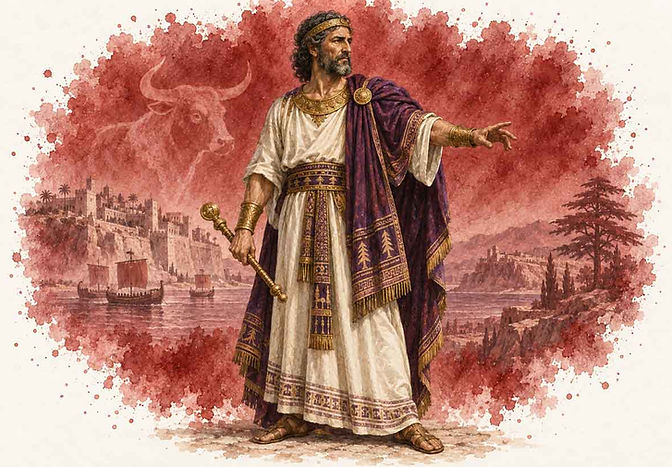
Agenor is the legendary Phoenician king whose search for his lost daughter scattered his children across the world of Greek myth. In Apollodorus's genealogy he is the son of Poseidon and Libya, and the brother of Belus, who remained in Egypt while Agenor went to Phoenicia. He is the husband of Telephassa, the mother who joined the search for Europa, and the father of Cadmus, Cilix and Phoenix in one influential version of the family. He is the king who told his sons not to return until their sister had been found, a command that turned a family disaster into stories of migration and settlement. Through Europa, carried to Crete by Zeus in the form of a bull, his line reaches the Cretan royal house; through Cadmus it reaches Thebes. Other traditions arrange the family differently, sometimes making Europa the daughter of Phoenix. Agenor therefore stands not as a documented founder of civilisations, but as a patriarch whose changing genealogy helped Greek storytellers connect Egypt, Phoenicia, Crete and the Greek mainland.
Gallery
Main Article - Who or What was...
Agenor
Agenor's ancestry connects the Nile with the coast of Phoenicia. In Apollodorus's account, his father was Poseidon, the god of the sea, and his mother was Libya, daughter of Epaphus. Through Epaphus the family traced its descent to Io, the Argive woman whose wanderings brought her to Egypt. Agenor's brother Belus remained in Egypt and became the father of Aegyptus and Danaus, whose children would be drawn into the tragedy of the Danaid marriages. Agenor went to Phoenicia and established himself there. Traditions associate his kingship with Tyre or Sidon, but his story belongs to legendary genealogy rather than a securely documented royal chronology.
He married Telephassa, and together they raised the family at the centre of the search for Europa. Apollodorus names their daughter Europa and their sons Cadmus, Cilix and Phoenix. Cadmus would eventually found Thebes; Cilix was connected with the name Cilicia; Phoenix with Phoenicia. The genealogy was never entirely fixed. Some sources make Europa the daughter of Phoenix rather than Agenor, so that Agenor becomes her grandfather in that version. Thasus also joins the search in Apollodorus, but is there called a son of Poseidon or, in another account, of Cilix. These alternatives should not be combined into a single family tree in which every relationship is equally certain.
The defining moment of Agenor's story was the disappearance of Europa. Zeus desired her and approached in the form of a tame bull. When she mounted the animal, it carried her across the sea to Crete. There she bore Minos, Sarpedon and Rhadamanthys in the genealogy followed by Apollodorus, although the parentage and generation of Sarpedon vary between traditions. Europa later married Asterius, who brought up the children. Through Minos, the story leads towards the Cretan kingship, the Labyrinth and the Minotaur. For Agenor, however, the event began not as the foundation of a dynasty but as the unexplained loss of a daughter.
Agenor sent his sons to find Europa and forbade them to return without her. Telephassa went with the searchers. They failed to recover the missing princess, and Apollodorus describes them abandoning their return and settling in different places. Phoenix settled in Phoenicia; Cilix established himself near the river Pyramus, giving his name to Cilicia; Thasus founded a settlement on the island of Thasos. Cadmus and Telephassa reached Thrace. After his mother's death, Cadmus went to Delphi, where Apollo's oracle told him to stop searching for Europa and follow a cow. Where it lay down, he was to build a city. That journey led him to Boeotia and the foundation story of Thebes, including the dragon of Ares and the Spartoi who sprang from its sown teeth.
A much later version appears in the Chronography of John Malalas. There Agenor has a differently arranged household, and near the end of his life he orders the division of his lands among Phoenix, Syros and Cilix. Their territories receive the names Phoenicia, Syria and Cilicia. This is a separate explanatory tradition, not a missing final chapter that can simply be attached to Apollodorus's account of the unsuccessful search. Its interest lies in the same pattern: places and peoples are linked to members of a legendary royal family.
Agenor's importance survives through those family connections. Cadmus's descendants include Semele, mother of Dionysus, and the troubled royal house of Thebes; Europa's descendants connect the family with Crete. The stories do not show that Agenor's children literally created the civilisations of the Mediterranean. They show how Greek myth used kinship, journeys and lost relatives to connect communities across the sea. Agenor's command never brings Europa home, but the search gives his family a place in the remembered origins of many lands.
Summary
Agenor endures as the Phoenician patriarch whose search for Europa became a story of dispersal and new beginnings. From his kinship with Belus in Egypt to Cadmus at Thebes and Europa in Crete, his family joins several great cycles of Greek legend. The different genealogies and later accounts of divided kingdoms reveal how adaptable that story could be. Agenor reminds us that myths can explain connections between peoples through the experiences of a single household: a missing daughter, a father's command and children whose journeys carry them beyond the home they left.
Now enter the Mythopouch World!
You’ve discovered:
Agenor
From Myth to Game
Join to access FREE real-world mythology "Learn Quests" and "Courses". Sign up to the newsletter for new releases, game updates, insider news, and more as Mythopouch brings real mythology to life. EARN the right to purchase an offline board game by completing FREE modules.


It's FREE to join as a MEMBER!
Not ready to join? Get the newsletter instead below


Looking for others?
Click into the field below to search, or click the icon to go to full page search function!

Looking for Mythology Insights?


Click below to view our mythology blog article insights, where we delve into the current Mythopouch Tier regions, and what we think you should know!
Sources & Retellings
Explore the original mythological Source texts (most from over 75 years ago, some as translated, possibly with mature content) and Mythopouch's source Retellings (a modern retelling also suitable for 15+) connected to this mythological entity. We are growing this resource and will link these in the future; for now, check the References below, then find the Sources or Retellings on those pages!


References
Validation References:
- Apollodorus, Library 3.1.1-2 and 3.4.1: family variants, search for Europa and Cadmus
- https://www.theoi.com/Text/Apollodorus3.html
- Apollodorus, Library 2.1.4: Poseidon, Libya, Belus and Agenor
- https://www.theoi.com/Text/Apollodorus2.html
- John Malalas, Chronography 2.30-31: a separate later account of the family and divided kingdom
- https://topostext.org/work/793
Cultural Context Notice
Mythology developed across different cultures, periods and traditions, and there is rarely one universally accepted version of a story. Mythopouch approaches these traditions with respect while remaining faithful to the complexity of the surviving material. Retellings and educational content may interpret or adapt historical sources, but are not presented as definitive accounts of any culture, religion or belief system.