
Details
Region
Greek
Regional Information Additional (if applicable)
Category
Deity
Historicity (actuality or factual truth of persons, events, and claims)
Mythological
Gender
Male
Time Period
8th century BCE (first attested in Homer and Hesiod)
Symbol
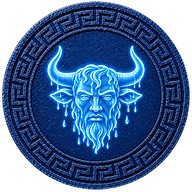
Wet Man-faced Bull
Tags
greek, river-god, potamoi, heracles, deianira, cornucopia, sirens, theseus, aetolia
Introduction - Overview
Achelous is the prince of all rivers, the mighty god of the largest waterway in Greece, whose name was once synonymous with fresh water itself and whose voice was said to roar like a bull across the mountains of Aetolia. He is the shape-shifting suitor who fought Heracles, the hero forced to complete twelve impossible labors, for the hand of Deianira, princess of Calydon, transforming from man to serpent to bull and losing his horn in the struggle. He is the father of the Sirens, the bird-bodied women whose bewitching song lured sailors to destruction on rocky shores. He is the generous host who welcomed the hero Theseus, prince of Athens and slayer of the Minotaur, the bull-headed monster of Crete, into his watery palace during a flood and told him how the Echinades islands were born from nymphs who forgot to honour him. And he is the broken-horned god whose defeat gave the world the Cornucopia, the Horn of Plenty that overflows with fruit and flowers, the image that passed from his Naiads onto later coins, civic emblems and every later picture of abundance.
Gallery
Main Article - Who or What was...
Achelous
Achelous was born to Oceanus, the Titan whose vast waters encircle the world, and Tethys, the Titaness who bore three thousand river gods and three thousand Oceanid nymphs. Some say his mother was Gaia, the primordial Earth herself. From his birth in the swirling depths, Achelous was destined for greatness. He was named "silver-swirling Achelous" among the mightiest of the river gods, and called the prince of all rivers. Only Zeus, the king of the gods, surpassed him in strength, though among all rivers Achelous stood without peer. The river that bore his name rose in the Pindus mountain range and flowed for more than two hundred kilometres through the heart of Aetolia and Acarnania, forming the disputed boundary between those lands before emptying into the Ionian Sea. Its roaring waters sounded like the voice of a bull, and its winding course through gorges and channels suggested the coils of a serpent. The Greeks saw the god in the river, and the river in the god.
The most famous tale of Achelous is his contest with Heracles for the hand of Deianira, the beautiful princess of Calydon and daughter of King Oeneus. Achelous had courted her long, pressing his suit with the authority of a god who ruled the very waters that nourished her father's kingdom. But Heracles, the son of Zeus and the mortal woman Alcmene, arrived in Calydon and claimed Deianira for himself. Rather than let words decide the matter, Heracles challenged the river god to a wrestling match. They met before the court, and Achelous fought first in his human form, a powerful man with water dripping from his hair and beard, locking arms with the hero in the classical stance. Heracles threw him to the ground. Achelous then transformed into a serpent, sheeny and coiled, slipping from the hero's grip with the sinuous ease of his own river. Heracles laughed, for he had strangled serpents in his cradle as an infant. Finally Achelous became a furious bull, lowering his broad head and charging with horns that could tear the earth itself. Heracles seized those horns as handles, flipped the beast to the ground, and with a mighty jerk snapped off one of them. The river god retreated in pain and humiliation beneath his waters, and Heracles carried Deianira away as his bride.
In another tale, told in the pages of the Metamorphoses, Achelous showed a gentler face. The hero Theseus was travelling home from the great boar hunt at Calydon when a flood barred his way. Achelous rose from his swollen stream and invited the mortal into his watery abode, a palace of spongy pumice with a moss floor and a roof of oyster shells, where barefoot nymphs served wine in jewelled cups. As they dined, Theseus pointed to islands scattered across the water and asked their names. Achelous told him they were the Echinades, once nymphs who had forgotten to invite him to their festival. In his fury the river god had swelled to flood, tearing forest and field away and sweeping the nymphs into the sea, where his waters and the ocean split the land into islands. Then Achelous pointed to a distant isle called Perimele, and confessed that she had been a maiden he loved, thrown from a cliff by her father when he discovered their union. Achelous had caught her and begged Poseidon, god of the sea, to transform her into land, and the god granted his prayer. Even a defeated god, it seemed, could love and grieve.
Achelous was father to many children besides the waters he spawned. By Melpomene, one of the nine Muses who presided over the arts and goddess of tragedy, he fathered the Sirens, the bird-bodied women whose song was so beautiful that sailors steered toward their island and died on the rocks. By other nymphs and mortal women he fathered nymphs of his own, including Callirhoe, whom he gave in marriage to Alcmaeon, one of the Epigoni, the sons of the Seven Champions who had fallen against Thebes. The river god also purified Alcmaeon when the Erinyes, the avenging spirits of blood-guilt, pursued him for killing his treacherous mother. In every tale, Achelous stands at the centre of the boundary between the wild and the civilised, the divine and the mortal, offering both destruction and sanctuary.
The broken horn of Achelous became one of the most enduring symbols in Western culture. The Naiads, the freshwater nymphs who attended him, took the severed horn and filled it with fruits and flowers, consecrating it as the Cornucopia, the Horn of Plenty. Some say Achelous later traded the horn of Amalthea, the goat who nursed infant Zeus, to recover his own. Either way, the image of the overflowing horn passed into the hands of gods of abundance and eventually onto Roman coins, Renaissance paintings, and the state seals of modern America. Achelous himself was worshipped throughout Greece as the representative of fresh water itself. The oracle at Dodona, the oldest sanctuary of Zeus, regularly commanded supplicants to offer sacrifice to Achelous before any other god, and his name was invoked in oaths and prayers from Athens to Sicily. On coins of Acarnania he was shown as a bull with the face of an old man, crowned with a single horn. His image appeared on the throne of Apollo at Amyklai near Sparta and in a statue of cedar and gold at Olympia. The river still bears his name today, flowing through the rainiest part of Greece, a quiet stream where once a god roared.
Summary
Achelous remains the supreme personification of the river's double nature, the god who both nourishes and destroys, who floods fields and then retreats to leave fertile soil behind. From the wrestling ring of Calydon to the watery palace that sheltered Theseus, from the bird-bodied Sirens to the Horn of Plenty that still symbolises abundance, his story runs like a current through Greek myth. Every river that roars in flood, every fertile delta, every oath sworn by running water still carries something of the prince of rivers, the bull-horned god who learned that even immortals must sometimes yield.
Now enter the Mythopouch World!
You’ve discovered:
Achelous
From Myth to Game
Join to access FREE real-world mythology "Learn Quests" and "Courses". Sign up to the newsletter for new releases, game updates, insider news, and more as Mythopouch brings real mythology to life. EARN the right to purchase an offline board game by completing FREE modules.


It's FREE to join as a MEMBER!
Not ready to join? Get the newsletter instead below


Looking for others?
Click into the field below to search, or click the icon to go to full page search function!

Looking for Mythology Insights?


Click below to view our mythology blog article insights, where we delve into the current Mythopouch Tier regions, and what we think you should know!
Sources & Retellings
Explore the original mythological Source texts (most from over 75 years ago, some as translated, possibly with mature content) and Mythopouch's source Retellings (a modern retelling also suitable for 15+) connected to this mythological entity. We are growing this resource and will link these in the future; for now, check the References below, then find the Sources or Retellings on those pages!


References
Validation References:
- Homer, Iliad 21.192-197 (8th century BCE) - Achelous as prince of rivers
- Hesiod, Theogony 337-340 (c. 700 BCE) - genealogy as son of Oceanus and Tethys
- Sophocles, Women of Trachis 9-27 (c. 450-425 BCE) - Deianira's account of the wrestling match
- Ovid, Metamorphoses 8.547-610, 9.1-100 (c. 8 CE) - hospitality to Theseus and the wrestling contest
- Apollodorus, Bibliotheca 2.7.5 (1st-2nd century CE) - the contest and the horn of Amalthea
- Pausanias, Description of Greece 3.18.16, 6.19.12 (c. 150 CE) - representations at Amyklai and Olympia
- Diodorus Siculus, Library of History 4.35.3 (1st century BCE) - rationalised account of the river's diversion
- Isler, Hans Peter, "Acheloos: Eine Monographie" (1970) - comprehensive study of the river god's iconography and cult
- Gantz, Timothy, Early Greek Myth: A Guide to Literary and Artistic Sources (1993) - Volume 1, pp. 433-434
- Burkert, Walter, Greek Religion (1985) - Chapter 3, river gods and nature deities
Cultural Context Notice
Mythology developed across different cultures, periods and traditions, and there is rarely one universally accepted version of a story. Mythopouch approaches these traditions with respect while remaining faithful to the complexity of the surviving material. Retellings and educational content may interpret or adapt historical sources, but are not presented as definitive accounts of any culture, religion or belief system.