Greek Mythology List


Welcome to the Mythopouch list of Greek mythology entries! We also delve into the ancient history of Greece and the surrounding areas. From heroes to goddesses, places, monsters, artifacts, weapons, creatures and more - which will only grow over time. Mythopouch provides real-world information extracted from the original source material such as that from: Homer, Hesiod, Apollodorus, Ovid, Pausanias, Pindar, Aeschylus, Sophocles, Euripides, Hyginus, Diodorus Siculus and Apollonius of Rhodes. Words and stories carry powerful messages that were passed down from one generation to the next, many of which are still very applicable to modern times. Our unique imagery is meant to capture the imagination and ignite the magic mythology spark within us all. Our "token mark" coin symbol that is assigned to each record is a visual representation of the entity, for use in Mythopouch learning modules and games.
Learn - Earn - Play
Greek Entity Quick Index
Our current list of ancient Greek mythology and ancient history entities are here - which are growing day by day!
Search by using the:
-
"Search Mythology Records" function to browse all mythology records and blog pages;
-
Browse the visual cards with overviews by clicking "Go to Visual A-Z";
-
Or just browse and click the A-Z entries below....
See more list entries
Read Ancient Greek Insights
Click below to view our ancient Greek mythology blog article insights, where we delve into the current Mythopouch Tier regions and what we think you should know!


Greek Entity Card Index
See more card entries

Byrsa
Byrsa is the historical citadel hill of Carthage, overlooking the Gulf of Tunis and closely associated with the foundation legend of Dido, also called Elissa. It is the place whose Greek name became linked with an oxhide bargain: the refugee queen is said to have cut a hide into thin strips so that a seemingly small grant of land could enclose the beginning of a settlement. It is part of the landscape in which a Phoenician foundation developed into Punic Carthage and was later transformed under Roman rule. The story of the bargain explains the place through ingenuity, negotiation and the precarious position of newcomers, but it does not prove that the settlement was established exactly as the legend describes. Ancient writers also differ over Dido's husband, her journey and the circumstances of her death. Byrsa therefore joins two kinds of memory. Its archaeology belongs to the history of an actual city, while the queen and the oxhide belong to the Greek and Roman literary traditions through which that city's beginnings were retold.

Cacus
Cacus is the fire-breathing giant of the Aventine Hill in Roman mythology, the son of Vulcan whose cave became a place of terror before Rome was founded. He is the thief who stole cattle from Hercules, the hero known to the Greeks as Heracles, and dragged them backwards into his lair so their hoofprints seemed to lead away from it. He is the monster whose clever deception failed when a hidden animal answered the lowing of the departing herd. In Virgil's Aeneid, Hercules tears open the rocky roof of the cave, plunges into the smoke and flame, and kills Cacus with his bare hands. The victory becomes a story explaining the worship of Hercules at the Ara Maxima, the Greatest Altar. Told by King Evander to the Trojan visitor Aeneas, it connects a familiar Greek hero with the sacred landscape of the future city. Other Roman writers tell the encounter differently, but the stolen cattle and the defeat of their thief remain at its heart.

Cadmus
Cadmus is the Phoenician prince who founded Thebes, the most cursed city in Greek mythology, by sowing the teeth of a dragon he had slain and watching armed warriors spring from the earth to fight one another to the death. He is the son of King Agenor of Tyre and the brother of Europa, the beautiful maiden whom Zeus, the king of the gods, abducted in the form of a white bull and carried away to Crete. He is the exile who searched the known world for his lost sister and, when the oracle at Delphi told him to abandon the quest, followed a stray cow to a spring in Boeotia where a serpent sacred to Ares, the god of war, devoured his companions. He is the culture hero who killed the dragon, sowed its teeth at Athena's command, and founded a city upon the blood of the five survivors who rose from the ground. He is the husband of Harmonia, the daughter of Ares and Aphrodite, whose wedding was blessed by the gods and cursed by a necklace forged in divine jealousy. And he is the old man who, after watching his children and grandchildren die in madness and flame, was transformed into a serpent alongside his wife and sent to wander the earth before finding peace in the Elysian Fields, the meadow of the blessed dead.

Caduceus
The Caduceus is the golden herald's staff of Hermes, the wand that can charm waking eyes to sleep and sleeping souls to rise, the one object in Olympus that guarantees safe passage anywhere in creation. It is the kerykeion, the badge of the heralds of ancient Greece, whose bearers could walk unharmed between two armies drawn up for battle, because the staff in their hands made their persons holy. It is the peace-gift of Apollo, handed to his baby brother Hermes to seal the strangest reconciliation in mythology, the day the god of music forgave the one-day-old infant who had stolen his cattle. It is the wand of the psychopomp, the guide of souls, with which Hermes leads the newly dead down to the river Styx while they gibber behind him like bats in a cave. And it is the serpent staff of peace, for the story says that Hermes once threw his rod between two fighting snakes, and the pair wound themselves around it and were reconciled, and so they remain for ever: two ancient enemies, held face to face in balance, beneath the wings of the messenger god.
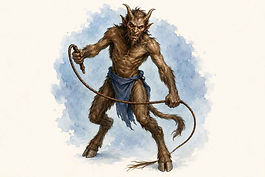
Calibos
FILM INVENTION (Clash of the Titans, 1981). No ancient Greek name exists; possibly loosely inspired by Phineus (Φινεύς).
Calibos is a fictional character created specifically for the 1981 film Clash of the Titans, produced by Ray Harryhausen and Charles H. Schneer. He does NOT appear in any ancient Greek mythological texts. The character was portrayed by British actor Neil McCarthy, with stop-motion animation effects provided by the legendary Ray Harryhausen. His inclusion here serves an important educational purpose: to distinguish between genuine figures from Greek mythology and characters invented for modern film adaptations.
In the film, Calibos is presented as the handsome young son of the sea goddess Thetis whose arrogance and cruelty earned him divine punishment. After he hunted and killed all but one of a herd of sacred winged horses (except Pegasus), Zeus transformed him into a hideous monstrosity - a creature with horns, cloven hooves, and a bestial appearance - and banished him from human society. This narrative bears some structural similarity to the myth of Actaeon (who was transformed into a stag by Artemis), but Calibos himself is a purely cinematic invention. The film Clash of the Titans is a loose adaptation of the Perseus myth, blending authentic mythological elements with original characters and plot points.

Calliope
Calliope is the chief of the nine Muses, the goddesses who inspire all the arts, and the Muse of epic poetry and eloquence, the voice that speaks through Homer and Virgil and every poet who has ever tried to tell a story on the grandest scale. She is the eldest daughter of Zeus, the king of the gods, and Mnemosyne, the Titan goddess of memory, born on the first of nine consecutive nights when her father lay with her mother. She is the mother of Orpheus, the musician whose songs could charm the beasts and move the stones, and of Linus, the first to teach the Greeks to sing to the harp. She is the goddess who defeated the daughters of Pierus in a singing contest and turned them into magpies for their presumption. And she is the Muse whom Dante invoked at the gates of Purgatory and whom Virgil called upon to sing of war, a goddess whose name has outlasted every empire that ever prayed to her.

Callirrhoe (Oceanid)
Callirrhoe is the Oceanid daughter of Oceanus and Tethys who becomes the mother of Geryon by Chrysaor. Hesiod lists her among the many daughters of Ocean and later names her union with Chrysaor, from which three-headed Geryon is born. Stesichorus gives this otherwise genealogical figure one of her most human moments by preserving fragments in which she begs Geryon not to fight Heracles and reminds him that she nursed him as a child. A Callirrhoe also appears among Persephone's Oceanid companions in the Homeric Hymn to Demeter. Because Greek mythology contains several women named Callirrhoe, later genealogies bearing the same name should not automatically be combined into one continuous biography.

Calyce
Calyce is the Aeolian princess remembered as the mother of Endymion, the beautiful mortal loved by Selene, goddess of the moon. She is the daughter of Aeolus, son of Hellen, and of Enarete, and belongs to a family whose children connect many of the royal houses of Greek myth. Her father is the ancestor of the Aeolians, not the wind-keeper who receives Odysseus in the Odyssey. Through her marriage to Aethlius, she links the Thessalian family with the legendary rulers of Elis in the western Peloponnese. Her son becomes both a king in the traditions of Elis and the everlasting sleeper of the moon's romance. Those stories do not always agree about his parentage, his dwelling place or his fate, but Calyce's place in the family is clearly preserved in Apollodorus. Although little survives about her own actions, her name connects the ancestry of kings with one of Greek mythology's enduring images: the moon's love for a mortal who does not grow old.

Calydon
Calydon is the Aetolian city whose name is inseparable from the hunt of the Calydonian Boar, the kingdom where a neglected offering to Artemis brings disaster upon the countryside. It is the home of King Oeneus, who receives the vine from Dionysus, and of Meleager, the prince who gathers renowned hunters to face the beast. It is the city where Atalanta's success becomes part of a bitter quarrel over honour, kinship and the spoils of victory. It is also the home of Deianira, whose marriage to Heracles carries another Calydonian story into the wider heroic tradition. In the Iliad, the boar's death leads to war between the Curetes and the Calydonians; other accounts connect the catastrophe with Althaea and the burning brand that holds her son's life. Calydon was a real settlement in western Greece, with archaeological remains and an important cult of Artemis Laphria. Its history and its heroic legends are connected by place, but they are not the same kind of evidence.

Calydonian Boar
The Calydonian Boar is the monstrous animal sent by Artemis to ravage the land of Calydon after King Oeneus neglects her at the harvest offerings. It is the beast that turns cultivated fields into a place of danger and brings renowned hunters together against a threat no ordinary household can contain. In Ovid's vivid telling, its bristling body, fearsome tusks and scorching breath make it a creature of divine anger rather than an ordinary wild boar. It is the quarry first wounded by Atalanta and finally killed by Meleager, whose decision to award her the hide provokes a fatal quarrel with his mother's brothers. The hunt ends with the monster's death, but the danger passes into the family that organised it. In one version, Althaea burns the brand tied to her son's life; in another, conflict spreads into war. Remembered in poetry and ancient art, the Calydonian Boar embodies both a shared heroic challenge and the destructive struggle over who deserves the honour of victory.

Calypso
Calypso is the nymph-goddess of Ogygia, the daughter of Atlas who detains Odysseus on her island for seven years in Homer's Odyssey and offers him immortality if he will remain with her. She is the immortal weaver whose wooded island, flowering meadows and flowing springs astonish Hermes when he arrives with a command from Zeus. She is the goddess who has rescued a shipwrecked man but will not initially grant the freedom he longs for, while he sits beside the sea mourning his separation from home. She is the lover who protests that the gods resent goddesses who take mortal partners, yet accepts that she must release her unwilling companion. And she is the provider of the tools, sailcloth, clothing and provisions that enable Odysseus to build a raft and leave. Her episode brings a painful contrast into the homecoming story: an immortal offers a life without ageing, but the mortal still chooses his wife, his own country and the uncertainty of returning to them.

Carthage
Carthage is the New City that rose from a murdered husband's gold and a single oxhide cut into strips, the Phoenician colony that grew into the greatest maritime empire the Mediterranean had ever seen and the only power that ever came close to destroying Rome. It is the city founded by Dido, also called Elissa, the Tyrian princess who fled her brother Pygmalion after he killed her husband Sychaeus for his treasure, and who tricked a Berber chieftain into giving her enough land to build a citadel on Byrsa Hill. It is the empire whose navy ruled the western sea, whose merchants traded from Sicily to Spain, and whose general Hannibal crossed the Alps with elephants to bring fire and sword to the Italian peninsula. It is the city whose queen cursed Aeneas and all his descendants, a curse that Virgil said fuelled the hatred that led to the three Punic Wars. And it is the city that Rome burned to the ground in 146 BCE, sowing its fields with salt and erasing its power forever, a destruction so complete that the world still remembers it as the ultimate act of Roman vengeance.