Greek
Iolcus
Name in Non-English, or Alternative Name/s
Ἰωλκός (Iolkos); variant forms Iāōlkos and Doric Iālkos; transliterated Iolkos or Iolcos
Also known as, and/or Titles and Roles
Iolkos, The City of Pelias, Jason's Homeland, The Harbour of the Argonauts, Well-Built Iolcus
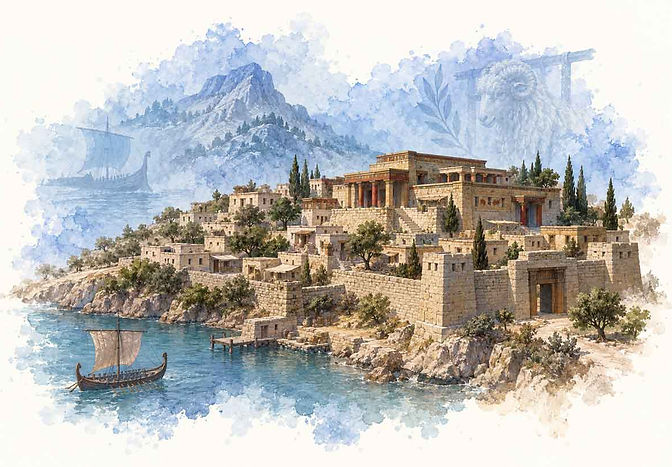
Mythopouch artistic interpretation
Details
Region
Greek
Regional Information Additional (if applicable)

Thessaly / Argonautic tradition / Mycenaean landscape
Category
Location
Historicity (actuality or factual truth of persons, events, and claims)
Historical
Gender
N/A
Time Period
Mythic Heroic Age in epic and tragedy; historically a Mycenaean palace centre, a minor Classical polis and a ruined memory after the foundation of Demetrias in 294 BCE
Symbol
Argo prow & one sandal
Tags
iolcus, jason, argonauts, pelias, golden-fleece, thessaly, argo, medea, mycenaean-thessaly
Introduction - Overview
Iolcus is the Thessalian city associated with Pelias, Jason and the departure of the Argonautic expedition. Homer calls it well-built and spacious within Thessalian geography, while later myth makes Pelias the usurping ruler who sends Jason after the Golden Fleece. The heroes assemble in the Iolcus-Pagasae region, and Apollonius places the Argo's departure at Pagasae on the Pagasitic Gulf. Mycenaean centres around modern Volos, including Kastro/Palaia, Dimini and Pefkakia, provide the Late Bronze Age landscape often discussed in attempts to locate historical Iolcus. Scholars and excavators have proposed different identifications, so no single excavated complex should be presented as the proven palace of Jason's legendary city.
Gallery
Main Article - Who or What was...
Iolcus
Iolcus stood in Magnesia, the eastern district of Thessaly, near the northern shore of the Pagasitic Gulf and the slopes of Mount Pelion. The River Anaurus ran near the city, and Lake Boebe lay inland to the west. The modern city of Volos covers and surrounds the ancient site, with the Kastro mound at Palaia identified as the Classical location and Dimini to the west preserving the Mycenaean predecessor. Iolcus could reach the sea through Pagasae and the smaller harbour of Neleia, although later writers debated whether Iolcus itself stood on the coast or a short distance inland.
Homer gives Iolcus its oldest literary portrait. In the Catalogue of Ships, the contingents from Pherae beside Lake Boebeis, Boebe, Glaphyrae and well-built Iolcus sailed under Eumelus, son of Admetus and Alcestis. Alcestis was the daughter of Pelias, linking the city to the Thessalian dynastic network. Eumelus had the best horses at Troy after Achilles, a tradition that turns Thessaly into the land of heroic horsemanship.
In the Odyssey, Odysseus hears the story of Tyro from the Underworld. Tyro, daughter of Salmoneus, loved the River Enipeus, but Poseidon took the river god's form and lay with her by the shore. She bore twin sons, Pelias and Neleus. Poseidon blessed Pelias with wealth and rule in spacious Iolcus, while Neleus became king of sandy Pylos. Tyro later married Cretheus and bore Aeson, Pheres and Amythaon. The genealogy creates Iolcus as a city shared between an older Aeolid line and Poseidon's violent interruption. Aeson should inherit from Cretheus, but Pelias seizes the throne.
Later mythographers filled the gap between epic memory and the Argonautic cycle. Pseudo-Apollodorus makes Cretheus the founder of Iolcus and says Minyans from Orchomenus settled there. Cretheus married Tyro and established the royal house. Pelias, son of Poseidon and Tyro, and Neleus were exposed as infants, found by a horse-herder and named for the marks on their bodies. Neleus left for Messenia, while Pelias remained in Thessaly, overthrew Aeson and made himself king. The act of usurpation gives Iolcus its central political meaning: the city is legitimate but illegitimately ruled.
Jason, Aeson's son, escaped Pelias by being hidden on Mount Pelion and educated by the centaur Chiron. When he came down to claim the kingdom, he lost one sandal in the River Anaurus while carrying Hera disguised as an old woman. Pelias had received an oracle warning that a one-sandalled man would destroy him. When Jason entered Iolcus, Pelias recognised the threat and asked what he would do to the man fated to kill him. Jason answered that he would send such a man to Colchis to bring back the Golden Fleece. Pelias immediately adopted the suggestion as a sentence of death.
Jason gathered the Argonautic company in the Iolcus-Pagasae region. Apollonius names a long roster of heroes and credits Argus with building the Argo under Athena's guidance, including a prophetic piece of Dodona's oak in the ship. The literary departure takes place from Pagasae, the harbour on the Pagasitic Gulf closely tied to Iolcus, rather than requiring the city itself to sit directly on the embarkation point.
The Argonauts sacrifice before departure and sail from the Pagasaean coast for Colchis. Iolcus remains the political cause and homeward destination of the quest even when the harbour is named separately. When Jason eventually returns with Medea and the Golden Fleece, the story turns from expedition to dynastic revenge against Pelias.
Medea's revenge against Pelias became the city's most notorious story. One version says she demonstrated her power of rejuvenation to Pelias' daughters by cutting up an old ram, boiling the pieces in a cauldron and producing a young lamb. She then promised to restore Pelias' youth if his daughters did the same to him. They cut their father into pieces and placed him in the cauldron, but Medea withheld the magical herbs. Pelias died, and his daughters were left guilty of parricide. Jason and Medea fled or were driven from Iolcus, while Acastus, Pelias' son, buried his father and held funeral games in his honour.
The games connected Iolcus to other heroic cycles. Peleus wrestled Atalanta there and defeated her only by tripping her. The funeral of Pelias joined the Argonauts, the Calydonian hunters and the suitors of Helen in one Thessalian gathering. Iolcus thus became the place where one generation of heroes passed its achievements to another.
The later feud between Peleus and Acastus brought violence back to the city. Acastus purified Peleus after he accidentally killed his father-in-law Eurytion, but Acastus' wife Astydamia fell in love with Peleus and accused him of attempted rape when he rejected her. Acastus took Peleus hunting on Pelion, hid his sword and abandoned him to the centaurs. Chiron recovered the sword and saved Peleus, who later returned with Jason and the Dioscuri, sacked Iolcus, killed Acastus and dismembered Astydamia. Thessalus, Jason's son, eventually inherited the kingdom. The succession of Iolcus therefore passes from usurpation to revenge to a new, uncertain dynasty.
Archaeology supplies a rich Late Bronze Age setting around the Bay of Volos but not a universally accepted identification of one palace as the Iolcus of myth. Dimini has yielded a substantial Mycenaean administrative centre with megaron complexes, while Kastro/Palaia and Pefkakia are also major contemporary sites. Different excavators have proposed Iolcus at Dimini or Kastro/Palaia, and recent regional study stresses the complexity of several important centres around the bay. The evidence strongly supports a significant Mycenaean landscape, but Jason's legendary palace cannot be archaeologically demonstrated.
In historical times Iolcus was a minor polis within the Thessalian confederation. Herodotus says the Thessalians offered it to Hippias after his expulsion from Athens, but the tyrant refused it. The city appears in the Periplus of Pseudo-Scylax as part of Magnesia. During the Persian Wars Thessaly submitted to Xerxes, and Iolcus had no independent role. Its final eclipse came when Demetrius Poliorcetes founded Demetrias in 294 BCE and moved the inhabitants of Iolcus and neighbouring towns to the new city. Strabo later speaks of Iolcus as a place that had ceased to exist, while remembering that the Magnesians still held a festival in honour of Pelias.
Religion kept the city's name alive. Iolcus worshipped Artemis Iolkia, whose temple and festival are mentioned by ancient sources. Fourth-century coins of Iolcus show the head of Artemis on the obverse and the prow of the Argo on the reverse. The coinage turns civic identity into myth: the goddess protects the city while the ship carries its fame into every harbour. A local sanctuary or cult of Pelias may also have survived through the Hellenistic period, proving that even the usurping king retained heroic honour in his own landscape.
Mythically, Iolcus serves two opposed functions. It is the homeland Jason must recover and the kingdom from which he is exiled. It is the starting point of a heroic voyage and the place where the voyage's violence returns. Pelias hopes the Golden Fleece will remove Jason permanently; instead, the quest gives Jason the fame, wife and power to threaten the throne. Medea's cauldron destroys the king who sent her husband away. The city that created the hero also expels him.
Its harbour makes it a threshold. From Iolcus, the Greek world opens into the Aegean, the Propontis, the Black Sea and Colchis. The Argo carries the names of Thessaly beyond the map. Yet the return home is never clean. The Golden Fleece reaches Iolcus accompanied by murder, deception and exile. Greek myth repeatedly treats nostos, homecoming, as dangerous: Odysseus returns to suitors in his house, Agamemnon returns to Clytemnestra's axe, and Jason returns to Medea's cauldron. Iolcus belongs to that pattern.
Ancient and modern readers have therefore read the city as more than a backdrop. Nilsson saw the Argonautic cycle as a memory of Mycenaean Thessaly. Later scholars have analysed the Catalogue of Ships as a heroic map whose place names preserve real geography. Iolcus stands at the intersection of the two readings: a genuine Bronze Age centre whose memory survived in epic, and a mythic harbour whose palace politics generate the voyage itself.
The accurate record of Iolcus therefore has both historical and legendary layers. Homer places the name in Thessaly and later myth makes it the royal setting of Pelias and Jason. The Argonauts are assembled through this political story but sail from nearby Pagasae. The Bay of Volos contains several major Mycenaean settlements, including Dimini, Kastro/Palaia and Pefkakia, any of which contributes to the Bronze Age background without proving the exact palace of mythic Iolcus. In later history Iolcus became a minor Thessalian polis and was overshadowed by Demetrias.
Summary
Iolcus endures as Jason's Thessalian homeland and the kingdom whose succession dispute launches the quest for the Golden Fleece. Later myth makes Pelias the usurper who sends Jason to Colchis, while Apollonius locates the Argo's departure at nearby Pagasae. Archaeology around the Bay of Volos has uncovered several important Mycenaean centres, especially Dimini, Kastro/Palaia and Pefkakia, but their relationship to the legendary Iolcus remains debated. The city is therefore both a genuine Thessalian place-name and the political heart of the Argonautic story.
Now enter the Mythopouch World!
You’ve discovered:
Iolcus
From Myth to Game
Join to access FREE real-world mythology "Learn Quests" and "Courses". Sign up to the newsletter for new releases, game updates, insider news, and more as Mythopouch brings real mythology to life. EARN the right to purchase an offline board game by completing FREE modules.


It's FREE to join as a MEMBER!
Not ready to join? Get the newsletter instead below


Looking for others?
Click into the field below to search, or click the icon to go to full page search function!

Looking for Mythology Insights?


Click below to view our mythology blog article insights, where we delve into the current Mythopouch Tier regions, and what we think you should know!
Sources & Retellings
Explore the original mythological Source texts (most from over 75 years ago, some as translated, possibly with mature content) and Mythopouch's source Retellings (a modern retelling also suitable for 15+) connected to this mythological entity. We are growing this resource and will link these in the future; for now, check the References below, then find the Sources or Retellings on those pages!


References
Validation References:
- Homer, Iliad 2.711-715 (c. 750 BCE) - well-built Iolcus in the Catalogue of Ships under Eumelus, son of Admetus and Alcestis
- Homer, Odyssey 11.254-259 (c. 750 BCE) - Tyro, Poseidon, Pelias in spacious Iolcus and Neleus in Pylos
- Pindar, Pythian Ode 4.78-262 (462 BCE) - Jason's return to Iolcus, Pelias' oracle and the assembly of the Argonauts
- Apollonius of Rhodes, Argonautica 1.4-233 (c. 270-245 BCE) - the catalogue of Argonauts, the construction of the Argo and the departure from Pagasae and Iolcus
- Apollodorus, Bibliotheca 1.9.10-17 and 1.9.27-28 (1st or 2nd century CE) - Cretheus, Pelias' usurpation, the Golden Fleece quest, Medea's revenge and the exile of Jason
- Ovid, Metamorphoses 7.297-349 (c. 8 CE) - Medea's rejuvenation of Aeson and the deception of Pelias' daughters
- Pausanias, Description of Greece 2.3.9 and 3.18.10 (c. 150 CE) - Thessalus' inheritance and the funeral tradition of Pelias
- Strabo, Geography 9.5.15 (early 1st century CE) - the site of Iolcus, its disappearance and the festival of Pelias
- Herodotus, Histories 5.94 (c. 430 BCE) - the Thessalians' offer of Iolcus to Hippias
- Nilsson, Martin P., The Mycenaean Origin of Greek Mythology (University of California Press, 1932), Iolcus chapter - the argument that the Argonautic cycle preserves the memory of Mycenaean Iolcus
- Hunter, Richard, Apollonius of Rhodes: Argonautica Book I (Cambridge University Press, 1993) - commentary on the catalogue, departure and Homeric geography of Iolcus
- Gantz, Timothy, Early Greek Myth: A Guide to Literary and Artistic Sources (Johns Hopkins University Press, 1993), Volume 1, "Jason and the Argonauts" - source history of the Iolcus traditions
- Hard, Robin, The Routledge Handbook of Greek Mythology (Routledge, 2004), "Jason and the Argonauts" - synthesis of the quest and Medea's revenge
- Visser, Edzard, Homers Katalog der Schiffe (Teubner, 1997), Thessaly section - modern study of the Catalogue of Ships and its geography
- Simpson, R. Hope and J.F. Lazenby, The Catalogue of the Ships in Homer's Iliad (Oxford University Press, 1970), Thessaly section - topographical commentary on Iolcus and the Homeric Catalogue
- Adrymi-Sismani, Vasso, "Iolkos", in I. Stamatopoulou and M. Yeroulanou (eds.), Excavating Classical Culture: Recent Archaeological Discoveries in Greece (Archaeopress, 2002) - Mycenaean palace and settlement evidence at Dimini
- Maran, Joseph, "The Spreading of the 'Helladic Motif' and the Transformation of Mycenaean Society", in K. Kilian and H. J. Weisshaar (eds.), Kolloquium Die Bronzezeit in Thessalien (Dr. Rudolf Habelt, 1988) - Thessalian Mycenaean culture and palace society
- Kramer-Hajos, Margaretha, Bronze Age Thessaly: An Introduction (Oxford University Press, 2016) - overview of Late Bronze Age Thessaly, Dimini and Iolcus
- Decourt, Jean-Claude and Mogens Herman Hansen, "Thessaly", in Mogens Herman Hansen and Thomas Heine Nielsen (eds.), An Inventory of Archaic and Classical Poleis (Oxford University Press, 2004), pp. 676-730 - historical status of Iolcus as a Thessalian polis
- OCD, "Iolcus", in Simon Hornblower and Antony Spawforth (eds.), Oxford Classical Dictionary, 4th edition (Oxford University Press, 2012) - concise reference synthesis of myth, site and archaeology
- Page, Denys, History and the Homeric Iliad (University of California Press, 1959), Catalogue section - historical criticism of the Catalogue of Ships and Thessalian geography
Cultural Context Notice
Mythology developed across different cultures, periods and traditions, and there is rarely one universally accepted version of a story. Mythopouch approaches these traditions with respect while remaining faithful to the complexity of the surviving material. Retellings and educational content may interpret or adapt historical sources, but are not presented as definitive accounts of any culture, religion or belief system.