Greek Mythology List


Welcome to the Mythopouch list of Greek mythology entries! We also delve into the ancient history of Greece and the surrounding areas. From heroes to goddesses, places, monsters, artifacts, weapons, creatures and more - which will only grow over time. Mythopouch provides real-world information extracted from the original source material such as that from: Homer, Hesiod, Apollodorus, Ovid, Pausanias, Pindar, Aeschylus, Sophocles, Euripides, Hyginus, Diodorus Siculus and Apollonius of Rhodes. Words and stories carry powerful messages that were passed down from one generation to the next, many of which are still very applicable to modern times. Our unique imagery is meant to capture the imagination and ignite the magic mythology spark within us all. Our "token mark" coin symbol that is assigned to each record is a visual representation of the entity, for use in Mythopouch learning modules and games.
Learn - Earn - Play
Greek Entity Quick Index
Our current list of ancient Greek mythology and ancient history entities are here - which are growing day by day!
Search by using the:
-
"Search Mythology Records" function to browse all mythology records and blog pages;
-
Browse the visual cards with overviews by clicking "Go to Visual A-Z";
-
Or just browse and click the A-Z entries below....
See more list entries
Read Ancient Greek Insights
Click below to view our ancient Greek mythology blog article insights, where we delve into the current Mythopouch Tier regions and what we think you should know!


Greek Entity Card Index
See more card entries

Arimaspeia
The Arimaspeia is a lost Greek epic poem associated with the northern reaches of the ancient imagination, a work in hexameters that described one-eyed people and gold-guarding griffins beyond the lands familiar to its audience. It was attributed to Aristeas of Proconnesus, a poet surrounded by stories of death, disappearance and return. Herodotus reports that Aristeas claimed to have reached the Issedones under the influence of Apollo and to have learned about the peoples living beyond them. Among these were the Arimaspians, the one-eyed horsemen of later art, the griffins with which they fought, and the Hyperboreans at the distant end of the geographical sequence. The poem itself is historically attested, even though the marvels it described and the miraculous stories about its author are not established events. Only fragments and ancient reports remain. Its importance lies in that combination of poetry, reported travel and religious imagination: a lost work that still helps readers understand how Greek writers pictured lands beyond their direct experience.

Arimaspians
The Arimaspians are the one-eyed warriors of the northern steppe, the most famous barbarians at the edge of the Greek world, whose perpetual war with the griffins over gold became a symbol of mortal greed colliding with divine guardianship. They are the horse-riding people who live beyond the Issedones, beyond the Scythians, beyond every people the Greeks had ever met, at the very margin where geography dissolves into myth. They are the thieves who cannot stop stealing, who raid the gold guarded by lion-bodied, eagle-headed beasts and are driven back again and again, neither side ever winning, neither side ever surrendering. They are the people whose name, according to Herodotus, means "one-eyed" in the Scythian tongue, whose single eye in the centre of the forehead made them as strange to Greek imagination as the griffins they fought. And they are the northernmost mortals in the oldest map of the world, the last human tribe before the griffins, and beyond them the Hyperboreans, the blessed people who live at the back of the north wind.

Aristaeus
Aristaeus is the rustic god who taught mortals to keep bees, press olives, and curdle milk into cheese, the most useful deity in the Greek pantheon and the only one whose gifts were practical skills rather than miracles of war or love. He is the son of Apollo, the god of the sun and music, and Cyrene, the huntress nymph who wrestled lions on Mount Pelion before the god carried her to Libya. He is the husband of Autonoë, the Theban princess whose son Actaeon was torn apart by his own hounds, and the father of that same doomed hunter. He is the saviour of Ceos, the island whose people were dying from the scorching heat of the Dog-Star Sirius until Aristaeus raised an altar to Zeus and won the Etesian winds that still cool the Aegean for forty days each summer. He is the pursuer whose chase of the nymph Eurydice drove her onto a serpent and into the underworld, setting in motion the tragedy of Orpheus. And he is the beekeeper who learned the bugonia rite from Proteus, the old man of the sea, sacrificing cattle so that new bees might swarm from their rotting carcasses and restore his hives.

Aristeas
Aristeas is the poet who died in a fuller's shop and came back to life, the shaman whose soul flew from his body as a raven and travelled to the edge of the known world. He is the native of Proconnesus, an island in the Sea of Marmara, who wrote the lost epic Arimaspeia and gave the Greeks their first map of the northern wilderness beyond Scythia. He is the servant of Apollo who entered a trance so deep that his body seemed dead, whose spirit journeyed past the Issedones to the land of the one-eyed Arimaspians, the gold-guarding griffins, and finally the blessed Hyperboreans who live beyond the north wind. He is the ghost who appeared in Metapontum in southern Italy years after his death, telling the citizens to build an altar to Apollo and leaving his name inscribed on a bronze arrow as proof. And he is the most enigmatic traveller in early Greek literature, a man who blurred the boundary between poet and prophet, between life and death, and between the geography of the earth and the geography of the soul.

Aristophanes
Aristophanes is the greatest surviving writer of Old Attic Comedy and the only poet of that genre whose plays survive complete. He is the Athenian citizen born around the middle of the 5th century BCE into the tribe Pandionis, son of Philippus and probably connected by property with the island of Aegina. He is the teenager who began competing at the City Dionysia in 427 BCE with the lost comedy The Banqueters, attacking the education of wealthy young men. He is the bold satirist whose lost Babylonians of 426 BCE showed Athens' allied states as slaves and led the politician Cleon to bring a prosecution against him. He is the author of eleven surviving plays: The Acharnians, The Knights, The Clouds, The Wasps, Peace, The Birds, Lysistrata, The Thesmophoriazusae, The Frogs, The Assemblywomen and Wealth. He is the comic poet who created Dicaeopolis negotiating a private peace with Sparta, Trygaeus flying to heaven on a dung beetle to rescue Peace, Peisthetaerus founding the city of Cloudcuckooland in the sky, Lysistrata organizing a sex strike to stop the Peloponnesian War, Dionysus judging a contest between Aeschylus and Euripides in the Underworld and Praxagora turning Athens into a women's communist state. He is the parodist of Socrates, Euripides, Cleon, the Sophists, generals, jurors, politicians, poets and the Athenian audience itself. He is the writer of about forty-four plays, of which only eleven survive, and whose fragments from the lost works include The Farmers, The Merchant Ships, Anagyrus, Amphiaraus, Lemnian Women, Gerytades and Cocalus. He is the dramatic innovator who used the agon, parabasis and fantastical reversal to turn political criticism into carnival. He is the poet whose work preserves the language, institutions, appetites, sexual jokes and civic anxieties of Athens during the Peloponnesian War. And he is the comic writer whose obscene humour, brilliant lyric metres, political satire and attacks on war remained readable enough to be translated, staged and adapted for more than two thousand years.

Artaxerxes II
Artaxerxes II was an Achaemenid king of Persia whose long reign became closely connected with Greek accounts of imperial politics and court life. He was the son of Darius II and Parysatis, the grandson of Artaxerxes I, and the elder brother of Cyrus the Younger. Cyrus's attempt to take the throne ended at the Battle of Cunaxa in 401 BCE, leaving the Greek mercenaries later remembered as the Ten Thousand to make their way out of the empire. Xenophon's Anabasis preserves their campaign and retreat. Artaxerxes was also served by Ctesias, the Greek physician whose writings helped shape Greek descriptions of Persia and India. Plutarch's later biography tells of the conflict between the king's mother Parysatis and his wife Stateira, including the allegation that Parysatis arranged Stateira's poisoning. These dramatic accounts must be distinguished from contemporary royal evidence and from details on which ancient writers disagreed. Artaxerxes's reign, usually dated to about 404-358 BCE, links Persian history with the Greek literature that transmitted both its events and its contested stories.
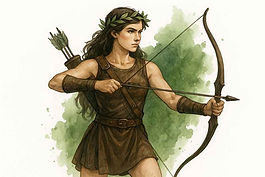
Artemis
Artemis is the virgin huntress who drives her golden chariot across the shadowy hills and windy peaks, drawing her bow to send grievous shafts into the race of wild beasts while the mountains tremble beneath her. She is the twin sister of Apollo, the god of the silver bow, born on the floating island of Delos and helping her mother deliver her brother moments after her own birth. She is the goddess who protects women in childbirth, the one who answers when a woman cries out in the sharp pang of labor, because the Moirai, the three sisters who spin the threads of fate, ordained at her birth that she would be their helper. She is the mistress of sixty Oceanid nymphs and twenty who tend the rivers and woods, leading them in wild dances on the mountains before hanging up her bow and leading the Muses and Graces in song at Delphi. And she is the relentless avenger who transforms the hunter Actaeon into a stag when he spies upon her bath, then drives his own fifty hounds into a frenzy so that they tear him apart, a warning that no mortal may look upon the divine without paying in blood.

Artemis's Bow and Arrows
Artemis's Bow and Arrows are the silver weapon of the virgin goddess of the hunt, the instrument with which she protects the wild places of the earth and strikes down any who dishonour her or her mother. They are the arrows that killed the seven daughters of Queen Niobe alongside the shafts of her twin brother Apollo, the god of music and prophecy, when Niobe boasted that she was greater than their mother Leto. They are the weapon that brought down the monstrous Calydonian Boar, a beast sent by Artemis herself to ravage the land of a king who forgot her at harvest time, and the bow that every hero of Greece tried to draw in the greatest hunt ever assembled. They are the arrows that turned the hunter Actaeon into a stag when he saw the goddess bathing, and the shafts that some say killed the giant Orion when he threatened to hunt every beast on earth. And they are the symbol that has outlived Olympus, carried by the Amazons on their shields, by the city of Ephesus on its coins, and by every image of female strength and independence that has ever drawn a bow against the sky.

Asclepius
Asclepius is the god of medicine and healing, the son of Apollo who learned the secrets of life and death from a centaur and paid for that knowledge with a thunderbolt from Zeus. He is the infant snatched from his mother's burning body on a funeral pyre, cut from her womb by his father or by Hermes, the messenger god, and raised in the caves of Mount Pelion by Chiron, the wise centaur who taught Achilles the arts of war. He is the physician who could cure any sickness, mend any wound, and even raise the dead back to life, a power so dangerous that Zeus, the king of the gods, destroyed him with a lightning bolt to preserve the boundary between mortals and immortals. He is the father of Machaon and Podalirius, the two physicians who tended the wounded Greeks at Troy, and of Hygeia and Panacea, the goddesses of health and universal remedy. And he is the constellation Ophiuchus, the Serpent-Bearer, who still shines in the summer sky with a serpent coiled about his staff, the oldest symbol of the healing arts in the Western world.

Astyanax
Astyanax is the young prince of Troy whose public name means "lord of the city," the son of Hector, the Trojans' leading defender, and Andromache, the daughter of Eetion of Cilician Thebe. He is the baby who recoils from his father's crested helmet in the Iliad, and whom Hector hopes will grow into a warrior greater than himself. He is the child whose future becomes inseparable from the survival of Troy, although he is too young to understand the hopes placed upon him. In accounts of the city's fall, his descent from Hector becomes a danger rather than a protection: the Greek victors fear the avenger he might become. Euripides makes his death and burial a central catastrophe of The Trojan Women, bringing his body back to Hecuba on Hector's shield. The later Roman playwright Seneca gives Andromache a desperate attempt to hide him in his father's tomb. These are distinct literary treatments, not episodes all narrated by Homer. Together they make Astyanax a powerful image of childhood caught in a war it did not choose.

Atalanta
Atalanta is the huntress who was suckled by a bear and raised by hunters, the woman who outran every man who tried to claim her and killed those who failed. She is the only woman who sailed with the Argonauts on their quest for the Golden Fleece, the magical ram's hide that Jason sought in the distant land of Colchis. She is the first hunter to wound the monstrous Calydonian Boar, the beast sent by Artemis to ravage the kingdom of Calydon, and she won the hide as her prize against the protests of every man present. She is the wrestler who defeated Peleus, the father of Achilles, the greatest warrior of the Trojan War, at the funeral games of King Pelias. And she is the swift-footed maiden who was finally beaten not by speed but by three golden apples, a trick that cost her her freedom and ultimately transformed her into a lioness, the very animal she had spent her life hunting.

Athena
Athena is the goddess who sprang fully grown and fully armed from the forehead of Zeus, the king of the gods, her birth so violent that the earth cried out and the sea tossed with dark waves while the sun himself stopped his chariot to watch. She is the grey-eyed daughter of Metis, the personification of cunning intelligence, whom Zeus swallowed whole to prevent the birth of a son who might overthrow him, and who forged her daughter's armor from inside his belly before Athena burst forth. She is the virgin warrior who carries the aegis, a goatskin breastplate fringed with golden tassels and bearing the severed head of the Gorgon Medusa, whose face turned all who looked upon it to stone, a gift from the hero Perseus after she helped him slay the monster. She is the patron of Athens, the city that took her name, which she won from Poseidon, the god of the sea, by offering the olive tree, a gift of nourishment, light, and peace, while Poseidon offered only a salt spring and a war-horse. And she is the strategist of the Trojan War, the goddess who favored Odysseus, the cunning king of Ithaca, above all other mortals, guiding him through ten years of trials until he returned to his wife Penelope and the palace he had built with his own hands.