Greek Mythology List


Welcome to the Mythopouch list of Greek mythology entries! We also delve into the ancient history of Greece and the surrounding areas. From heroes to goddesses, places, monsters, artifacts, weapons, creatures and more - which will only grow over time. Mythopouch provides real-world information extracted from the original source material such as that from: Homer, Hesiod, Apollodorus, Ovid, Pausanias, Pindar, Aeschylus, Sophocles, Euripides, Hyginus, Diodorus Siculus and Apollonius of Rhodes. Words and stories carry powerful messages that were passed down from one generation to the next, many of which are still very applicable to modern times. Our unique imagery is meant to capture the imagination and ignite the magic mythology spark within us all. Our "token mark" coin symbol that is assigned to each record is a visual representation of the entity, for use in Mythopouch learning modules and games.
Learn - Earn - Play
Greek Entity Quick Index
Our current list of ancient Greek mythology and ancient history entities are here - which are growing day by day!
Search by using the:
-
"Search Mythology Records" function to browse all mythology records and blog pages;
-
Browse the visual cards with overviews by clicking "Go to Visual A-Z";
-
Or just browse and click the A-Z entries below....
See more list entries
Read Ancient Greek Insights
Click below to view our ancient Greek mythology blog article insights, where we delve into the current Mythopouch Tier regions and what we think you should know!


Greek Entity Card Index
See more card entries

Thanatos
Thanatos is the personified spirit of death in Greek mythology, the winged figure who comes not with violence but with the quiet certainty that every life must end. He is the son of Nyx, the primordial goddess of night, and Erebus, the primordial god of darkness, born in the generation before the Olympian gods ever claimed Olympus, a being so ancient that even Zeus, the king of the gods, could not command him without consequence. He is the twin brother of Hypnos, the spirit of sleep, and the two of them move through the world together, one bringing the rest that mimics death and the other bringing the rest that is death. He is the gentle end who cut the golden thread of life for the hero Sarpedon on the battlefield of Troy, lifting the king's body from the carnage and carrying it through the air to his homeland in Lycia while Sleep guarded the corpse. He is the prisoner who was tricked and bound in his own chains by Sisyphus, the craftiest king of Corinth, so that for a time no mortal on earth could die and the old and wounded wandered in endless suffering. And he is the figure who came for Alcestis, the queen of Pherae who volunteered to die in her husband's place, only to be wrestled to the ground by Heracles, the greatest hero in Greece, who seized Death himself by the throat and forced him to give the queen back, the only time in all Greek myth that a mortal man defeated death in single combat.

The Dioscuri
The Dioscuri are the inseparable twin brothers Castor and Pollux, one mortal and one divine, whose devotion to each other became so legendary that the gods themselves rewrote the rules of life and death to keep them together. They are the Spartan horsemen who rescued their sister Helen from the hero Theseus, storming Attica with an army to bring her back before she ever saw the walls of Troy. They are the Argonauts who sailed with Jason on the quest for the Golden Fleece, saving the ship Argo from a crushing storm when all other heroes despaired. They are the warriors who fell in love with their cousins, abducted them from their betrothed, and fought a fatal feud that ended in blood and thunder. And they are the constellation Gemini, two bright stars that appear in the winter sky as a promise that brotherhood can outlast even death itself, and that the love between two people can be stronger than the boundary between mortality and immortality.

The Niobids
The Niobids are the fourteen children of Niobe and Amphion whose slaughter by Apollo and Artemis stands as the most terrible divine punishment in Greek mythology. They are seven sons and seven daughters, the pride of Thebes, whose beauty and number drove their mother to boast before the temple of Leto, the Titan goddess of motherhood and the mother of Apollo and Artemis. They are the youths cut down by golden arrows on the racecourse and the maidens pierced by silver shafts in the palace, all in a single day that turned Thebes into a city of mourning. They are the brothers and sisters who died because their mother counted them too loudly, the innocent victims of a pride that was not their own. They are the buried ones whose tomb was shown to visitors at Thebes for centuries, a mound of earth that marked the place where divine vengeance had fallen. And they are the eternal warning that the children of the proud suffer for the sins of the parent, that no mortal family, however blessed, may rival the gods. Every mass grave, every generation punished for the arrogance of the one before it, and every mother who has buried a child carries their shadow.

The Spartoi
The Spartoi are the armed warriors who sprang fully grown from the earth when Cadmus, the Phoenician prince who founded Thebes, sowed the teeth of the Dragon of Ares in a field on the Ismenian Hill. They are the earth-born soldiers born from the bones of a monster, each one clad in bronze armour and bearing spear and shield, who rose from the soil as if the dragon itself had been reborn in human form. They are the brothers who turned upon one another in a frenzy of mutual slaughter the moment they emerged, killing all but five of their number in a battle so swift and terrible that Cadmus could only watch in horror. They are the five survivors, Echion, Udaeus, Chthonius, Hyperenor, and Pelorus, who became the ancestors of the noble families of Thebes and from whose bloodlines the greatest Theban heroes and kings would descend, including the house of Oedipus, the king who would kill his father and marry his mother. And they are the eternal symbol of a city born from violence, the founding fathers of Thebes who were themselves born from the corpse of a dragon and who carried the monster's ferocity in their veins, a reminder that every civilisation has its roots in blood.

Themis
Themis is the Titaness of divine law, the goddess of the order that holds the whole cosmos in place, and the voice that first spoke the future at Delphi. She is the daughter of Uranus, the starry Sky, and Gaia, the broad Earth, one of the twelve Titans who ruled before the Olympian gods, and the mother, by Zeus himself, of the Seasons of Good Order, Justice and Peace and of the three Fates who spin, measure and cut the thread of every human life. She is the counsellor beside the throne of Zeus, the herald who summons the gods to assembly on Olympus, and the partner with whom Zeus planned the Trojan War to lighten the burden of the overcrowded Earth. She is the prophetess who warned the gods that the sea nymph Thetis would bear a son greater than his father, saving Zeus from the fate of his father and grandfather. She is the oracle who told the last two survivors of the Great Flood how to repopulate the empty world. And she stands today, in one disguise or another, outside courthouses across the world as the blindfolded figure with the scales, the ancient face of justice itself.

Theseus
Theseus stands as one of the most celebrated heroes of Greek mythology, second only to Heracles in the breadth of his exploits and his lasting significance in the Greek cultural imagination. Unlike many heroes whose tales remain confined to myth, Theseus occupies a unique position at the boundary between legend and history. He was venerated as the legendary founder of Athenian democracy and the unifier of Attica, credited with transforming Athens into the political and cultural centre of the region. The ancient Greeks regarded him as a real historical king, and his cult endured well into the classical period, with Athenians proudly tracing their civic institutions back to his reign.

Thetis
Thetis is the sea nymph whose beauty was so great that both Zeus, the king of the gods, and Poseidon, the ruler of the oceans, desired her for a wife, until a prophecy warned that her son would be greater than his father and both gods stepped back in fear. She is the Nereid who married the mortal hero Peleus, the king of the Myrmidons in Thessaly, after he proved his worth by holding onto her through every shape she could assume, from lion to serpent to fire and water, never letting go until she surrendered. She is the mother of Achilles, the greatest warrior of the Trojan War, whom she tried to make immortal by dipping him in the River Styx, the sacred water that flowed around the Underworld, leaving only his heel untouched. She is the goddess who begged Zeus to let the Trojans triumph while her son sat sulking in his tent, and who later brought Achilles a new suit of armour forged by Hephaestus, the lame smith-god, after Hector, the Trojan prince, had stripped the old armour from the body of Patroclus, Achilles's beloved companion. And she is the grieving mother who held her son's body when he fell at Troy, the immortal who wept for the mortal she could not save, a figure of divine power and maternal sorrow whose name is inseparable from the story of the Iliad.

Thoosa
Thoosa is the sea nymph who bore the Cyclops Polyphemus to Poseidon and gave one of the Odyssey's most famous monsters a divine lineage. She is the daughter of Phorcys, an ancient sea power whose family belongs to the darker and more dangerous edges of Greek myth. Homer names her only briefly, saying that she lay with Poseidon in arching sea caves and became the mother of Polyphemus. Her importance becomes clear after Odysseus blinds the Cyclops: Polyphemus can call upon Poseidon as his father because Thoosa has joined the sea god to the old marine line of Phorcys. She is not securely a Nereid, despite that label appearing in some modern retellings. Theocritus later brings her into the pastoral world of Sicily, where Polyphemus remembers her accompanying Galatea and complains that his mother will not plead his love. Thoosa never receives a separate adventure, cult or death story, but her quiet place in the genealogy explains why a cave-dwelling Cyclops can summon the anger of the god who rules the sea.

Thyrsus of Dionysus
The Thyrsus of Dionysus is the staff that turns sober men into madmen and civilised cities into wilderness, the fennel-rod wrapped in ivy that the god of wine and ecstasy carries wherever he walks and that his frenzied female followers, the Maenads, raise against any who oppose his worship. It is the weapon that tore King Pentheus of Thebes limb from limb when he tried to spy on the Bacchic rites, the staff that the Theban women wielded like clubs as they ripped their own king apart with their bare hands. It is the wand that Dionysus used to transform the mast of a pirate ship into a vine heavy with grapes, and that turned the pirates themselves into dolphins when they tried to kidnap him. It is the staff that led the god's armies across India and the East, a conqueror's weapon that needed no edge because ecstasy itself was the blade. And it is the symbol that still adorns every wine bottle, every theatre mask, and every image of revelry in the Western world, the original proof that the boundary between order and chaos is as thin as a pine cone on a fennel stalk.

Tiresias
Tiresias is the blind seer of Thebes who saw the truth that no one else could see and paid for that sight with his eyes. He is the son of the shepherd Everes and the nymph Chariclo, a mortal man who once lived as a woman for seven years after striking a pair of mating serpents with his staff. He is the prophet who told the gods that women enjoy pleasure more than men, and who was struck blind by Athena, the grey-eyed goddess of wisdom and war, but given the gift of understanding the language of birds as compensation. He is the seer who warned King Oedipus that he was the murderer he sought, who advised the Seven Against Thebes that the city would fall only if the last son of Oedipus led the attack, and who met Odysseus, the hero of the Trojan War whose ten-year voyage home became the subject of Homer's Odyssey, in the Underworld to tell him how to reach Ithaca. He is the man who prophesied that Narcissus, the most beautiful youth in Greece, would live to a ripe old age only if he never came to know himself. And he is the only mortal in Greek mythology who retained his mind and his prophetic power in the realm of the dead, a seer who could speak across the boundary between life and death.

Titans
The Twelve Titans are the first generation of gods born from the union of Uranus, the primordial sky, and Gaia, the broad-bosomed Earth. They are the elder gods who ruled the cosmos before the Olympians existed, a family of twelve siblings who divided the world among themselves and governed its fundamental forces. They are the parents of the second generation of gods and the ancestors of almost every deity in the Greek pantheon. They are the defeated army who fought the ten-year Titanomachy against Zeus and the young Olympian gods, a war that shook the cosmos to its foundations. They are the prisoners cast into the dark pit of Tartarus after their defeat, where some remain in chains while others were later freed. And they are the namesakes of the planet Saturn's largest moon, the chemical element titanium, and the word "titanic" itself, a legacy that has made their name synonymous with immense size and power for three thousand years.
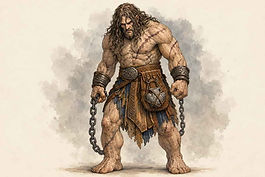
Tityos
Tityos stands among the most notorious offenders in Greek mythology, a giant whose crime against the divine mother Leto secured him a place in the eternal punishments of Tartarus alongside the likes of Tantalus, Sisyphus, and Ixion. His myth weaves together themes of hubris, divine vengeance, and the terrible consequences of violating the sanctity of the gods. From his extraordinary birth to his gruesome torment in the underworld, the story of Tityos has captivated audiences from the earliest Greek poets through the Roman epic tradition and into the literature of the medieval world.