Greek Mythology List


Welcome to the Mythopouch list of Greek mythology entries! We also delve into the ancient history of Greece and the surrounding areas. From heroes to goddesses, places, monsters, artifacts, weapons, creatures and more - which will only grow over time. Mythopouch provides real-world information extracted from the original source material such as that from: Homer, Hesiod, Apollodorus, Ovid, Pausanias, Pindar, Aeschylus, Sophocles, Euripides, Hyginus, Diodorus Siculus and Apollonius of Rhodes. Words and stories carry powerful messages that were passed down from one generation to the next, many of which are still very applicable to modern times. Our unique imagery is meant to capture the imagination and ignite the magic mythology spark within us all. Our "token mark" coin symbol that is assigned to each record is a visual representation of the entity, for use in Mythopouch learning modules and games.
Learn - Earn - Play
Greek Entity Quick Index
Our current list of ancient Greek mythology and ancient history entities are here - which are growing day by day!
Search by using the:
-
"Search Mythology Records" function to browse all mythology records and blog pages;
-
Browse the visual cards with overviews by clicking "Go to Visual A-Z";
-
Or just browse and click the A-Z entries below....
See more list entries
Read Ancient Greek Insights
Click below to view our ancient Greek mythology blog article insights, where we delve into the current Mythopouch Tier regions and what we think you should know!


Greek Entity Card Index
See more card entries

Perdix
Perdix is the nephew of Daedalus, the most celebrated inventor and craftsman in all Greek mythology, the boy whose genius proved so threatening that his own uncle murdered him out of jealousy and cast him from the heights of Athens. He is the young inventor who looked at the spine of a fish or the jawbone of a snake and saw the first saw, who fashioned the potter's compass from two iron rods joined by a rivet, and who built the potter's wheel that shaped clay into vessels of beauty and utility. He is the student who surpassed his master, whose mind raced ahead of Daedalus's own, and who paid for his brilliance with his life. He is the boy whom Athena, the grey-eyed goddess of wisdom and craft, caught in mid-air and transformed into a partridge, the bird that never flies high and always stays close to the ground, forever remembering the fall from which the goddess saved it. And he is the victim whose murder drove Daedalus into exile, setting in motion the chain of events that would lead to the Labyrinth, the Minotaur, and the wings of wax and feathers that carried Icarus too close to the sun.

Persephone
Persephone is the goddess whose abduction from a flowering meadow created winter itself, the daughter whose disappearance turned the world barren and whose return made the earth bloom again. She is the maiden who became queen of the dead, ruling beside her husband Hades in the shadowy kingdom beneath the earth. She is the girl who ate six pomegranate seeds in the Underworld, a bite that bound her to the realm of the dead for a portion of every year. She is the Kore, the maiden whose name was whispered in the secret rites of Eleusis, where initiates believed her story held the promise of life after death. And she is the dual-natured goddess who walks both worlds, springing up with flowers in one hand and commanding the spirits of the departed with the other, a figure who embodies the cycle of death and rebirth that governs every seed buried in the ground.

Perseus
Perseus is the hero who beheaded the Gorgon Medusa, a creature so terrible that one look at her face turned living things to stone, and lived to tell the tale, the only mortal to survive a direct encounter with that monstrous sisterhood and the founder of a dynasty that would shape the Greek world for generations. He is the son of Zeus, the king of the gods and wielder of the thunderbolt, who came to his mother Danae in a shower of golden rain, a union that her father King Acrisius of Argos had tried to prevent by locking her in a bronze tower because of a prophecy that his grandson would kill him. He is the exile who was cast into the sea in a wooden chest with his mother, only to wash ashore on the island of Seriphos and be raised by a fisherman, Dictys, while the island's cruel king Polydectes plotted to force Danae into marriage. He is the champion who slew Medusa using the polished shield of Athena, the goddess of wisdom born fully armed from the head of her father Zeus, the curved sword Harpe given by Hermes, the messenger god whose swift feet carried him between Olympus and the earth below, and the cap of invisibility borrowed from Hades, the god of the dead who ruled from the darkness beneath the earth. He is the rescuer who saved Andromeda, a princess chained to a rock as sacrifice to a sea-monster, and made her his queen. And he is the man who fulfilled the prophecy that began his story, killing his grandfather Acrisius not with sword or spear but with a discus thrown at a funeral games, an accident that satisfied fate without intent.

Phaeacians
The Phaeacians are the extraordinary seafaring people of Scheria whose hospitality and magical ships carry Odysseus home from the edge of the world. They are the descendants of Poseidon, shaped from their origin by the sea god's protection and destined to receive his punishment when they defy his hatred of Odysseus. They are the people who once lived beside the brutal Cyclopes before Nausithous led them to a safer island far from ordinary mortals. They are the community ruled by King Alcinous and Queen Arete, where twelve kings share counsel, women spin royal purple and a stranger may win safety by clasping the queen's knees. They are the inventors of vessels that need no pilots, rudders or sails, because the ships themselves understand their passengers' thoughts and know every land and city. They are the dancers, athletes, singers and feasters who prefer pleasure, craftsmanship and song to war. They are the listeners who hear Odysseus tell the Cyclops, Circe, the Sirens, the Underworld and Calypso. They are the people punished for helping him, when Poseidon turns their returning ship to stone at the harbour mouth. And they are the model of the mythic utopia, a society close to the gods where abundance, beauty, hospitality and technology remove the normal hardships of human life.

Phaethon
Phaethon is the shining son of the sun who asked to drive his father's chariot for a single day and fell from the sky in a blaze of fire that scorched the earth and turned the oceans to steam. He is the son of Helios, the Titan who drives the sun across the heavens in a chariot of gold, and Clymene, the Oceanid nymph of fame, and the boy whose pride in his divine blood led him to demand proof that he was truly the child of a god. He is the youth who swore upon the river Styx that his father would grant him any wish, and who used that oath to claim the one thing Helios knew he could not control. He is the charioteer who lost the reins, who let the sun chariot dive toward the earth and soar toward the stars, who burned Libya to desert and froze the Scythian plains until Zeus, the king of the gods, struck him from the sky with a thunderbolt to save the cosmos itself. And he is the brother whose fall turned his sisters into poplar trees, whose amber tears still drip into the river Eridanus, and whose tomb was shown to travellers on the banks of the Po until the Roman Empire itself had crumbled into dust.

Pharos
Pharos is the island off the Egyptian coast where Greek myth placed Proteus, the shape-shifting old man of the sea, and where the Ptolemies built the most famous lighthouse of the ancient world. It is the lonely island of the Odyssey, one day's sail from the Nile, where Menelaus was becalmed for twenty days and learned from Eidothea how to seize her father and force him to reveal the future. It is the residence of Proteus, who rises from the waves at noon, counts his seals and changes shape when captured, becoming lion, serpent, leopard, boar, running water and leafy tree before speaking the truth. It is the island that Alexander the Great considered for his new city, only to be told by a dream in which Homer quoted his own lines that the site was too small for the metropolis Alexander imagined. It is the landmark for which the Ptolemies joined island to mainland by the Heptastadion causeway and built a harbour system worthy of Alexandria's trade. It is the site of the lighthouse designed by Sostratus of Cnidus, a tower of square, octagonal and circular stages whose flame guided sailors toward the dangerous harbour mouth. It is the dedication of Posidippus, who called Proteus the saviour of Hellenes and praised Sostratus for cutting a tower through the breadth and depth of heaven. It is the wonder whose image appeared on coins, mosaics, gems and travellers' descriptions from Rome to the Islamic world. It is the monument whose destruction by earthquakes did not erase its name, because Pharos became the ordinary word for lighthouse in Greek and the root of far, faro, phare, farol and farol. And it is the place where myth, navigation, royal propaganda and architecture met in a single tower of light.

Philonoe
Philonoe is the Lycian princess who married Bellerophon, the hero who tamed the winged horse Pegasus and slew the Chimera, and who bore the sons whose descendants would fight at Troy. She is the daughter of Iobates, the king of Lycia in southwestern Asia Minor, and the sister of Anteia, the queen of Tiryns whose false accusation of rape had nearly cost Bellerophon his life. She is the prize that Iobates offered when he realised that no mortal man could complete the impossible tasks he had set unless the gods themselves were his allies. She is the wife who stood beside Bellerophon at the height of his glory, who bore him Isander, Hippolochus, and Laodameia, and who watched her husband's pride grow until the gods struck him down. And she is the woman whom Artemis, the virgin goddess of the hunt, granted immortality, either because of her virtue or because of her suffering, making her one of the few mortals in Greek myth to escape death entirely.

Phineus (Blind Seer)
Phineus is the blind prophet-king whose rescue from the Harpies becomes one of the defining episodes of the Argonauts' voyage. He is the seer granted prophecy by Apollo, but punished because he reveals divine knowledge too completely. He is the starving ruler whose meals are snatched away by winged Harpies, leaving behind only scraps fouled by an unbearable stench. He is the husband of Cleopatra, daughter of the North Wind Boreas, and therefore the brother-in-law of Zetes and Calais, the winged heroes who finally drive the Harpies away. He is the guide who repays the Argonauts by explaining the route toward Colchis and the secret of passing the Symplegades, the Clashing Rocks. Other traditions make his blindness the result of helping Phrixus, choosing long life over sight or mistreating his own sons. This record concerns the blind seer of the Argonautic tradition, not the separate Phineus who challenged Perseus for Andromeda.

Phineus (son of Belus)
Phineus, son of Belus, is the rejected betrothed of Andromeda whose attempt to reclaim her from Perseus ends in petrification. He belongs to the royal house of Belus and, in the later genealogical tradition, is the brother of King Cepheus of Aethiopia. He is the uncle and earlier suitor of Andromeda, but he fails to rescue her when Poseidon's sea monster threatens the kingdom. Perseus succeeds where Phineus does not, kills the monster and receives Andromeda's hand. Phineus then enters the wedding feast with armed followers and turns the celebration into a battle. As the fight closes around Perseus, the hero raises Medusa's severed head and turns Phineus's supporters to stone. Phineus averts his eyes and begs for mercy, but Perseus forces the Gorgon's gaze upon him as well. This is the Phineus of the Perseus cycle, not the blind seer rescued from the Harpies.

Phoenix Greek
The phoenix stands as the supreme symbol of cyclical rebirth in Western mythology-a solitary bird that lives for centuries, dies in flames, and rises renewed from its own ashes. Though the phoenix is often identified as a Greek creation, its true origins lie in ancient Egypt, where the grey heron deity Bennu served as the ba (soul-manifestation) of the sun god Ra and played a central role in creation mythology. The Bennu was believed to have been the first living creature to appear on the primordial mound (benben) that emerged from the waters of chaos at the dawn of creation; its cry was said to have initiated the ordering of time itself. This Egyptian antecedent, dating to the Pyramid Texts of the Old Kingdom (c. 2400-2300 BCE), predates the Greek phoenix by nearly two millennia and provided the theological framework that Herodotus encountered when he visited Heliopolis in the 5th century BCE.
The Greek historian's account in his Histories (c. 440 BCE) marks the phoenix's entry into Western literary tradition, though Herodotus himself expressed skepticism about the tale he relayed from Egyptian priests. He described an eagle-sized bird with red and gold plumage that appeared at Heliopolis every 500 years, carrying the embalmed body of its deceased father wrapped in myrrh to the Temple of the Sun. Notably, Herodotus's version lacks the element of fire; the self-immolation narrative developed later, crystallizing in the works of Ovid, Pliny, and Lactantius. The transformation from the Egyptian Bennu-an immortal heron associated with solar cycles and creation-to the Greek phoenix-a bird that actively dies and regenerates-reflects a fundamental shift from cosmological symbolism to personal allegory, from the eternal recurrence of the sun to the possibility of individual transformation through destruction.
Phorcys
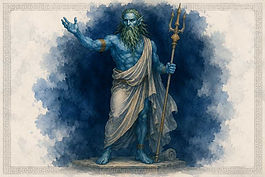
Phorcys is the ancient sea-god whose marriage to his own sister produced the most terrible monsters in Greek mythology, a primordial deity so old that he was born before the Olympian gods ever claimed Olympus. He is the son of Gaia, the primordial Earth, and Pontus, the personification of the sea itself, a union of land and water that produced a god of the deep places where no light reaches. He is the husband of Ceto, his sister and fellow child of the sea, whose name means "the whale" or "the sea-monster," and together they populated the oceans with creatures that would haunt Greek heroes for generations. He is the father of the Gorgons, the three sisters whose faces turned men to stone, of the Graeae, the three grey sisters who shared a single eye and a single tooth between them, and of Echidna, the half-woman half-serpent mother of Cerberus, the Hydra, the Chimera, and the Nemean Lion. He is the grandfather of Polyphemus, the one-eyed Cyclops who imprisoned Odysseus in his cave, through his daughter Thoosa, the nymph of the waves. And he is the old man of the sea whose very harbour on Ithaca, a sheltered cove with two jutting headlands that broke the force of the waves, bore his name and welcomed Odysseus home after twenty years of wandering, as if the primordial father of monsters had always kept a place for the hero who had survived them all.
Phrixus
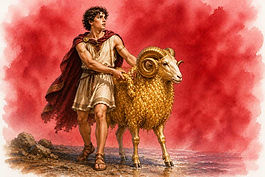
Phrixus is the rider of the golden ram, the boy who escaped the sacrificial altar of his own father and flew across the sky on a beast with a fleece of pure gold, leaving his sister behind in the sea that would take her name. He is the son of Athamas, the king of Orchomenus in Boeotia, and Nephele, the cloud-nymph whom the gods had given to the king as a divine bride. He is the victim of Ino, his stepmother, who roasted the seed corn to bring famine upon the land and then bribed the messengers of Delphi to return with a false prophecy demanding the children's deaths. He is the exile who reached Colchis on the far shore of the Black Sea, who married Chalciope, the daughter of King Aeetes, and who sacrificed the golden ram to Zeus and hung its fleece upon an oak tree in the grove of Ares, where a dragon guarded it until Jason came. And he is the man whose escape set in motion the most famous quest in Greek mythology, for without the golden fleece there would have been no Argo, no Jason, and no voyage that defined the age of heroes.