Greek Mythology List


Welcome to the Mythopouch list of Greek mythology entries! We also delve into the ancient history of Greece and the surrounding areas. From heroes to goddesses, places, monsters, artifacts, weapons, creatures and more - which will only grow over time. Mythopouch provides real-world information extracted from the original source material such as that from: Homer, Hesiod, Apollodorus, Ovid, Pausanias, Pindar, Aeschylus, Sophocles, Euripides, Hyginus, Diodorus Siculus and Apollonius of Rhodes. Words and stories carry powerful messages that were passed down from one generation to the next, many of which are still very applicable to modern times. Our unique imagery is meant to capture the imagination and ignite the magic mythology spark within us all. Our "token mark" coin symbol that is assigned to each record is a visual representation of the entity, for use in Mythopouch learning modules and games.
Learn - Earn - Play
Greek Entity Quick Index
Our current list of ancient Greek mythology and ancient history entities are here - which are growing day by day!
Search by using the:
-
"Search Mythology Records" function to browse all mythology records and blog pages;
-
Browse the visual cards with overviews by clicking "Go to Visual A-Z";
-
Or just browse and click the A-Z entries below....
See more list entries
Read Ancient Greek Insights
Click below to view our ancient Greek mythology blog article insights, where we delve into the current Mythopouch Tier regions and what we think you should know!


Greek Entity Card Index
See more card entries

Oenomaus
Oenomaus is the chariot-killer of Pisa, the king of Elis who murdered eighteen suitors rather than give his daughter Hippodamia to any man, and who died when his own divine horses dragged him to pieces across the rocks of the Olympic plain. He is the son of Ares, the god of war, and the possessor of a team of horses so swift that no mortal steeds could outrun them, a gift from his divine father that made him invincible in the chase and terrible in the kill. He is the father who loved his daughter too possessively, who received an oracle that he would be killed by his son-in-law and who chose murder over surrender, nailing the heads of his victims to the pillars of his palace as trophies of his refusal. He is the king who was betrayed by his own charioteer, Myrtilus, the son of Hermes, who replaced the bronze linchpins of his chariot with wax and sent him to his death in the dust. And he is the founder of the Olympic Games in death, for the contests that would become the greatest athletic festival of the ancient world were established on his grave to commemorate the race that killed him.

Ogygia
Ogygia is the hidden island where Calypso rescues Odysseus after the loss of his last companions and holds him for seven years before Zeus orders his release. It is the navel of the sea, an island at the far edge of the known world and yet central to Odysseus's inner journey. It is the home of Calypso's cave, where a great fire burns, cedar and juniper perfume the air, birds nest in the trees and four springs send clear water in different directions. It is the place where Odysseus sits on the shore by day, weeping towards Ithaca, while at night he sleeps beside the goddess who promises him immortality. It is the paradise that becomes a prison, the refuge that becomes an obstacle and the last stage before Odysseus returns to the human world of Phaeacia. It is the island whose location ancient geographers never settled, linking it to Gozo or Gaudos, Nymphaea near Corcyra, Othonoi, Perejil and even the Atlantic beyond Britain. And it is the primeval island whose name carries the adjective Ogygian, a word for things ancient beyond memory, remote beyond time and hidden beyond the borders of ordinary geography.

Oneiroi
The Oneiroi are the dream-spirits of Greek mythology, the black-winged sons of Night who emerge from the underworld each evening to slip through the keyholes and window-cracks of sleeping mortals, bringing visions that may heal the soul or shatter the mind. They are the children of Nyx, the primordial Night, or in some accounts of Hypnos, the god of sleep, and they dwell in a cavern near the river Oceanus, the world-encircling stream, where the sun never reaches and the poppies grow thick upon the walls. They are the messengers who pass through two gates: the gate of horn, through which pass the true dreams that warn and prophesy, and the gate of ivory, through which pass the false dreams that deceive and torment. They are the spirits who visited Penelope in her grief, who haunted the sleep of Clytemnestra with visions of blood, and who stood beside the bed of Achilles to comfort him after the death of Patroclus. And they are the oldest explanation for why we dream, the Greek answer to the mystery of the sleeping mind: that every vision in the night is a visitor from the dark, winged and wordless, bearing a message that we must learn to read.

Oracle of Delphi
The Oracle of Delphi is the most powerful voice in Greece, the priestess called the Pythia who sat upon a bronze tripod above a chasm and spoke the words of Apollo, god of prophecy and light. She is the woman whose riddles shaped the destinies of kings, from Croesus, king of Lydia, who asked whether he should attack Persia and was told he would destroy a great empire, only to discover too late it was his own. She is the priestess who told Laius, king of Thebes, that his son would kill his father and marry his mother, a prophecy that drove every tragedy that followed. She is the institution that declared Socrates, the Athenian philosopher who questioned everything, the wisest man in Athens because he alone knew he knew nothing. She is the sanctuary that declared Delphi the omphalos, the navel stone marking the centre of the world, proved by two eagles released by Zeus from opposite ends of earth. And she is the voice that fell silent in the fourth century CE when the Roman emperor Theodosius closed her temple, ending a tradition of prophecy that had guided the Greek world for over a thousand years.

Orestes
Orestes is the matricide who became the first man in history to be tried for murder and acquitted by a jury, the son of Agamemnon who avenged his father's death by killing his mother and then walked free because a goddess cast the deciding vote. He is the son of Agamemnon, the high king of the Greeks who led the thousand ships against Troy, and Clytemnestra, the queen who murdered her husband in his bath with the help of her lover Aegisthus. He is the boy who was smuggled out of Mycenae by his sister Electra and raised in Phocis by King Strophius, where he grew up with Pylades, the prince who would become his inseparable friend and the model of male devotion for all later Greek literature. He is the young man who returned to his father's house in secret, killed Aegisthus and Clytemnestra with a single sword, and then collapsed beneath the weight of what he had done. And he is the hunted son who was pursued by the Furies, the avenging spirits of matricide, across Greece until he reached Athens, where Athena herself presided over his trial and civilization was born from the verdict of a court.

Orpheus
Orpheus is the musician whose song was so beautiful that trees bent to listen, rivers changed their courses, and the very stones wept, the greatest bard in all of Greek mythology and the only mortal whose art was stronger than death itself. He is the Thracian poet who descended into the underworld, the realm of Hades, the god of the dead who ruled from the darkness beneath the earth, to reclaim his beloved wife Eurydice from the grip of death, armed with nothing but his lyre and his voice. He is the husband who won her freedom with music that moved the Furies, the dread goddesses of vengeance who tormented the wicked with whips and serpents, to tears, only to lose her forever when he turned to look back before they reached the light. He is the founder of a mystery religion, the Orphic cult, whose followers believed that the soul was divine and imprisoned in the body, and that purification through ritual and abstinence could free it from the cycle of rebirth. He is the poet whose hymns and theogonies were attributed to him for centuries, shaping Greek religious thought as deeply as Homer shaped its epic imagination. And he is the torn body whose head, thrown into the river Hebrus by the Maenads, the frenzied female followers of Dionysus, the god of wine and ecstatic revelry, still sang as it drifted to the sea.

Orthrus
Orthrus is the two-headed hound that guards Geryon's cattle on Erytheia and is killed by Heracles during the tenth labour. Hesiod makes him the first child named from the union of Typhon and Echidna and identifies him as Geryon's dog. Pseudo-Apollodorus later specifies that Orthrus has two heads and describes how the dog smells Heracles at his camp and attacks before being struck down. Orthrus is also connected with the Sphinx and the Nemean Lion in Hesiod's monster genealogy, although the identity of the mother in that passage is textually ambiguous and is often read as the Chimera rather than Echidna. His story is brief but precise: he is the first guardian Heracles must defeat before the red cattle can be taken.

Palladium of Troy
The Palladium of Troy is the wooden image of Athena that fell from heaven and made the city of Troy invincible for as long as it stood within her walls, the luck of a kingdom carved from the sacred olive wood of the goddess herself. It is the statue that Odysseus, the cunning king of Ithaca, and Diomedes, the prince of Argos, stole by night, crawling through a sewer and slaying the guards who watched over it, the theft that doomed Troy to fall. It is the image that the Trojan hero Aeneas, the son of the goddess Venus and the mortal Anchises, carried from the burning city to Italy, and that became the sacred guardian of Rome itself, housed in the temple of Vesta where the eternal flame burned. It is the statue that the Greeks believed had once been the height of a man, then shrank over the centuries, and that the Romans swore was still kept in the imperial palace as the safeguard of the empire. And it is the ancestor of every luck-bringer, every guardian icon, and every national treasure that a people believe protects them from destruction, the original proof that a city stands or falls by the god it keeps.

Pan
Pan is the goat-foot god of the wild who haunts the mountains of Arcadia, his horned head crowned with pine and his laughter echoing through the valleys. He is the inventor of the panpipes, the haunting instrument he carved from the reeds of a nymph who escaped his embrace by transforming into marsh plants. He is the god whose sudden, terrible cry sends armies into blind flight, a phenomenon called panic after his name. He is the shepherd who watches over flocks and hunters alike, protector of the lonely places where civilization ends and the wilderness begins. He is the companion of Dionysus, the god of wine and ecstatic revelry, riding with satyrs and maenads through the forests in midnight celebration. And he is the god whose supposed death was reported across the Mediterranean during the reign of the Roman emperor Tiberius, a moment that marked the passing of an age.

Pandora
Pandora is the first woman ever created, the all-gifted being whom the gods fashioned from clay and water to punish mankind for the theft of fire by Prometheus, the Titan who stole divine flame for humanity and was chained to a rock for eternity as punishment. She is the beautiful evil whose face was modeled by Hephaestus, the divine smith, and whose mind was filled with deceit by Hermes, the messenger god, making her irresistible and dangerous in equal measure. She is the wife of Epimetheus, the foolish Titan whose name means Afterthought, who accepted her as a gift from Olympus despite his brother Prometheus's warning never to take anything from Zeus. She is the mortal woman who lifted the lid of the great clay jar, the pithos, and released every sorrow and affliction into a world that had known only ease and plenty. She is the trembling hand that slammed the lid shut just in time to trap one thing at the bottom, the spirit of Hope, the single consolation that keeps humanity from total despair. And she is the eternal symbol of the double-edged gift, the beautiful face that hides a ruinous purpose, and the curiosity that changes the world forever.

Pandora's Jar
Pandora's Jar is the sealed clay vessel that unleashed every evil upon the human race, the most destructive gift ever given by the gods and the single object that transformed mortal life from ease and plenty into struggle, suffering, and toil. It is the container that held every sorrow the gods could devise, from disease and famine to war and despair, all packed into one jar and given to the first woman, Pandora, as her dowry when she was sent down to earth to punish mankind for the theft of fire by Prometheus, the Titan who stole divine flame for humanity and was chained to a rock for eternity as punishment. It is the vessel that Pandora opened in curiosity, releasing plagues and pains into the world like a swarm of black insects, and that she slammed shut just in time to trap one thing at the bottom, the one thing that keeps humanity from total despair. It is the jar that became a box in later centuries when a mistranslation by Erasmus, the Renaissance scholar, changed the Greek word pithos, meaning a large storage jar, into the Latin pyxis, meaning a small box, and so created one of the most famous misnomers in Western culture. And it is the symbol that still appears in every warning about unintended consequences, every cautionary tale about curiosity, and every debate about whether hope is a blessing or the cruellest torment of all.
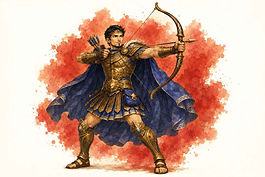
Paris
Paris is the Trojan prince whose choice of the most beautiful goddess set in motion the greatest war in Greek mythology, the ten-year siege of Troy that consumed heroes, kingdoms, and the age of bronze itself. He is the shepherd who was raised on Mount Ida, the mountain near Troy where he herded sheep and dreamed of glory, unaware that he was the son of King Priam, the ruler of Troy, and Queen Hecuba, who had abandoned him as an infant because of a prophecy that he would destroy the city. He is the judge who awarded the golden apple to Aphrodite, the goddess of love and beauty born from the foam of the sea, when Hera, the queen of the gods, and Athena, the goddess of wisdom born fully armed from the head of her father Zeus, the king of the gods and wielder of the thunderbolt, also claimed it, and in doing so won the love of the most beautiful woman in the world but earned the eternal hatred of the two most powerful goddesses on Olympus, the sacred mountain where the twelve great Olympian gods made their eternal home. He is the abductor who sailed to Sparta and carried away Helen, the wife of King Menelaus, a princess whose face was said to have launched a thousand ships and whose beauty was so great that every prince of Greece had once competed for her hand. He is the archer who killed Achilles, the greatest warrior of the Trojan War, by shooting him in the heel, the one weak spot where his mother Thetis, the sea-nymph, had held him when she dipped him in the River Styx to make him invulnerable. And he is the man who, in the tenth year of the war, faced Menelaus in single combat to decide the fate of Troy, only to be saved by Aphrodite when defeat was certain, and who later died by the bow of Philoctetes, the Greek archer whom the gods had forced to join the war at the last hour.