Greek Mythology List


Welcome to the Mythopouch list of Greek mythology entries! We also delve into the ancient history of Greece and the surrounding areas. From heroes to goddesses, places, monsters, artifacts, weapons, creatures and more - which will only grow over time. Mythopouch provides real-world information extracted from the original source material such as that from: Homer, Hesiod, Apollodorus, Ovid, Pausanias, Pindar, Aeschylus, Sophocles, Euripides, Hyginus, Diodorus Siculus and Apollonius of Rhodes. Words and stories carry powerful messages that were passed down from one generation to the next, many of which are still very applicable to modern times. Our unique imagery is meant to capture the imagination and ignite the magic mythology spark within us all. Our "token mark" coin symbol that is assigned to each record is a visual representation of the entity, for use in Mythopouch learning modules and games.
Learn - Earn - Play
Greek Entity Quick Index
Our current list of ancient Greek mythology and ancient history entities are here - which are growing day by day!
Search by using the:
-
"Search Mythology Records" function to browse all mythology records and blog pages;
-
Browse the visual cards with overviews by clicking "Go to Visual A-Z";
-
Or just browse and click the A-Z entries below....
See more list entries
Read Ancient Greek Insights
Click below to view our ancient Greek mythology blog article insights, where we delve into the current Mythopouch Tier regions and what we think you should know!


Greek Entity Card Index
See more card entries

Herse
Herse is the daughter of Cecrops, the half-serpent first king of Athens, and the sister who opened Athena's forbidden chest to gaze upon the earth-born child Erichthonius. She is one of the three Cecropid sisters, alongside Aglauros and Pandrosos, whose story gave the Athenian Acropolis its most famous tale of forbidden knowledge and divine punishment. She is the obedient sister in some tellings, the transgressive one in others, with the roles shifting among Herse, Aglauros and Pandrosos as each ancient writer reshaped the tale. She is the radiant maiden who caught Hermes' eye during an Athenian festival, when the god circled her like a bird of prey until her jealous sister demanded gold to admit him. She is the shadowy mother of Cephalus or Ceryx in later genealogies, tying the Cecropid house to the hero who was loved by Eos and the herald of the Eleusinian Mysteries. And she is the dew-bearing daughter whose name connects her to the moisture that fed Athenian fields, though her myth belongs to the sealed basket, the divine child and the fatal cliff above the city.

Hesiod
Hesiod is the Boeotian poet whose Theogony and Works and Days survive as the most securely attributed works in his name. He is the farmer-poet of Ascra, son of a father who left the Aeolian city of Cyme to seek a better life on the Greek mainland. He is the shepherd who received his poetic gift directly from the Muses beside Mount Helicon, where nine goddesses breathed a divine voice into him and commanded him to sing of the immortal gods. He is the poet of justice, who quarrelled with his brother Perses over an inheritance and transformed a private dispute into a universal poem about work, law, greed and Zeus's rule. He is the mythographer of the cosmos, tracing Chaos, Earth, Sky, Titans, Olympians, monsters and mankind through a genealogy of power. He is the teacher of the Ages of Man, Pandora, the Promethean theft of fire and the two kinds of strife. He is the traditional rival of Homer, defeating the greater epic singer in a legendary contest because his poetry praised peace and farming while Homer sang of war. He is the ancient name around which a much larger Hesiodic corpus gathered, including the spurious Shield of Heracles and the debated Catalogue of Women. And he is the first Greek author whose poems speak in a recognisable personal voice, naming himself, describing his land, attacking injustice and turning everyday labour into epic.

Hesione
Hesione is the Trojan princess who was chained to a rock as a sacrifice to a sea monster and rescued by Heracles, the hero forced to complete twelve impossible labours, only to be given away as a prize to his companion Telamon and forgotten by the city that once called her king's daughter. She is the daughter of Laomedon, the king of Troy who cheated the gods and brought ruin upon his house, and the sister of Priam, the last king of Troy who would one day watch the same city burn. She is the mother of Teucer, the greatest archer of the Greeks at Troy who could not return home because of his father's crime. She is the woman whose rescue was the first act of violence against Troy by a Greek hero, the precedent that made the later war thinkable, and the victim whose fate foreshadowed the fate of every Trojan woman who would be dragged from the burning city a generation later. And she is the forgotten princess of Greek myth, the woman saved by the greatest hero and abandoned by the greatest king, a footnote in the story of Troy who nonetheless set in motion the hatred that would destroy her world.

Hesperides
The Hesperides are the nymphs of the western evening, the daughters of Atlas who tend the garden of golden apples at the edge of the world where the sun goes down. They are the maidens whose voices are the sound of dusk settling over the ocean, whose hair catches the last light of the day, and whose garden contains the most precious fruit ever grown, a tree of golden apples that Gaia, the earth-goddess, gave to Hera, the queen of Olympus, as a wedding gift. They are the nymphs who dance in the twilight, who sing to the serpent Ladon that coils around their tree, and who welcomed the hero Heracles, the son of Zeus who was forced to complete twelve impossible labours, when he came to steal what they guarded. They are the sisters whom the Greeks placed in the far west, beyond the pillars of Heracles, in a land where the sunsets last forever and the apples glow like molten metal in the branches. And they are the eternal guardians of the boundary between the known world and the dark beyond, the nymphs who prove that the most beautiful things in myth are always the most fiercely protected.
Hestia
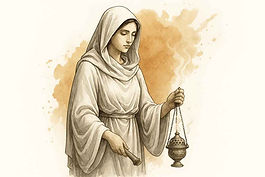
Hestia is the eldest of the Olympian gods, the first-born child of the Titans Cronus and Rhea, and the last to be vomited up by her father after Zeus forced him to disgorge his swallowed children. She is the goddess of the hearth, the sacred fire that burns at the center of every home, every temple, and every city in Greece, the flame that must never be allowed to die. She is the only Olympian who never took part in the wars of the gods, the quarrels of heroes, or the schemes of mortals, and for that peace she was granted the first portion of every sacrifice and the highest seat at every feast. She is the virgin goddess who refused marriage offers from both Poseidon, the god of the sea who shook the earth with his trident, and Apollo, the golden god of music and prophecy who drove his chariot across the sky. And she is the silent guardian of domestic order, the deity who asks nothing but that the fire be kept burning, a presence so fundamental that the Greeks rarely told stories about her because her power was too deep for drama.

Hippasus
Hippasus is the enigmatic Pythagorean philosopher of southern Italy whose legend made him the martyr of irrational numbers. He is the early Greek thinker who placed fire at the beginning of the universe and described the cosmos as finite, in motion and governed by changing cycles. He is the experimenter who struck bronze disks of different sizes and discovered the musical ratios that make harmony. He is the mathematician credited with constructing the dodecahedron inside a sphere, one of the most difficult forms in ancient geometry. He is the Pythagorean who broke the silence of the school by revealing a secret that seemed to violate its doctrine of number. He is the philosopher who drowned at sea, whether thrown overboard by his fellows, punished by the gods or lost in a storm remembered as divine justice. And he is a figure whose historical existence is secure but whose greatest deeds are buried beneath later legend, making him less a recovered life than a question mark that mathematics has refused to forget.

Hippocampus
Hippocampus is the legendary sea-creature with the head and forequarters of a horse and the tail of a fish, the chariot-beast of Poseidon, the god of the sea, and the mount of the Nereids, the fifty sea-nymph daughters of the Titan Nereus who attended the ocean god. It is the creature that pulled the chariot of Poseidon across the waves, its hooves striking foam from the water as it galloped through the depths. It is the steed of the sea-god's retinue, the mount upon which the Tritons, the merman attendants of Poseidon who blew conch-shell trumpets, rode in procession through the ocean. It is the creature depicted on ancient coins, carved into temple friezes, and painted on the walls of Roman baths, a symbol of the boundary between the world of land and the world of water. It is the ancestor of the modern word "hippocampus," the name given to the seahorse-shaped structure in the human brain that governs memory. Every wave that breaks upon the shore carries the echo of its galloping hooves.
Hippocrene
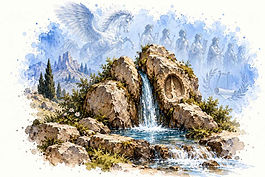
Hippocrene is the Horse's Fountain of Mount Helicon, a spring named by Hesiod among the waters used by the Muses and later explained as the mark of Pegasus's hoof. The distinction between these layers matters. Hesiod already knows Hippocrene but does not say that Pegasus created it. Pausanias supplies that later origin story, saying the horse of Bellerophon struck the ground and made the spring. Callimachus sets the blinding of Tiresias at Hippocrene, while Ovid imagines Athena visiting Helicon to inspect the newly famous spring of Pegasus. Roman poets later made Hippocrene a conventional symbol of poetic inspiration, even though Hesiod's own poetic calling occurs generally beneath Helicon rather than explicitly beside this spring.

Hippodamia
Hippodamia is the princess of Pisa whose hand in marriage was won by a chariot race that killed her father and cursed the next three generations of her descendants, the most cursed royal house in all Greek mythology. She is the daughter of Oenomaus, the king of Pisa in Elis who loved her so possessively that he murdered eighteen suitors rather than give her away, and the wife of Pelops, the Phrygian prince whose name became the word for the whole Peloponnese, the island of Pelops. She is the mother of Atreus and Thyestes, the brothers whose feud of adultery, cannibalism, and revenge produced Agamemnon and Menelaus, the kings who launched the thousand ships against Troy. She is the woman who stood beside the finish line and watched her father's chariot collapse, his body dragged to death by his own horses, and who rode away from the scene as the bride of a man who had bought her with treachery and murder. And she is the forgotten matriarch of Greek tragedy, the queen whose wedding day was the beginning of a curse that would not end until Orestes, her great-grandson, was pursued by the Furies to the threshold of madness.

Hippolyta
Hippolyta is the Amazon queen whose girdle becomes the object of Heracles' ninth labour. Pseudo-Apollodorus says Ares gave her the girdle as a sign of her pre-eminence among the Amazons and tells how Hippolyta was initially willing to give it to Heracles before Hera stirred the Amazons to attack. Other traditions alter the battle, the captive Amazons and Hippolyta's fate. A second group of stories connects Theseus with an Amazon wife and the invasion of Attica, but the woman's identity varies: Antiope is common, while Hippolyta appears in some sources. The same variation affects the mother of Hippolytus. Hippolyta should therefore be treated as the securely named queen of the girdle labour, with the Theseus, motherhood and wedding-death episodes clearly marked as overlapping variants rather than one fixed biography.

Hippolytus
Hippolytus is the son of Theseus and an Amazon mother whose tragedy is defined by his devotion to Artemis, his rejection of Aphrodite and Phaedra's destructive passion. Many sources name his mother Antiope, while some traditions use Hippolyta or another Amazon name. Euripides' surviving Hippolytus makes Aphrodite drive Phaedra to desire her stepson because Hippolytus honours Artemis and rejects Aphrodite's sphere. After Phaedra dies and leaves a false accusation, Theseus calls on Poseidon to punish his son. A monster from the sea terrifies Hippolytus' horses, the chariot is wrecked and the young man is fatally injured. Artemis reveals the truth before he dies. A separate Roman tradition later revives him through Asclepius and carries him to Italy as Virbius.

Hippomenes
Hippomenes is the swift-footed suitor who won Atalanta, the fastest woman in Greece, by throwing golden apples across a racecourse and claiming her for his bride while she stooped to pick them up. He is the son of Megareus, the king of Onchestus in Boeotia, and the young man who dared to compete against a huntress who had already killed every other suitor who tried to outrun her. He is the favourite of Aphrodite, the goddess of love, who gave him three golden apples from the garden of the Hesperides, the nymphs who tended the tree of golden fruit at the western edge of the world. He is the husband who could not keep his prize, who made love to his wife in a temple of Zeus and was punished by being transformed into a lion, the king of beasts, losing his human mind and his human voice forever. And he is the proof that in Greek mythology, winning the prize is never the end of the story, and that the gods who help you claim a wife will not protect you from your own lack of self-control.