Arthurian Mythology List


Welcome to the Mythopouch list of Arthurian Legend mythology entries! We also delve into the early history of Britain, Wales, and the Celtic and medieval traditions that shaped the Arthurian world. From kings, queens, knights and mages to castles, quests, monsters, artefacts, weapons, enchanted objects, creatures and more, this collection will continue to grow over time. Mythopouch provides real-world background and mythological information drawn from early chronicles, Welsh tales and medieval romances such as: the Welsh Triads, Culhwch and Olwen, the Historia Brittonum, the Annales Cambriae, Geoffrey of Monmouth, Chrétien de Troyes, the Lancelot-Grail or Vulgate Cycle, Sir Gawain and the Green Knight, and Thomas Malory’s Le Morte d’Arthur. Arthurian legend carries powerful ideas about courage, honour, loyalty, temptation, sacrifice, prophecy, betrayal and the dream of a better kingdom - messages passed from storyteller to storyteller for centuries, many of which still speak to modern life. Our unique imagery is meant to capture the imagination and ignite the Arthurian spark within us all. Our “token mark” coin symbol assigned to each record is a visual representation of the entity, for use in Mythopouch learning modules and games.
"Nothing is given, everything is earned" at Mythopouch!
Learn - Earn - Play
Arthurian Entity Quick Index
Our current list of ancient British mythology (Arthurian Legend) and ancient history entities are here - which are growing day by day!
Search by using the:
-
"Search Mythology Records" function to browse all mythology records and blog pages;
-
Browse the visual cards with overviews by clicking "Go to Visual A-Z";
-
Or just browse and click the A-Z entries below....
See more list entries
Read Arthurian Legend Insights
Click below to view our Arthurian Legend (ancient British) mythology blog article insights, where we delve into the current Mythopouch Tier regions and what we think you should know!


Arthurian Entity Card Index
See more card entries

Vortigern (King)
Vortigern is the legendary British ruler whose decision to employ Saxon warriors became the medieval explanation for the beginning of Anglo-Saxon conquest. He is the king later stories place behind the rise and murder of Constans, the arrival of Hengist and Horsa, and the grant of Kent to Hengist after a disastrous royal marriage. He is the father of Vortimer, the British prince who fights the Saxons before dying in the romance tradition. He is the survivor of the Treachery of the Long Knives, when unarmed British nobles are slaughtered at a supposed peace meeting. He is also the ruler whose collapsing fortress at Dinas Emrys leads to the discovery of the red and white dragons, a prophecy later absorbed into the story of Merlin. Whether a historical ruler stands behind the name remains uncertain, but medieval Britain remembered Vortigern as the king whose attempt to buy security opened the island to a greater danger.
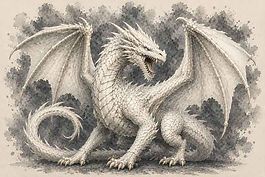
White Dragon
The White Dragon of Dinas Emrys stands as one of the foundational symbols of Arthurian Britain-a supernatural creature whose battle beneath Vortigern's doomed tower set in motion the prophecies that would elevate Merlin from fugitive child to the greatest wizard of medieval legend. Its story first appears in Nennius's Historia Brittonum (c. 829), one of the earliest surviving sources for Arthurian material, where the boy Emrys (later identified with Merlin) interprets the combat between two dragons for the British warlord Vortigern. The White Dragon represents the invading Saxons-those Germanic peoples who, invited into Britain by Vortigern himself as mercenaries under Hengist and Horsa, gradually seized territory until they threatened to consume the island. Its whiteness symbolizes the pale complexion of the northern invaders and the cold, destructive force of conquest that would reshape Britain.
The setting of the White Dragon's battle is Dinas Emrys, a hillfort rising 250 feet above the Gwynant valley in northwestern Wales. According to the Historia Brittonum, Vortigern retreated to Wales after inviting the Saxons to Britain and attempted to build a fortress on this strategic height. But the tower's foundations collapsed each night, no matter how diligently the builders worked by day. Vortigern's magicians advised him that the structure could only stand if he sacrificed a boy born without a father-blood sprinkled on the stones would secure the foundations. The boy they found was Myrddin Emrys (Merlin Ambrosius), who, when brought before Vortigern, revealed that the tower collapsed not because of any magical requirement for sacrifice, but because two dragons fought in a pool beneath the hill. Excavations in the 1950s revealed an actual cistern beneath Dinas Emrys, confirming the ancient association between the site and underground water.

White Stag
The White Stag is the supernatural quarry whose hunt turns celebration into adventure in some of the earliest Arthurian romances. In Chrétien de Troyes's Erec and Enide, Arthur revives the custom of hunting the white stag at Easter, even though Gawain warns that the prize will cause rivalry: the hunter must kiss the fairest lady at court. Arthur kills the stag while Erec, separated from the main hunt with Guinevere, is drawn into the insult and pursuit that will lead him to Enide. The Welsh Geraint and Enid preserves the same opening structure. Malory later uses a different white hart as a courtly marvel, sending it through Arthur's hall with hounds in pursuit and launching another set of adventures. Across these related traditions the white animal is less a single continuous creature than a recurring herald of movement, drawing Arthur's household out of ceremony and onto the road.

Ysbaddaden
Ysbaddaden is the chief giant of all Britain, the monstrous father of Olwen whose eyelids drooped so low that they had to be propped up with golden forks, and who was fated to die the very day his daughter married. He is the tyrant who murdered twenty-three of his own nephew's children out of cruelty, stripped his brother the shepherd Custennin of his lands, and guarded Olwen in a castle so fair that men called it the fairest in the world. He is the giant who set Culhwch forty impossible tasks, the anoethau, ranging from the ploughing of a barren field in a single day to the hunting of Twrch Trwyth, a former Irish king transformed by God into a monstrous boar whose comb, razor, and shears lay hidden between his ears. He is the fork-eyed monster who threw poisoned stone-spears at Arthur's warriors for three days running, only to have every spear caught and hurled back into his own flesh. And he is the giant whose own beard became the instrument of his death, for when Culhwch completed the impossible and returned to shave him, the blade cut to the bone, and Ysbaddaden's nephew Goreu avenged his murdered brothers by striking off the tyrant's head and placing it on the spike of the citadel.

Yvain
Yvain is the Knight of the Lion, the Arthurian hero who went mad in the forest after losing the love of his lady, was healed by a magic ointment, and earned the loyalty of a lion by slaying the serpent that held it captive. He is the son of King Urien of Gorre and the nephew of King Arthur, a knight who killed the guardian of a magical fountain, married the dead man's widow, and then lost everything because he loved tournament glory more than his word. He is the champion who defended the maid Lunete when she was condemned to burn, who defeated the giant Harpin of the Mountain, and who fought his own cousin Gawain in a day-long combat so brutal that neither knew the other's face until their voices gave them away. He is the figure at the centre of the most psychologically complex Arthurian romance, Chrétien de Troyes's Le Chevalier au Lion, a knight whose story was retold in Welsh as Owain in the Mabinogion, in German as Hartmann von Aue's Iwein, and in English as Ywain and Gawain. And he is the knight who, in the end, won back his lady's love not by force but by faithful service, proving that a knight's greatest conquest is the trust he forges anew after breaking it.