Arthurian Mythology List


Welcome to the Mythopouch list of Arthurian Legend mythology entries! We also delve into the early history of Britain, Wales, and the Celtic and medieval traditions that shaped the Arthurian world. From kings, queens, knights and mages to castles, quests, monsters, artefacts, weapons, enchanted objects, creatures and more, this collection will continue to grow over time. Mythopouch provides real-world background and mythological information drawn from early chronicles, Welsh tales and medieval romances such as: the Welsh Triads, Culhwch and Olwen, the Historia Brittonum, the Annales Cambriae, Geoffrey of Monmouth, Chrétien de Troyes, the Lancelot-Grail or Vulgate Cycle, Sir Gawain and the Green Knight, and Thomas Malory’s Le Morte d’Arthur. Arthurian legend carries powerful ideas about courage, honour, loyalty, temptation, sacrifice, prophecy, betrayal and the dream of a better kingdom - messages passed from storyteller to storyteller for centuries, many of which still speak to modern life. Our unique imagery is meant to capture the imagination and ignite the Arthurian spark within us all. Our “token mark” coin symbol assigned to each record is a visual representation of the entity, for use in Mythopouch learning modules and games.
"Nothing is given, everything is earned" at Mythopouch!
Learn - Earn - Play
Arthurian Entity Quick Index
Our current list of ancient British mythology (Arthurian Legend) and ancient history entities are here - which are growing day by day!
Search by using the:
-
"Search Mythology Records" function to browse all mythology records and blog pages;
-
Browse the visual cards with overviews by clicking "Go to Visual A-Z";
-
Or just browse and click the A-Z entries below....
See more list entries
Read Arthurian Legend Insights
Click below to view our Arthurian Legend (ancient British) mythology blog article insights, where we delve into the current Mythopouch Tier regions and what we think you should know!


Arthurian Entity Card Index
See more card entries

Spear of Longinus
The Spear of Longinus is the weapon that pierced the side of Jesus Christ as he hung dead upon the cross, the lance whose thrust released a stream of blood and water that has shaped Christian theology, art, and legend for two thousand years. It is the spear of an unnamed Roman soldier, later called Longinus, who stabbed the crucified Christ to confirm his death when the Jewish authorities asked Pilate to break the legs of the condemned so that their bodies might be removed before the Sabbath began. It is the relic that healed the soldier's own blindness, according to legend, when the blood and water from Christ's wound fell upon his eyes, converting him on the spot to the faith of the man he had just killed. It is the lance that became the most coveted object in medieval Europe, carried by Constantine the Great into battle, inherited by Charlemagne, and made the centrepiece of the Imperial Regalia of the Holy Roman Empire, the collection of sacred objects used to crown the rulers of Central Europe for a thousand years. It is the weapon that the Crusaders believed they had discovered buried beneath the floor of a church at Antioch in 1098, a find that turned a starving and surrounded army into a victorious host overnight. And it is the bleeding lance of Arthurian Grail romance, the spear that drips blood in the Grail procession witnessed by Perceval, the knight who failed to ask the question that would have healed the wounded Fisher King, and that Richard Wagner made the instrument of both wound and salvation in his opera Parsifal, where the same spear that pierced Christ is the only thing that can heal the king who guards the Grail.

Stonehenge
Stonehenge is the most famous prehistoric monument in the world, the circle of massive sarsen stones and smaller bluestones on Salisbury Plain that has inspired legends of giants, wizards, and ancient kings for over a thousand years. It is the Giant's Dance, the stone circle that Geoffrey of Monmouth claimed was brought from Ireland by Merlin's magic at the command of King Aurelius Ambrosius, to serve as a memorial for the British nobles treacherously slaughtered by the Saxon leader Hengist. It is the temple of healing stones, where every rock was said to possess medicinal virtue, where giants of old had washed the stones and bathed the sick in water that infallibly cured them. It is the place where the Devil himself was said to have built the circle, throwing the Heel Stone at a friar who outwitted him with a riddle. It is the astronomical calculator aligned to the midsummer sunrise, the burial ground of kings, and the centre of a ceremonial landscape that stretches across the Wiltshire downs. And it is the reminder that the most enduring monuments are those whose builders remain unknown, leaving only stones that outlast every empire, every legend, and every attempt to explain them.

Taliesin
Taliesin is the early British bard whose name became a voice for both royal praise and supernatural knowledge. A historical poet active towards the end of the sixth century is associated with songs for Urien Rheged and other rulers, while later literature transforms Taliesin into a wonder-working child and a speaker who remembers events beyond a human lifetime. In the rebirth story, he begins as Gwion Bach, gains inspiration from Ceridwen's cauldron, escapes through changing shapes and is swallowed before being born again. Elphin finds the infant and becomes the patron whose fortunes the miraculous bard defends. The Book of Taliesin preserves poetry from different periods, including Arthurian material such as Preiddeu Annwn, but the manuscript is not the historical poet's own book. Keeping these layers distinct allows the real bard and the legendary persona to be explored together without treating shapeshifting as biography or attributing every poem under his name to one sixth-century author.

Tarn Wadling
Tarn Wadling is the lost lake of Arthurian legend, a shallow body of water between Carlisle and Penrith in Cumbria that was famous for its carp in the Middle Ages and famous for its ghosts in the poems, and that was drained to nothing in the nineteenth century by farmers who preferred pasture to mystery. It is the tarn where King Arthur met the Baron of Tearne Wadling, the menacing knight who threatened the king's life and whose sister was the loathly lady Dame Ragnelle, the hideous hag who would become Sir Gawain's bride. It is the lake where the ghost of Queen Guinevere's mother glided across the water in the fifteenth-century poem The Awntyrs off Arthure, a rotting figure covered in toads and serpents, glowing with a spectral flame, who warned her daughter of pride and prophesied the fall of the Round Table. It is the tarn that Gervase of Tilbury called Laikibrait, "the lake which cries," a name that may have come from the methane released by its murky bed, the will-o-the-wisps that flickered above its surface, or the wailing of the dead who were said to dwell in its depths. And it is the lake that appears on the fourteenth-century Gough Map alongside Lake Windermere, the only two bodies of water marked in that part of England, proof that a pool of five or six hundred yards across could command the imagination of a kingdom.

Thames
The Thames is the dark river that runs through the heart of Britain, a sacred waterway whose Celtic name Tamesa means "smooth" or "wide spreading" and whose Latin form Tamesis gave the world the deity known as Old Father Thames, the river god with flowing beard and hair who carries an urn of plenty. It is the river that the Britons regarded as a living being, an important member of the community and the lifeblood of the land, into whose waters they cast swords, shields, and precious offerings for two thousand years to appease the spirits that dwelt beneath the surface. It is the guardian river of Gildas, the sixth-century chronicler who declared that the Thames was always the river of boundaries, the liminal space between two jurisdictions where kings met to negotiate and saints were martyred. It is the river where Brutus, the grandson of Aeneas and the legendary founder of Britain, came ashore to build Troia Nova, the city that would become London. And it is the river that St. Alban parted with prayer in the fourth century, whose waters stood abrupt like precipices on either side so that the martyr could walk across dry ground to his execution, a miracle that made the Thames a Christian holy river while never fully dispelling the older gods who still linger in its currents.

Thomas Malory (Sir)
Sir Thomas Malory is the fifteenth-century English knight-prisoner whose Le Morte Darthur became the most influential English telling of King Arthur's rise, fellowship and fall. He is the writer who names himself as "Sir Thomas Malleorre, knyght" and repeatedly asks readers to pray for his "good delyveraunce", words that place the making of his book inside imprisonment. He is the author who drew on enormous French prose cycles, the Prose Tristan and older English Arthurian poems, then reshaped them into a fast-moving English narrative of Uther Pendragon, King Arthur, Lancelot, the Holy Grail, Guinevere and the destruction of the Round Table. He completed the work in the ninth year of King Edward IV, between March 1469 and March 1470, while England was being torn apart by the Wars of the Roses. He died in 1471 and never saw William Caxton print the book in 1485. And he is the author whose text was transformed again in modern understanding when the Winchester Manuscript was discovered in 1934, revealing a Malory closer to the medieval page than readers had seen for nearly five centuries.
Tintagel
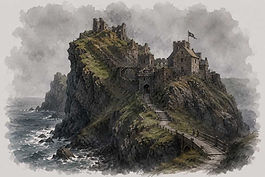
Tintagel is the castle where the Arthurian age was conceived, the sea-girt fortress on the north coast of Cornwall where Gorlois locked away his wife Igraine and where Merlin's craft admitted a king in a borrowed face. It is the impregnable rock of Geoffrey of Monmouth, ringed by the sea but for one narrow way, that no army could take and one enchantment entered without a blow. It is the castle of King Mark in the Tristan legend, the seat from which the sorrow of Isolde was ruled, and the shore where one tradition has Merlin find the infant Arthur, cast up naked by the waves. It is also a real place: a citadel of the Dark Age kings of Dumnonia, rich with wine and oil from the Mediterranean, where archaeologists have uncovered the grandest stronghold of Arthur's century. And it is a castle built backwards: the ruins that crown the headland today were raised in the 13th century by an earl who wanted to own the legend, making Tintagel that rare thing, a fortress that became real because of its story.

Tristan
Tristan is the greatest tragic hero of Arthurian romance, the nephew of King Mark of Cornwall who slew a dragon to win the Irish princess Isolde for his uncle and then fell hopelessly in love with her through a fateful draught. He is the knight of Lyonesse, orphaned when his father Rivalen died in battle before his birth, raised at his uncle's court to become the finest warrior and musician in Britain, the man whose skill on the harp could make stone weep and whose prowess with the sword could slay any beast. He is the lover who shared a love potion with Isolde on the voyage back from Ireland, binding them together in a passion so absolute that no duty, no king, and no church could tear them apart. He is the exile who fled to the forest of Morois with Isolde, who laid his sword between them as they slept to prove their honour, and who was driven from Cornwall into the arms of another woman he could never love. And he is the dying knight who sent for Isolde across the sea, who watched for the colour of the sail, and who yielded up his spirit when the black canvas told him she had not come, a tragedy that has inspired poets, composers, and lovers for eight hundred years.
Tro the Boar, Twrch Trwyth
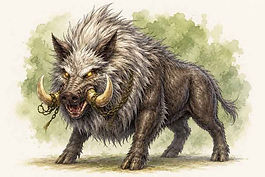
Twrch Trwyth (Tro the Boar) is an enchanted monstrous boar from Welsh Arthurian legend, the greatest monster in the early Welsh Mabinogion and the earliest named adversary associated with King Arthur in written literature. The boar's name literally means "the boar, Trwyth" in Welsh - the creature was originally a king named Trwyth, son of Taredd Wledig, who had been transformed into a swine by divine punishment. He appears first in Nennius's Historia Brittonum (c. 829 CE) in the De Mirabilibus Britanniae ("Wonders of Britain") appendix, where the footprint of Arthur's dog Cabal (Cavall) is described as having been made while chasing the great boar Troynt. The full narrative of the hunt appears in Culhwch and Olwen (c. 1100), the earliest Arthurian tale in the Mabinogion collection and the first written record of King Arthur in a narrative context.
Twrch Trwyth is a monster of terrifying proportions: a gargantuan boar whose poisonous bristles, supernatural speed, and enormous strength make him nearly invincible. Between his ears are hidden three magical implements - a comb, a pair of scissors, and a razor - which are the object of the heroes' quest and the key to completing the impossible tasks set by the giant Ysbaddaden Bencawr.
Tryamour (Lady)
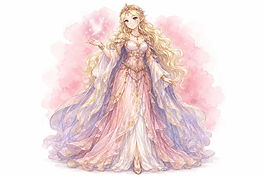
Lady Tryamour is the fairy princess whose beauty outshone Queen Guinevere so that a single breath from her lips struck the queen blind, a punishment delivered in the full sight of King Arthur and every knight of the Round Table. She is the daughter of the King of Olyroun, the sovereign of all the fairies of the Occident, the western realm beyond the mortal world, a kingdom of eternal summer where the wounded are healed and the old grow young. She is the mistress who rescued Sir Launfal, the impoverished steward of Arthur's court, from despair, offering him a magical purse that never emptied, a white horse named Blaunchard swifter than any mortal steed, an invisible dwarf servant named Gyfre, and armour that no weapon could pierce. She is the lover who demanded absolute secrecy as her price, warning that a single spoken word about her existence would shatter every enchantment forever. And she is the lady who rides out of the sky on a white palfrey to save her knight from the gallows, proving that in the fairy realm, love is a contract written in silence and sealed with power that no mortal court can match.

Uther Pendragon
Uther Pendragon is the father of King Arthur and the storm before the golden age, the fierce, lovesick and war-haunted king of Britain whose single night at Tintagel begot everything that followed. He is the younger brother of Aurelius Ambrosius, who fought the Saxons at his brother's side, led the expedition that carried the Giant's Dance from Ireland to raise Stonehenge, and took the dragon's name from a blazing star that promised him the crown. He is the king who burned with desire for Igraine, the wife of his own Duke of Cornwall, and who wore another man's face, by Merlin's craft, to enter her chamber while her true husband died that same night at his siege. He is the sick king carried in a litter to his last victory, poisoned by the spring he trusted, and laid to rest among the stones he had raised. And he is the darker half of the Arthurian beginning, the passion to Arthur's justice, the deception that made the king and planted the seed of all that came after.

Valentyne (Sir) of Lombardy
Sir Valentyne of Lombardy is the fifteen-foot giant knight whose challenge arrives at the exact centre of the romance of Sir Launfal, the moment when the fairy-touched steward must prove his knighthood all over again. He is the lord of Atalye, a terrifying figure from the Italian north who hears of Launfal's prowess and burns with envy, sending a messenger to Arthur's court to demand that the English knight travel to Lombardy and joust with him or else have his manhood shamed forever. He is the colossal adversary whose sheer size makes the contest grotesque rather than glorious, a giant who knocks Launfal's helmet from his head and shatters his shield with blows so mighty that only the invisible dwarf Gyfre, the fairy servant of Lady Tryamour, keeps the English knight from instant death by snatching up his fallen gear unseen. He is the knight whose name evokes the feast of lovers yet whose body embodies brute masculine potency, a deliberate contrast that turns the duel into a test of Launfal's honour combined. And he is the giant who dies on Lombard soil, slain by Launfal's sword after the invisible dwarf has tilted the combat, his death proving that fairy magic can defeat even the most monstrous mortal strength.