Arthurian Mythology List


Welcome to the Mythopouch list of Arthurian Legend mythology entries! We also delve into the early history of Britain, Wales, and the Celtic and medieval traditions that shaped the Arthurian world. From kings, queens, knights and mages to castles, quests, monsters, artefacts, weapons, enchanted objects, creatures and more, this collection will continue to grow over time. Mythopouch provides real-world background and mythological information drawn from early chronicles, Welsh tales and medieval romances such as: the Welsh Triads, Culhwch and Olwen, the Historia Brittonum, the Annales Cambriae, Geoffrey of Monmouth, Chrétien de Troyes, the Lancelot-Grail or Vulgate Cycle, Sir Gawain and the Green Knight, and Thomas Malory’s Le Morte d’Arthur. Arthurian legend carries powerful ideas about courage, honour, loyalty, temptation, sacrifice, prophecy, betrayal and the dream of a better kingdom - messages passed from storyteller to storyteller for centuries, many of which still speak to modern life. Our unique imagery is meant to capture the imagination and ignite the Arthurian spark within us all. Our “token mark” coin symbol assigned to each record is a visual representation of the entity, for use in Mythopouch learning modules and games.
"Nothing is given, everything is earned" at Mythopouch!
Learn - Earn - Play
Arthurian Entity Quick Index
Our current list of ancient British mythology (Arthurian Legend) and ancient history entities are here - which are growing day by day!
Search by using the:
-
"Search Mythology Records" function to browse all mythology records and blog pages;
-
Browse the visual cards with overviews by clicking "Go to Visual A-Z";
-
Or just browse and click the A-Z entries below....
See more list entries
Read Arthurian Legend Insights
Click below to view our Arthurian Legend (ancient British) mythology blog article insights, where we delve into the current Mythopouch Tier regions and what we think you should know!


Arthurian Entity Card Index
See more card entries

Logres
Logres is the name of King Arthur's kingdom in medieval romance, the mythic heart of Britain ruled from Camelot by the once and future king and his knights of the Round Table. It is the land of the Holy Grail, for the romances call the wonders of that sacred quest the adventures of the kingdom of Logres, the enchanted marvels that drew every true knight out on the road. It is the land blasted by the Dolorous Stroke, when the knight Balin struck King Pellam with the very spear that had pierced Christ on the cross, and three kingdoms lay waste in a single blow. It is the realm the poet Chretien de Troyes called the old kingdom of ogres, a land prophesied to be destroyed by a lance that bleeds by itself. It is a name older than Arthur, drawn from Lloegr, the ancient Welsh word for England, which the chroniclers said was named for Locrinus, the eldest son of Brutus of Troy. And it is the name modern writers reached for when they wanted Britain at its most sacred, the hidden kingdom of the spirit behind the everyday world.

Lot (King)
King Lot is the proud northern king whose marriage and whose death shaped the destiny of Camelot more deeply than almost any man who never sat at its table. He is the husband of Morgause, the half-sister of King Arthur, and through her the brother-in-law of the king himself. He is the father of four of the greatest knights of the Round Table: Sir Gawain, the courteous champion whose strength rose with the sun; Sir Agravain, the jealous accuser; Sir Gaheris, the loyal brother; and Sir Gareth, the kitchen knight beloved of all. He is the leader of the eleven rebel kings who refused to kneel to the boy Arthur and fought him across Britain in a war that lasted years. He is the king slain by Sir Pellinore in the press of battle, a death that lit a blood feud between two great houses and burned until it devoured the Round Table itself. And in the oldest tellings he is the father of Mordred, the traitor who would one day kill Arthur, making Lot the grandsire of Camelot's ruin.

Lunete
Lunete is Laudine's resourceful handmaid in Chrétien de Troyes's Yvain, the woman whose protection and persuasion repeatedly change the knight's fortunes. Remembering his earlier courtesy, she saves him when he is trapped inside the castle of the man he has mortally wounded. Her invisibility ring conceals him from the household, and her arguments persuade the grieving widow to accept him as a new husband and defender. When Yvain later breaks his promise to return, the marriage she helped arrange becomes the cause of an accusation against her. She faces death until he returns to defend her in combat. Even after that rescue, her work is unfinished: she must find a way to reconcile Laudine with the estranged husband. Lunete's power lies less in rank than in memory, judgement and speech. The Welsh Luned and Middle English Lunet or Lunette belong to related retellings, while Gareth's companion Lynette is a different Arthurian woman.

Lynette (Lady) the Damsel
Lady Lynette the Damsel is the sharp-tongued heroine who rode from a besieged castle to Arthur's court and found herself a kitchen knave for a champion, the sister whose scorn turned to wonder and whose sorcery guarded her sister's honour more fiercely than any sword. She is the Damosel Savage, the haughty damsel who called Sir Gareth of Orkney a scullion and a kitchen page even as he defeated the Black Knight, the Green Knight, and the Red Knight of the Red Lands, the tyrant who had hanged every other champion who came against him. She is the surgeon who staunched the blood of the men her own enchanted knights had wounded, the sorceress who sent phantom attackers to prevent her sister from lying with Gareth before their wedding, and the woman who healed those same wounds with ointments that only she could make. She is the rider of the ambling mule who carried news between warring brothers and brought King Arthur to the mountain where Gareth and Gawain had fought each other to a standstill. And she is the bride of Gaheris, Gareth's brother, the woman who married into the house of Orkney and vanished from the chronicles as suddenly as she had arrived, leaving behind the most vivid portrait of a damsel in Arthurian romance: proud, practical, magical, and utterly unforgettable.

Lyonesse
Lyonesse is the lost kingdom that sank beneath the waves off the coast of Cornwall, a land of 140 churches and fertile plains that was swallowed by the Atlantic in a single night and whose bells are still said to toll mournfully beneath the western sea. It is the homeland of Sir Tristan, the tragic knight whose father King Meliodas ruled there until the land vanished while Tristan was away at the court of his uncle King Mark, leaving the prince an heir to a kingdom that no longer existed. It is the battlefield where King Arthur pushed his son Mordred back league by league in Alfred Tennyson's Idylls of the King, the sunset bound where the final clash of the Round Table took place on a coast of ever-shifting sand. It is the place where Trevelyan, the last governor, escaped on a white horse as the tidal wave rose, losing a shoe in the flight and founding the Cornish families of Vyvyan and Trevelyan, whose crests bear the white horse to this day. And it is the sunken land whose memory is preserved in the petrified tree stumps that emerge at low tide in Mount's Bay, the forest that was once dry ground, proof that the legend of Lyonesse is older than the Arthurian poets who gave it their name.
Mabinogion
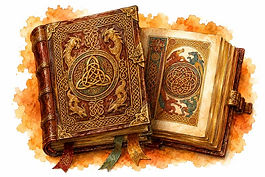
The Mabinogion is the treasure chest of Welsh mythology, a collection of eleven medieval prose tales that carries almost everything we know of the old gods, heroes, and enchantments of Wales. It is the home of the Four Branches of the Mabinogi, where Prince Pwyll swaps places with the king of the otherworld, where Rhiannon rides a horse no horse can catch, and where the flower-woman Blodeuwedd is punished by being turned into an owl. It is the book of Bran the Blessed, the giant king who wades across the sea to Ireland and whose buried head guards Britain from invasion. It contains Culhwch and Olwen, the oldest full Arthurian tale in any language, with its giant's forty impossible tasks. It holds the Welsh romances of Owain, Peredur, and Geraint, cousins of the knights of the Round Table. And its very name is a beautiful mistake: an English aristocrat, Lady Charlotte Guest, took the word mabinogi, meaning tales of a hero's youth, and turned it into a plural that the world has used ever since.

Mabon
Mabon is the divine son of Modron in Welsh mythology, a child stolen when he was only three nights old and later rescued for one of Arthur's most demanding quests. In Culhwch and Olwen, the hunt for Twrch Trwyth requires the hound Drudwyn, and only Mabon can hunt with him. Yet nobody knows where the missing youth is held. Arthur's companions seek the knowledge of ancient animals until the Salmon of Llyn Llyw leads them to a lamenting prisoner at Gloucester. Once freed, Mabon joins the hunters and takes the razor from the great boar during the struggle in the Severn. Other Welsh traditions remember him among the Exalted Prisoners and as a servant of Uther Pendragon. His name is also linked with Maponos, a deity worshipped in Roman Britain. These connections give Mabon a divine background, but the medieval story centres on captivity, rescue and the return of a missing person to the company that needs him.
Margawse (Queen)
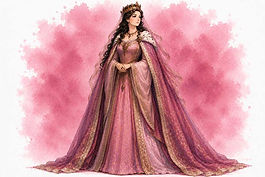
Queen Margawse is the most fateful mother in Arthurian legend, the woman whose five sons include the flower of chivalry and the man who destroyed it. She is the daughter of Gorlois, Duke of Cornwall, and the lovely Igraine, born at Tintagel before Uther Pendragon's deception made her the half-sister of a king she would never know as kin. She is the wife of King Lot of Orkney and Lothian, and the mother of his four splendid sons: Gawain, whose strength waxes with the sun; Agravain the Proud; Gaheris; and Gareth, the kitchen knight beloved of all. She is the queen who lay with her own half-brother Arthur without either knowing their blood, and who bore from that night Mordred, the child fated to strike his father down at Camlann. She is the indirect cause of the May Day massacre, when Arthur cast every noble newborn to the sea to kill the one he feared. And she is the queen beheaded in her own bed by her son Gaheris for the lover she took, a death that set the Orkney clan hunting blood until the Round Table bled with it.

Matholwch
Matholwch is the king of Ireland whose marriage to Branwen begins the tragedy of the Second Branch of the Mabinogi. He arrives with thirteen ships seeking an alliance with Bran, her giant brother and ruler of Britain. The wedding is followed by an insult when Efnysien mutilates the Irish king's horses, and a settlement is reached through gifts that include the Cauldron of Rebirth. In Ireland, however, resentment at the insult turns against Branwen. Matholwch allows her humiliation and prevents news of her treatment from reaching her family. Her message, carried by a trained starling, brings Bran across the sea. Matholwch then offers the kingship to their son Gwern in an attempt to make peace, but the reconciliation hall becomes the setting for the child's murder and a devastating battle. He belongs to Welsh myth rather than a securely identified line of Irish kings. His story follows the collapse of an alliance through injury, pressure and failed reconciliation.
Merlin
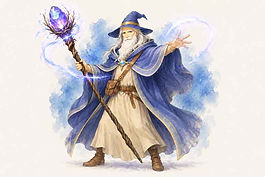
Merlin is the preeminent wizard of Arthurian legend, a figure of prophecy, magic, and tragedy who serves as the architect of King Arthur's destiny. Geoffrey of Monmouth created the literary Merlin in the 12th century by combining two earlier figures: the Welsh prophet Myrddin, a wild man of the woods associated with the town of Carmarthen, and Ambrosius, a boy-prophet from the Historia Brittonum. Geoffrey's Prophetiae Merlini (c. 1130) and Historia Regum Britanniae (c. 1136) established Merlin as a major character in British legend. Later traditions, particularly Robert de Boron's Merlin (c. 1200), added the famous story of his demonic parentage.
As Arthur's advisor, mentor, and the engineer of his conception and rise to power, Merlin occupies a unique position in the Arthurian cycle. He is simultaneously a bridge between the pagan and Christian worlds, a being of supernatural origin who uses his powers for benevolent ends, and a prophet who can see all of time yet is powerless to prevent his own destruction.
Merlin's Staff
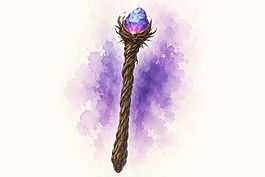
Merlin's staff is the magical implement through which the legendary wizard of Arthurian legend focuses and directs his supernatural powers. Unlike Excalibur, which is described in detail in medieval texts, Merlin's staff exists more in the realm of accumulated tradition, illustration, and modern interpretation. Medieval manuscript illuminations from the 13th to the 15th centuries frequently depict Merlin carrying a staff or wand, though no canonical description of its powers or origin appears in the primary Arthurian texts. The concept of the wizard's staff as a channel of magical power draws on deep roots in Germanic and Celtic tradition - the druidic staff (slat) was a recognized symbol of authority in ancient Britain.
In modern fantasy literature and gaming, Merlin's staff has become firmly established as a powerful artifact, the ancestor of Gandalf's staff in The Lord of the Rings, the wands of Harry Potter, and the magical implements of countless fantasy RPGs. The staff represents the idea that great magical power requires focus and direction - raw magical energy is dangerous without a wizard's discipline to channel it.

Molmutine Laws
The Molmutine Laws are the legendary laws attributed to Dunvalo Molmutius, the ruler called Dyfnwal Moelmud in Welsh tradition. In Geoffrey of Monmouth's account, conquest is followed by protections for temples, cities, roads and the ploughs that sustain the population. The lawgiver's achievement is not simply taking a crown: it is making ordinary movement and work safer after civil war. His son Belinus renews the laws, while later traditions connect their transmission with Gildas and King Alfred. Welsh legal memory also associates Dyfnwal with measures, and early modern writers turn the lawgiver into a symbol of Britain's ancient justice. The record concerns that legendary code, not an authenticated statute book surviving from pre-Roman Britain. Its medieval descriptions must also be distinguished from the much later material associated with Iolo Morganwg. The laws remain important as a story about the duties of kingship and as an example of how later generations gave their ideals an ancient ancestry.