Details
Region
Greek
Regional Information Additional (if applicable)

Ionian / Carian / Persian / Egyptian
Category
Person
Historicity (actuality or factual truth of persons, events, and claims)
Historical
Gender
Male
Time Period
c. 484-c. 425 BCE
Symbol
Scrolls
Tags
greek, herodotus, histories, greek-history, persian-wars, father-of-history, inquiry, ancient-egypt, classical-greece
Introduction - Overview
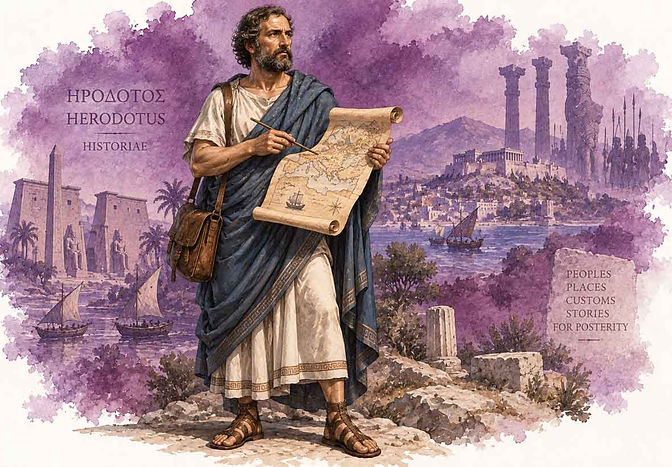
Herodotus is the Greek writer whose Histories created a new form of literature by asking how human events could be investigated, tested, preserved and explained. He is the man from Halicarnassus who introduced himself as the author of an inquiry, the first surviving long prose work to preserve the Greek word historia from which history takes its name. He is the traveller who carried his questions through Egypt, the Levant, Babylon, Thrace, Scythia and the islands of the Greek world. He is the storyteller who moved between Croesus and Cyrus, the pyramids and the Nile, Scythian horse-riders, Persian kings, Greek oracles and the women who changed the course of empires. He is the historian of Marathon, Thermopylae, Salamis, Plataea and Mycale, where Greek cities resisted the Persian invasions of 490 and 480 BCE. He is the self-conscious investigator who announced that he would report what had been said, sometimes with belief and sometimes with doubt. And he is the writer whom Cicero called the father of history and Plutarch attacked as a malicious liar, two verdicts that still shape every reading of his work.
Gallery
Main Article - Who or What was...
Herodotus
Herodotus was born in Halicarnassus, a Greek city on the Carian coast of Asia Minor and now called Bodrum in Turkey. In his lifetime Halicarnassus lay within the Persian Empire, making the future historian a subject of the very power whose wars he would narrate. The opening of the Histories names him Herodotus of Halicarnassus, and his own text remains the strongest evidence for his life. Later tradition, especially the Byzantine encyclopaedia called the Suda, made his father Lyxes, his mother Dryo and his brother Theodorus, and connected him through family or friendship with Panyassis, an epic poet of Halicarnassus. The names belong to the world of the city's inscriptions, but every attempt to build a full biography from them must remain cautious.
The family's wealth and education would have given the young Herodotus access to books, travel and learned conversation. He wrote in the Ionian dialect, the language of earlier prose writers and a natural medium for a man from the eastern Greek world. Halicarnassus itself had strong ties to Egypt and the wider Persian Empire. Its people had quarrelled with their Dorian neighbours and developed a cosmopolitan, outward-looking character. Herodotus grew up on the boundary between Greek and non-Greek, city and empire, memory and rumour. That position gave him both his opportunities and his questions.
Later tradition sent him into exile. The Suda says that Lygdamis, tyrant of Halicarnassus and grandson of the famous Queen Artemisia, drove Herodotus and his family to Samos. There he supposedly learned the Ionian dialect, although inscriptions from Halicarnassus show that Ionic was already used in official documents there. The same tradition says he returned, helped overthrow the tyrant and then left Halicarnassus for good. The story of the heroic liberator has the colour of a city legend, but Samos appears often enough in the Histories to suggest that Herodotus knew the island well. He may also have known Ionia, the coast where earlier thinkers had begun criticising myths and explaining the world through observation.
His travels were central to his work. He visited Egypt, where he saw or reported temples, embalmers, sacred animals and the yearly flood of the Nile. He travelled to Tyre and questioned the priests of the Phoenician temple. He moved east towards Babylon and north into Thrace and the lands of the Scythians. He knew mainland Greece well enough to describe Athens before and after the Persian Wars, Sparta's institutions, Delphi's oracle, Olympia's festival and the roads between cities. He also gathered accounts from Cyrene, the Black Sea, southern Italy and the Aegean islands. Whether he personally entered every region he describes remains debated, but the Histories move with the curiosity of a man who treated travel as a form of knowledge.
Herodotus did not invent historical writing out of nothing. He inherited the epic scale of Homer, the genealogies of Hesiod and the rational criticism of Ionian writers such as Hecataeus of Miletus. Hecataeus had begun sorting inherited legends into what seemed plausible and implausible. Herodotus went further. He did not ask only what the old poets said. He asked what people remembered, what he could see, which account best explained the evidence and why one people had gone to war with another. He used the word historia for inquiry, and his book made that inquiry into a continuous narrative.
The first lines of the Histories state his purpose. Herodotus publishes the results of his research so that human actions will not fade with time, so that the great and wonderful deeds of Greeks and non-Greeks will not lose their glory, and especially so that the cause of the conflict between them will be understood. He begins not with the Persian invasion of 480 BCE but with stories of abduction and counter-abduction between Europe and Asia: Io, Europa, Medea and Helen. The choice is characteristic. Herodotus reaches the Persian Wars by moving backward through myth, geography, custom, genealogy and the memories of different peoples. The cause of war is never one event. It is an accumulation of stories, injuries, ambitions and interpretations.
The early books tell the rise of Persian power. Croesus, the fabulously wealthy king of Lydia, learns through the Delphic oracle that if he crosses the Halys River he will destroy a great empire. He attacks Cyrus the Great of Persia and destroys his own kingdom. Herodotus uses the story to explore wealth, pride, oracles and the instability of human fortune. Cyrus, founder of the Persian Empire, expands from Media into Lydia, Babylon and the eastern world. His son Cambyses conquers Egypt and displays cruelty and madness, while Darius gains the throne through a conspiracy and turns Persia into an administrative empire. Each ruler receives a personality, a set of speeches and a visible chain of cause and effect.
Book Two belongs to Egypt. Herodotus describes the Nile's flood, the division of the country, the practices of embalming, sacred animals, temple customs and the long sequence of pharaohs. He records the claims of Egyptian priests and gives his own observations alongside them. His figures for the lengths of Egyptian history and the sizes of armies can be impossible, yet his descriptions preserve priceless evidence for customs, monuments and religious life. He also records an alternative story in which Helen never reaches Troy but remains in Egypt while the Greeks fight for a phantom at the city walls. The tale shows his willingness to preserve traditions that unsettle the most famous Greek myth.
Herodotus treats foreign peoples as human societies with their own reasoned customs. He describes Persians, Babylonians, Egyptians, Indians, Ethiopians, Scythians and Libyans in scenes that range from admiration to comedy to sharp moral criticism. In one famous passage he asks King Darius to compare the customs of Greeks and Indians concerning the dead. Greeks burn their fathers, while a certain Indian people eat theirs. Each group, when offered money to abandon the practice, reacts with horror. Herodotus draws the conclusion that custom is king over all. The observation makes him both an ethnographer and a moral thinker. He recognises that people call their own way of life natural and other ways barbaric.
The final five books carry the Histories into the wars themselves. The Ionian Revolt of Greek cities against Persia gives Darius a reason to punish Athens and Eretria. The Persian landing at Marathon in 490 BCE ends with an Athenian charge that drives the invaders back to their ships. Ten years later Xerxes crosses into Europe with an army so large that Herodotus' numbers have disturbed readers ever since. At Thermopylae, Leonidas of Sparta and his small force hold the pass until betrayal allows Persia to attack from behind. At Salamis, Themistocles lures the Persian fleet into the narrow strait where the heavier Greek ships can fight. At Plataea and Mycale in 479 BCE, the Persian land and naval forces are broken.
Herodotus did not reduce these events to a simple contest between Greek freedom and Persian despotism, although that contrast gives his narrative much of its power. He shows Greek factions, disputes and cowardice as clearly as Persian luxury, arrogance and cruelty. His battle scenes are filled with remembered names, tactical arguments, omens and speeches. He records women who rule or advise, slaves who deceive kings, interpreters who save armies and kings who discover that empire carries its own punishment. Xerxes watches his vast host at Abydos and weeps because not one of his millions will be alive in a hundred years. His uncle Artabanus answers that life is short and brittle, and that no human being should call any day happy until it has ended.
Herodotus' method moves between autopsy, or personal sight, and akoe, what he has heard. When accounts conflict, he sometimes reports each version and steps aside. When a story seems impossible, he may still preserve it because it was told. When different peoples claim the same monument or honour, he compares their traditions. His gods and oracles act through dreams, signs and the punishment of excessive pride, but human choices still produce the events. A tyrant's decision, a mistaken interpretation of an oracle, a personal grudge or a strategic blunder can alter the destiny of nations. The divine order may punish arrogance, yet human beings must still answer for what they do.
That mixture of criticism and storytelling made him both admired and attacked. Sophocles echoed Herodotus closely enough to suggest familiarity with his work. Aristotle read him as a writer from Thurii and cited his stories. Cicero later honoured him as the father of history. Plutarch wrote an entire treatise attacking Herodotus for malice, calling him a liar who delighted in exposing great men. The two judgements describe the same book from different angles. Herodotus preserves facts, errors, memories, legends, hearsay and moral stories together, and he announces his authorial presence rather than hiding behind a neutral voice.
His fame spread through public readings. Later Greek tradition placed him at Olympia, where he is said to have recited his Histories to an enormous crowd, or waited for cloud cover to protect him from the sun until the audience left, inspiring a proverb about missing one's opportunity by asking for perfect conditions. Eusebius reports that the Athenians rewarded him for public recitations, and later anecdotes connect him with Pericles, Sophocles and the intellectual world of fifth-century Athens. Not every detail can be trusted, but the stories show how Herodotus existed in the Greek imagination: not as a cloistered writer but as a traveller, speaker and performer.
Herodotus spent time in Athens and knew the city before the Peloponnesian War. He admired the Athenian role in resisting Persia, although he could also criticise Athenian ambition. In 443 BCE he joined or became connected with Thurii, the Athenian-sponsored colony in southern Italy. Aristotle calls him Herodotus of Thurium, and some ancient manuscripts give that name instead of Herodotus of Halicarnassus. Thurii, Athens and Macedonia all appear in later traditions about his death. The latest events securely mentioned in the Histories belong to the opening years of the Peloponnesian War around 431-430 BCE. He may have died in the Athenian plague, returned to Thurii, visited the Macedonian court or remained in the Greek world. No ancient account settles the place or exact year.
His death did not end the movement of his book. The Histories survived through manuscripts copied in late antiquity and the Byzantine world, divided into nine books named after the Muses. Thucydides followed him with a tighter, more analytical history of the Peloponnesian War, and the contrast between Herodotean narrative and Thucydidean political analysis shaped the history of the discipline. Roman readers preserved his reputation, Renaissance scholars translated and annotated him, and modern historians returned to him as a source for Persia, Egypt, early Greece and the Persian Wars.
Some details once mocked have found support. The description of a boat called a baris in Egypt was strengthened by the discovery of such vessels among the sunken remains of Thonis-Heracleion. Herodotus' report that Babylon had access to bitumen, his descriptions of embalming, the customs of Scythian burial and the route of the Persian army have been compared with archaeology and ancient evidence. Other stories remain impossible, exaggerated or shaped by local memory. That tension is not an accident of his work. Herodotus created history as an inquiry in which evidence, wonder, probability, hearsay and interpretation remain visible on the page.
His subject is ultimately larger than war. Herodotus asks how people remember, how empires grow, how customs differ, how the gods are imagined, how power changes character and how human beings face death. His opening promise is to keep deeds from disappearing. In that promise, history becomes a bridge between the living and the dead. The historian travels, asks, compares and writes so that those who come later can argue with the past rather than forget it. Herodotus stands at the beginning of that practice because he makes the argument itself part of the story.
Summary
Herodotus endures as the Greek writer who turned inquiry into history and made the Persian Wars the first great subject of sustained prose narrative. From his Halicarnassian birth and journeys through Egypt, Babylon, Scythia and Greece to the battles of Marathon, Salamis and Plataea, his Histories unite travel, memory, ethnography, oracles and human ambition. He is both a careful investigator and an irresistible storyteller, preserving what he saw, what he heard and what he doubted. Herodotus remains the father of history because he taught the world that the past survives only when someone asks how it happened.
Now enter the Mythopouch World!
You’ve discovered:
Herodotus
From Myth to Game
Join to access FREE real-world mythology "Learn Quests" and "Courses". Sign up to the newsletter for new releases, game updates, insider news, and more as Mythopouch brings real mythology to life. EARN the right to purchase an offline board game by completing FREE modules.


It's FREE to join as a MEMBER!
Not ready to join? Get the newsletter instead below

Related Entries
Looking for others?
Click into the field below to search, or click the icon to go to full page search function!

Looking for Mythology Insights?


Click below to view our mythology blog article insights, where we delve into the current Mythopouch Tier regions, and what we think you should know!
Sources & Retellings
Explore the original mythological Source texts (most from over 75 years ago, some as translated, possibly with mature content) and Mythopouch's source Retellings (a modern retelling also suitable for 15+) connected to this mythological entity. We are growing this resource and will link these in the future; for now, check the References below, then find the Sources or Retellings on those pages!


References
Validation References:
- Herodotus, Histories 1.1-5, 1.29-46 and 1.84-91 (c. 430 BCE) - the proem, Croesus, the oracle and the fall of Sardis
- Herodotus, Histories 2.1-4, 2.35-36, 2.99-182 and 2.112-120 (c. 430 BCE) - Egypt, the Nile, embalming, history and the alternative story of Helen
- Herodotus, Histories 3.17-25 and 3.38 (c. 430 BCE) - India, Ethiopia and the argument that custom is king
- Herodotus, Histories 4.1-82 (c. 430 BCE) - Scythia, geography, customs and Darius' northern campaign
- Herodotus, Histories 5.77 and 6.101-120 (c. 430 BCE) - the Ionian Revolt, Athens and the battle of Marathon
- Herodotus, Histories 7.20-104, 7.138-144, 7.201-239 and 8.75-96 (c. 430 BCE) - Xerxes' invasion, Thermopylae, oracles and Salamis
- Herodotus, Histories 9.82-89 and 9.100-106 (c. 430 BCE) - Plataea, the Persian defeat and the recognition of divine participation in human affairs
- Aristotle, Rhetoric 1409a28 and Sophistical Refutations 167b (4th century BCE) - ancient references to Herodotus as a writer and thinker
- Cicero, On the Laws 1.1.5 (52 BCE) - the honourable tradition calling Herodotus the father of history
- Plutarch, On the Malice of Herodotus 1 and 5 (1st or 2nd century CE) - the major ancient attack on Herodotus as a malicious storyteller
- Lucian, Herodotus or Aetion (c. 165 CE) - later stories about the fame and public reading of the Histories
- Eusebius, Chronicle, Olympiad 81.1 and 83.3 (early 4th century CE) - ancient chronographic notices concerning Herodotus' Athenian recitations and career
- Gould, John, Herodotus (St Martin's Press, 1989) - life, narrative technique, religious outlook and historical method
- Marincola, John, Greek Historians (Oxford University Press, 2001) - Herodotus in the development of Greek historical writing
- Asheri, David, Alan Lloyd and Aldo Corcella, A Commentary on Herodotus, Books I-IV (Oxford University Press, 2007) - historical and literary commentary on the first half of the Histories
- Mikalson, Jon D., Herodotus and Religion in the Persian Wars (University of North Carolina Press, 2003) - gods, oracles, piety and divine causation in Herodotus
- Baragwanath, Emily, Motivation and Narrative in Herodotus (Oxford University Press, 2008) - speeches, character, explanation and the logic of the Histories
- Fehling, Detlev, Herodotus and His Sources: Citation, Invention, and Narrative Art (Francis Cairns, 1989) - a controversial study of source claims, invention and narrative technique
Cultural Context Notice
Mythology developed across different cultures, periods and traditions, and there is rarely one universally accepted version of a story. Mythopouch approaches these traditions with respect while remaining faithful to the complexity of the surviving material. Retellings and educational content may interpret or adapt historical sources, but are not presented as definitive accounts of any culture, religion or belief system.