Details
Region
Greek
Regional Information Additional (if applicable)

Assyrian / Roman Imperial biography
Category
Person
Historicity (actuality or factual truth of persons, events, and claims)
Legendary
Gender
Male
Time Period
c. 1st century CE (flourished during the reign of Nero and the Flavian emperors)
Symbol
Scroll
Tags
greek, damis, apollonius-of-tyana, philostratus, nineveh, india, brahmans, julia-domna, memoirs
Introduction - Overview
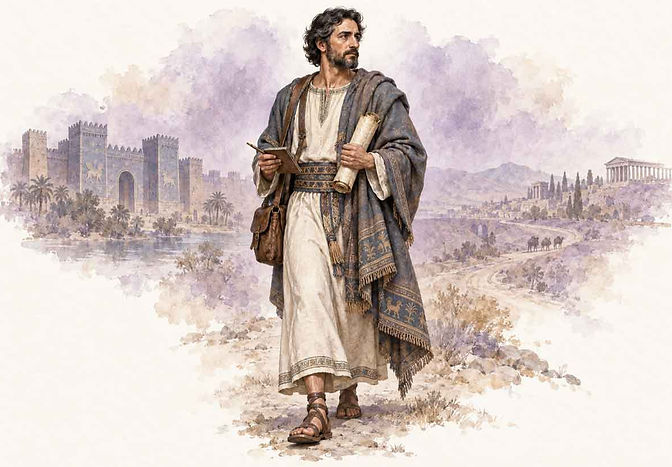
Damis is the Assyrian disciple whose memoirs became the foundation for the most extraordinary biography of antiquity, the companion who followed a philosopher across the known world and wrote down everything he saw. He is the young man from Nineveh who met Apollonius of Tyana, the Neopythagorean sage who was said to possess the power of prophecy, invisibility, and communion with the gods, and who abandoned his home to follow the philosopher to India and beyond. He is the witness who recorded Apollonius's conversations with the Brahmans, his trial before Domitian, the Roman emperor who ruled with terror, and his mysterious disappearance from the temple of Dictynna on Crete. He is the author of the memoirs that Philostratus, the Athenian sophist who composed the Life of Apollonius of Tyana in the 3rd century CE, claimed to have received from Julia Domna, the wife of the emperor Septimius Severus. And he is the most disputed figure in ancient biography, a man whom some scholars believe was the genuine source of Philostratus's work and others dismiss as a literary fiction invented to lend authority to a philosophical romance, a legacy that makes him the invisible hand behind one of the most controversial books ever written about a holy man.
Gallery
Main Article - Who or What was...
Damis
Damis was born in Nineveh, the ancient Assyrian city on the Tigris River that had been destroyed by the Medes and Babylonians in 612 BCE but which remained an important settlement in the Parthian and Roman periods. He was a young man of good family, educated in Greek philosophy and eager for wisdom, when he first encountered Apollonius of Tyana. The meeting took place in the town of Nineveh itself, or in some accounts nearby, around the year 43 CE. Apollonius was already famous as a philosopher, a vegetarian, a celibate, and a worker of miracles who claimed descent from the ancient sage Pythagoras, the philosopher who had founded a religious brotherhood in southern Italy and who believed in the transmigration of souls. Damis was captivated. He asked to become the philosopher's disciple, and Apollonius accepted him. From that day forward, Damis would not leave his master's side for more than thirty years.
The journey began in earnest when Apollonius resolved to travel to India to study with the Brahmans, the wise men of the East who were said to possess knowledge far beyond anything known in the Mediterranean world. Damis accompanied him every step of the way. They crossed the Euphrates, travelled through Mesopotamia and Media, ascended the Caucasus Mountains, and descended into the Indus valley. Damis recorded everything: the customs of the Parthians, the gymnosophists who studied naked in the Indian sun, the elephants and tigers of the eastern forests, and above all the conversations between Apollonius and the Brahmans, who tested the Greek philosopher with riddles and philosophical challenges. In Philostratus's telling, Damis's memoirs were the source for these detailed accounts, the only eyewitness record of a Greek philosopher's encounter with Indian wisdom.
After India, the companions returned to the West. They visited Babylon, where Apollonius conversed with the Magi, the priests of the Persian fire-cult. They travelled to Athens, where Apollonius debated with the Stoics and the Epicureans. They went to Rome, where they fell afoul of Nero, the emperor whose madness had made him the most dangerous ruler in the Mediterranean, and later of Domitian, the emperor who ruled from 81 to 96 CE with a combination of military efficiency and paranoid cruelty. Domitian arrested Apollonius and put him on trial for magic and sedition. Damis was imprisoned alongside his master, and he recorded the philosopher's defiant defence before the emperor, a speech so eloquent that Domitian, unable to find a pretext for execution, was forced to release him.
The most mysterious episode in Damis's memoirs concerns the end of Apollonius's life. The philosopher had travelled to Ephesus, where he suddenly called the citizens together and announced that a great tyrant had died at that very hour. The tyrant was Domitian, who was indeed being assassinated in Rome at the moment Apollonius spoke. Later, Apollonius entered the temple of Dictynna on Crete and simply vanished. Some said he had been assumed into heaven like the disciples of Pythagoras. Others said he had never died at all but continued to wander the earth in secret. Damis, according to Philostratus, recorded these events faithfully and then retired to write his memoirs, which he left as a testament to the life of the man he had followed across half the world.
The historical existence of Damis has been debated since the Renaissance. Philostratus claimed that he received the memoirs from Julia Domna, the Syrian empress who was the wife of Septimius Severus and the mother of Caracalla. She was a patron of philosophy and literature, and Philostratus said that she had commissioned him to write the Life of Apollonius from the notes of the Assyrian disciple. But modern scholars are divided. Some, following the French scholar Petzold and the German philologist Solmsen, argue that Damis was a genuine historical figure and that his memoirs were a real source, however much Philostratus embellished them. Others, including the influential scholar Graham Anderson, contend that Damis was a literary fiction invented by Philostratus to give his philosophical romance the authority of an eyewitness account. The debate remains open, and Damis remains a ghost at the edge of history, the disciple who may or may not have existed but whose name is inseparable from the most fascinating biography of the ancient world.
Summary
Damis endures as the invisible witness of antiquity, the Assyrian disciple whose memoirs, real or invented, became the foundation for the Life of Apollonius of Tyana. From the streets of Nineveh to the temples of India, from the prisons of Domitian to the temple of Dictynna where his master vanished, his story is one of devotion, travel, and the uncertain boundary between history and fiction. Every biography of a holy man, every account of a philosopher's journey to the East, every debate about the reliability of ancient sources carries his shadow. Damis reminds us that the most important witnesses are sometimes the ones we cannot prove existed.
Now enter the Mythopouch World!
You’ve discovered:
Damis
From Myth to Game
Join to access FREE real-world mythology "Learn Quests" and "Courses". Sign up to the newsletter for new releases, game updates, insider news, and more as Mythopouch brings real mythology to life. EARN the right to purchase an offline board game by completing FREE modules.


It's FREE to join as a MEMBER!
Not ready to join? Get the newsletter instead below


Looking for others?
Click into the field below to search, or click the icon to go to full page search function!

Looking for Mythology Insights?


Click below to view our mythology blog article insights, where we delve into the current Mythopouch Tier regions, and what we think you should know!
Sources & Retellings
Explore the original mythological Source texts (most from over 75 years ago, some as translated, possibly with mature content) and Mythopouch's source Retellings (a modern retelling also suitable for 15+) connected to this mythological entity. We are growing this resource and will link these in the future; for now, check the References below, then find the Sources or Retellings on those pages!


References
Validation References:
- Philostratus, Life of Apollonius of Tyana 1.19, 1.40, 3.50, 7.28, 8.28-31 (c. 220 CE) - the primary source for Damis's relationship with Apollonius
- Philostratus, Life of Apollonius of Tyana 1.3 (c. 220 CE) - Philostratus's claim to have received Damis's memoirs from Julia Domna
- Cassius Dio, Roman History 67.18 (c. 230 CE) - Domitian's persecution of philosophers
- Suetonius, Life of Domitian 15 (c. 120 CE) - Domitian's expulsion of philosophers from Rome
- Eusebius, Against Hierocles 2 (c. 300 CE) - early Christian critique of Philostratus and the Damis source
- Photius, Bibliotheca codex 44 (Byzantine, 9th century CE) - summary of Philostratus's work and the Damis tradition
- Anderson, Graham, Philostratus: Biography and Belles Lettres in the Third Century A.D. (Croom Helm, 1986) - scholarly analysis questioning the historicity of Damis
- Bowie, Ewen, "Apollonius of Tyana: Tradition and Reality" in Aufstieg und Niedergang der romischen Welt (1978) - comprehensive scholarly study of the sources
- Dzielska, Maria, Apollonius of Tyana in Legend and History (Polish Academy of Sciences, 1986) - scholarly analysis of the historical Apollonius and the Damis question
- Petzold, Karl-Ernst, "Die historische Grundlage der Vita Apollonii" in Rheinisches Museum (1969) - scholarly argument for the historicity of Damis
- Solmsen, Friedrich, "Philostratus und Damis" in Rheinisches Museum (1940) - scholarly study of the relationship between Philostratus and his alleged source
Cultural Context Notice
Mythology developed across different cultures, periods and traditions, and there is rarely one universally accepted version of a story. Mythopouch approaches these traditions with respect while remaining faithful to the complexity of the surviving material. Retellings and educational content may interpret or adapt historical sources, but are not presented as definitive accounts of any culture, religion or belief system.