
Details
Region
Greek
Regional Information Additional (if applicable)
Category
Person
Historicity (actuality or factual truth of persons, events, and claims)
Legendary
Gender
Female
Time Period
Heroic Age; first attested in Hesiod (8th century BCE)
Symbol
Bow and Girdle
Tags
greek, amazon, theseus, hippolytus, ares, attic-war, molpadia, areopagus, themiscyra
Introduction - Overview
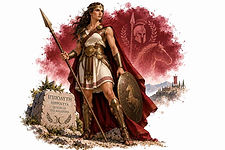
Antiope is the Amazon queen who fell in love with the enemy, the daughter of Ares who betrayed her warrior sisters for a Greek hero and paid for that love with her life. She is the co-ruler of the Amazons, the fierce women who lived without men and fought with a skill that matched any army in Greece, who shared her throne with her sister Orithyia. She is the captive who became a bride, carried off by Theseus, the Athenian hero who slew the Minotaur in the labyrinth of Crete, during Heracles' ninth labour against her own people. She is the mother of Hippolytus, the boy who would grow up to worship Artemis and die because his stepmother Phaedra loved him. She is the warrior who fought at her husband's side when her own sisters came to burn Athens, who was struck down not by an Athenian spear but by an arrow from the Amazon Molpadia, one of her own. And she is the only Amazon who ever married, whose tomb was shown to visitors in Athens for centuries, a reminder that even the fiercest warrior can be undone by love.
Gallery
Main Article - Who or What was...
Antiope (Amazon)
Antiope was born to Ares, the Olympian god of war whose battle-cry could shake the earth, and to Otrera, the queen who founded the Amazon nation on the shores of the Black Sea. Her sisters were Hippolyta, who wore the golden girdle that Heracles would one day demand as his ninth labour; Melanippe, whose life Heracles spared in exchange for the girdle; Penthesilea, who would later fight and die at Troy; and Orithyia, who shared the throne with Antiope as co-ruler of the Amazons. The Amazons were not merely women who fought. They were a nation that lived by the bow and the horse, that burned off their right breasts to draw the bowstring more easily, and that met with men only to conceive children, keeping the daughters and sending the sons away. Antiope was raised in this world, trained in every weapon, and crowned as queen of a people who feared no army on earth.
The trouble began with Heracles. The hero, forced to complete twelve impossible labours by King Eurystheus, was sent to fetch the girdle of Hippolyta from the Amazon capital at Themiscyra. He travelled with a company of heroes that included Theseus, the king of Athens who had already proved his courage by slaying the Minotaur, the bull-headed monster of Crete, and by navigating the labyrinth built by Daedalus. When the Greek ships reached Themiscyra, Heracles demanded the girdle. Hippolyta was willing to give it to him, but the goddess Hera, who hated Heracles for being the son of her husband Zeus and a mortal woman, stirred the Amazons into a frenzy. A great battle broke out. In the chaos, Theseus caught sight of Antiope. Some say he abducted her by force, seizing her in the smoke of battle and carrying her to his ship. Others, following the account of Pausanias, say that Antiope looked upon Theseus and loved him, that she betrayed her sisters of her own free will and followed him back to Athens as a bride. Either way, the queen of the Amazons was gone, and the nation she had ruled was left leaderless and enraged.
In Athens, Antiope and Theseus were married. She bore him a son they named Hippolytus, after her sister Hippolyta, the queen whose girdle had caused the war. The boy grew up devoted to Artemis, the virgin huntress goddess of the wilderness, and swore an oath of chastity that would one day destroy him. But before that tragedy, another came. The Amazons did not forget their stolen queen. They gathered an army, sailed across the Aegean, and landed on the coast of Attica. They burned the villages of the Athenians and laid siege to the city itself, camping on the very hill that would one day be called the Areopagus, the Hill of Ares. Theseus led the defence. The battle was fierce, the Amazons fighting with the fury of women who had come to reclaim their own. And in the thick of it, Antiope stood beside her husband, fighting against the sisters she had once ruled.
The end came from an unexpected hand. During the battle, an Amazon named Molpadia drew her bow and fired at Theseus. Antiope saw the arrow fly. She threw herself in front of her husband, or the shot went wild, or Molpadia mistook her for an enemy in the chaos. The arrow struck Antiope in the chest or the throat. She fell, and Theseus, enraged, killed Molpadia where she stood. The tombs of both women were shown in Athens for centuries. Pausanias, the Greek traveller who wrote a guide to the ancient world in the second century CE, recorded that visitors could still see the grave of Antiope and the grave of Molpadia, two enemies buried in the same city, one who had died for love and one who had died for loyalty.
But there are darker versions of the story. In the tradition followed by Ovid in his Heroides, and by Hyginus in his handbook of myths, Theseus did not remain faithful. He decided to abandon Antiope and marry Phaedra, the Cretan princess whose mother Pasiphae had loved a bull and given birth to the Minotaur. When Antiope learned of the wedding, she gathered a band of loyal Amazons and burst into the feast, swearing to kill every guest. Theseus met her with force. He struck her down himself, and in Ovid's telling she was pregnant when she died. In yet another version, an oracle had prophesied that Theseus would kill Antiope, and he fulfilled that prophecy on the battlefield. The ancient sources disagree on almost every detail except the central fact: the queen of the Amazons loved a Greek hero, and that love killed her.
Summary
Antiope remains the most human of the Amazons, the warrior queen who chose love over loyalty and became the only member of her race to marry. From the shores of the Black Sea to the Areopagus in Athens, from the girdle of Hippolyta to the arrow of Molpadia, from the birth of Hippolytus to the wedding feast of Phaedra, her story traces the boundary between two worlds that could not coexist. Every woman who has ever fought for one side while born to another, every queen who lost her throne for a foreign husband, every tomb that marks a life divided between love and duty carries something of Antiope in it. She reminds us that the fiercest warriors are not immune to the oldest weakness of all.
Now enter the Mythopouch World!
You’ve discovered:
Antiope (Amazon)
From Myth to Game
Join to access FREE real-world mythology "Learn Quests" and "Courses". Sign up to the newsletter for new releases, game updates, insider news, and more as Mythopouch brings real mythology to life. EARN the right to purchase an offline board game by completing FREE modules.


It's FREE to join as a MEMBER!
Not ready to join? Get the newsletter instead below



Looking for others?
Click into the field below to search, or click the icon to go to full page search function!

Looking for Mythology Insights?


Click below to view our mythology blog article insights, where we delve into the current Mythopouch Tier regions, and what we think you should know!
Sources & Retellings
Explore the original mythological Source texts (most from over 75 years ago, some as translated, possibly with mature content) and Mythopouch's source Retellings (a modern retelling also suitable for 15+) connected to this mythological entity. We are growing this resource and will link these in the future; for now, check the References below, then find the Sources or Retellings on those pages!


References
Validation References:
- Hesiod, Catalogue of Women, fragment 43a (trans. Most) (8th century BCE) - genealogy of Antiope as daughter of Ares
- Pausanias, Description of Greece 1.2.1, 1.41.7 (c. 150 CE) - Antiope's love for Theseus, the Attic War, and the tombs in Athens
- Plutarch, Life of Theseus 26-28 (c. 100 CE) - the abduction, the battle, and the death of Antiope
- Diodorus Siculus, Library of History 4.16.4, 4.28.1-4 (1st century BCE) - Theseus and Antiope during Heracles' ninth labour
- Ovid, Heroides 4.117-120 (c. 8 BCE) - Theseus kills the pregnant Antiope
- Hyginus, Fabulae 30, 241 (2nd century CE) - the abduction and the oracle that Theseus would kill her
- Apollodorus, Bibliotheca, Epitome 1.16 (1st-2nd century CE) - the Amazon expedition and variant identifications
- Gantz, Timothy, Early Greek Myth: A Guide to Literary and Artistic Sources (1993) - Volume 1, pp. 292-295, the Amazonomachy and Theseus
- Hardwick, Lorna, "Ancient Amazons: Heroes, Outsiders or Women?" (Greece & Rome 37.1, 1990) - pp. 14-36, the mythic representation of Amazons
- Blok, Josine H., The Early Amazons: Modern and Ancient Perspectives on a Persistent Myth (Brill, 1995) - Chapter 4, Antiope and the Athenian Amazonomachy
Cultural Context Notice
Mythology developed across different cultures, periods and traditions, and there is rarely one universally accepted version of a story. Mythopouch approaches these traditions with respect while remaining faithful to the complexity of the surviving material. Retellings and educational content may interpret or adapt historical sources, but are not presented as definitive accounts of any culture, religion or belief system.