Details
Region
Greek
Regional Information Additional (if applicable)

Classical / Parian / Attic
Category
Person
Historicity (actuality or factual truth of persons, events, and claims)
Historical
Gender
Male
Time Period
Active in the later fifth century BCE (Classical Greek period); Nemesis statue dated approximately 430 BCE
Symbol
Chisel
Tags
greek, agoracritus, sculptor, phidias, nemesis, rhamnous, parian-marble, alcamenes, classical-greek
Introduction - Overview
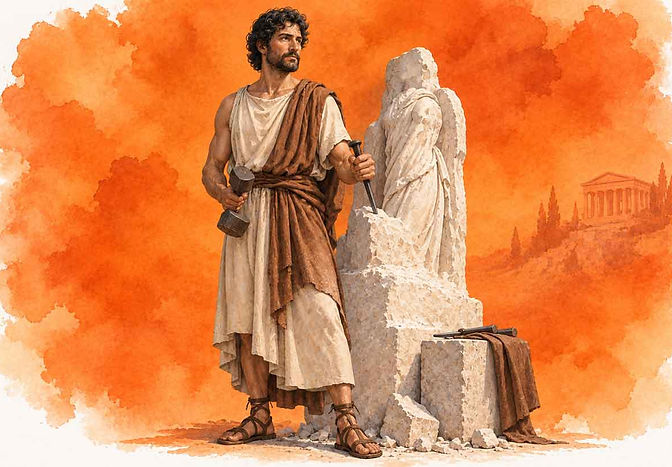
Agoracritus is the historical Greek sculptor from Paros whose reputation became closely bound to his teacher Phidias and to the monumental image of Nemesis at Rhamnous. He worked in the later fifth century BCE, when the sculptural workshops of Athens were producing some of the best-known monuments of Classical Greece. He is the artist whom Pliny describes as a favoured pupil of Phidias and a rival of Alcamenes in a competition to make an image of Aphrodite. He is the sculptor associated with a Nemesis whose fragments, ancient descriptions and later copies have helped scholars recover something of its original form. Around that statue gathered stories of artistic rivalry, divine retribution and a block of marble supposedly brought by the Persians for a victory monument at Marathon. Those stories must be distinguished from the surviving sculpture and from the conflicting ancient attributions. Agoracritus stands at the meeting of art history and legend, an artist whose work survived in pieces while the stories surrounding it remained remarkably complete.
Gallery
Main Article - Who or What was...
Agoracritus
Agoracritus came from the island of Paros and worked in the later fifth century BCE. His precise birth date and arrival in Athens are not securely established. Ancient writers connect him closely with Phidias, the sculptor associated with the Athenian building programme and the great images of Athena and Zeus. Pliny describes Agoracritus as a favoured pupil and reports that Phidias allowed the younger artist to receive credit for some of his own works. The anecdote shows how closely their reputations became intertwined, although it cannot establish the authorship of every disputed statue.
Agoracritus has also been associated with sculpture on the Parthenon. In his reconstruction of the Nemesis from Rhamnous, George Despinis identified stylistic characteristics that he used to propose a role for Agoracritus and his workshop in parts of the Parthenon's friezes and pediments. The treatment of drapery was especially important: folds could suggest the form of the body beneath the clothing while retaining their own elaborate movement. These connections are scholarly attributions based on comparison, not signatures preserved on the Parthenon figures. They help explain how researchers try to distinguish individual artists within a large workshop tradition.
The best-known rivalry comes from Pliny. He reports that Agoracritus and Alcamenes, both pupils of Phidias, competed to make an image of Aphrodite. According to this account, the Athenians favoured Alcamenes because he was their fellow citizen, rather than because his work was better. Pliny says that Agoracritus sold his statue on condition that it should not remain in Athens and called it Nemesis; it was set up at Rhamnous in Attica. The story offers an explanation for the statue's identity and location, but it is an anecdote rather than a securely documented competition. It does not establish exactly what physical alterations, if any, were made to the figure.
Pausanias preserves a different story about the marble. He says that the Persians brought a block to Marathon intending to make a trophy after their expected victory, only for their defeat to turn it into material for an image of Nemesis. In his account the sculptor is Phidias, not Agoracritus. The tale makes the goddess of retribution answer an army's premature confidence. It should therefore be presented as an ancient explanation of the monument, not as verified evidence for the stone's transport or the statue's commission. The competing attribution also matters: ancient accounts did not agree on every part of the work's history.
The statue itself was a monumental standing figure, reconstructed at approximately three and a half metres high. Pausanias describes a crown decorated with deer and small figures of Victory, an apple branch in one hand and a cup in the other. The base showed Helen being brought to Nemesis by Leda, together with other figures connected with the story. This followed the tradition in which Nemesis was Helen's mother and Leda her nurse. A damaged head and numerous marble fragments preserve physical evidence for the image, while ancient descriptions and later copies help explain its appearance. Agoracritus was also associated with an image of the Mother of the Gods and with statues of Athena Itonia and Zeus at Koroneia.
The Nemesis eventually survived only in fragments. Its destruction has been discussed in relation to late-antique religious change, but a precise event and its perpetrators should not be presented as settled facts. Excavation at Rhamnous in 1812-1813 recovered the head now catalogued by the British Museum. In the late 1960s and early 1970s, Despinis studied and assembled hundreds of further fragments, allowing a much fuller reconstruction of the statue and its style. Agoracritus's surviving reputation thus rests on several kinds of evidence: the stone itself, the ancient stories attached to it and the modern work of identifying what the fragments once formed.
Summary
Agoracritus endures as the Parian sculptor whose Nemesis links Classical artistry with ancient stories of rivalry and retribution. His relationship with Phidias, the reported competition with Alcamenes and the legend of Persian trophy marble all shaped the statue's reputation, but they do not carry the same certainty as its surviving fragments. From Rhamnous to the reconstruction of its scattered remains, his story shows how art history is pieced together. Agoracritus reminds us that an artist can be recovered through careful comparison while the legends surrounding a masterpiece remain part of its meaning.
Now enter the Mythopouch World!
You’ve discovered:
Agoracritus
From Myth to Game
Join to access FREE real-world mythology "Learn Quests" and "Courses". Sign up to the newsletter for new releases, game updates, insider news, and more as Mythopouch brings real mythology to life. EARN the right to purchase an offline board game by completing FREE modules.


It's FREE to join as a MEMBER!
Not ready to join? Get the newsletter instead below


Looking for others?
Click into the field below to search, or click the icon to go to full page search function!

Looking for Mythology Insights?


Click below to view our mythology blog article insights, where we delve into the current Mythopouch Tier regions, and what we think you should know!
Sources & Retellings
Explore the original mythological Source texts (most from over 75 years ago, some as translated, possibly with mature content) and Mythopouch's source Retellings (a modern retelling also suitable for 15+) connected to this mythological entity. We are growing this resource and will link these in the future; for now, check the References below, then find the Sources or Retellings on those pages!


References
Validation References:
- Pliny, Natural History 36.16-17: pupil of Phidias, disputed authorship and competition anecdote
- https://www.attalus.org/translate/pliny_hn36a.html
- Pausanias, Description of Greece 1.33.2-8: Persian-marble legend, attribution to Phidias and statue description
- https://www.theoi.com/Text/Pausanias1C.html
- Friendly and Karapanayiotis, 'Nemesis', Expedition 15.1 (1972): report of Despinis's reconstruction and stylistic attributions; historical scholarship, not a current consensus statement
- https://www.penn.museum/sites/expedition/nemesis/
- British Museum, 1820,0513.2: head from the Parian-marble Nemesis; catalogue search metadata verified, full object page blocked
- https://www.britishmuseum.org/collection/object/G_1820-0513-2
Cultural Context Notice
Mythology developed across different cultures, periods and traditions, and there is rarely one universally accepted version of a story. Mythopouch approaches these traditions with respect while remaining faithful to the complexity of the surviving material. Retellings and educational content may interpret or adapt historical sources, but are not presented as definitive accounts of any culture, religion or belief system.