Details
Region
Greek
Regional Information Additional (if applicable)

Roman / Imperial Greek literature
Category
Person
Historicity (actuality or factual truth of persons, events, and claims)
Historical
Gender
Male
Time Period
c. 175 - c. 235 CE (Roman Imperial period)
Symbol
Scroll & Bee
Tags
greek, aelian, roman-writer, de-natura-animalium, varia-historia, attic-greek, honey-tongued, animal-lore, ctesias
Introduction - Overview
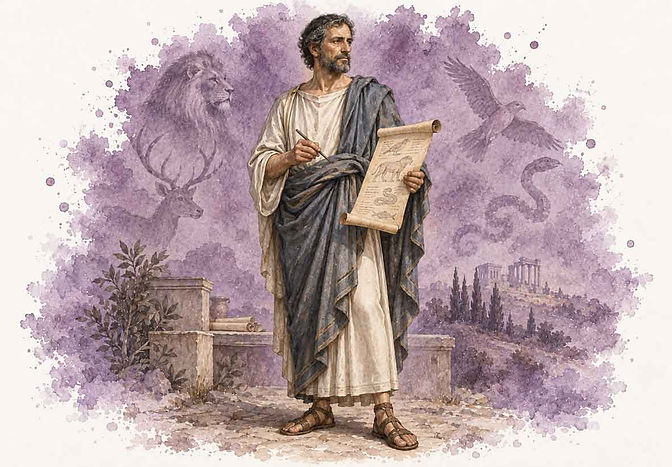
Aelian is the Roman writer who wrote in Greek so beautifully that his readers called him honey-tongued, a compiler of wonders whose works preserve valuable fragments of lost Greek mythology. He is the author of De Natura Animalium, a seventeen-book catalogue of animals that is also one of the richest treasure-houses of mythological anecdote in all of classical literature, where elephants mourn their dead, dolphins rescue drowning sailors, and the manticore, the man-eating monster with a lion's body and a scorpion tail, inhabits the India of ancient travellers' tales. He is the collector of Varia Historia, a miscellany of fourteen books that gathers the stray facts, quotations, and stories that fell through the cracks of grander histories, including tales of Pythagoras, the philosopher who believed in the transmigration of souls, and Alexander the Great, the Macedonian conqueror who claimed descent from heroes. He is the man whom Philostratus describes as never having travelled beyond Italy, yet whose reading carried him into the reported wonders of distant lands. And he is the invisible bridge between the lost books of antiquity and the modern scholar, a writer whose habit of quotation preserves traces of works that would otherwise have vanished.
Gallery
Main Article - Who or What was...
Aelian
Aelian was born in Praeneste, a town in the hills east of Rome famous for its ancient oracle and its temple of Fortuna, the Roman goddess of chance and fate, around the year 175 CE. His full name was Claudius Aelianus, and he was a Roman citizen by birth, not a Greek. Yet he chose to write in Attic Greek, the classical dialect of Athens that had been the language of the city's greatest writers centuries before his birth, and he cultivated a style so pure and so deliberately archaic that the later Suda records his nickname meliglossos, the honey-tongued. He lived in Rome during the reigns of the emperors Septimius Severus and Caracalla, the father and son who ruled the empire from 193 to 217 CE, but he seems never to have left Italy. His accounts of distant lands depended heavily on reading rather than personal travel.
His great work was De Natura Animalium, On the Characteristics of Animals, seventeen books that describe the habits of creatures from elephants to ants, from parrots to scorpions. The work is not a scientific treatise in the manner of Aristotle, the philosopher who had founded the study of biology centuries earlier through observation and classification. Aelian's method was anecdotal, moralising, and deeply rooted in mythology. He believed that animals possessed virtues that humans had lost, and he filled his pages with stories that blur the line between natural history and folklore. In his pages, the phoenix knows the passage of five hundred years, the halcyon calms the winter sea to lay its eggs, and the manticore, the man-eating monster with a human face and a scorpion tail that was first described by the Greek physician Ctesias at the Persian court, shoots its venomous stingers like arrows. For modern scholars, these passages are invaluable. They preserve fragments of the lost Indica of Ctesias, the Persian history of Dinon, and the paradoxography of Antigonus of Carystus, works that vanished long ago but survive in Aelian's quotations.
His other major work, Varia Historia, Miscellaneous History, is a collection of fourteen books of historical and biographical anecdotes, many of them mythological or quasi-mythological in nature. Here Aelian gathered stories about Pythagoras, the philosopher who believed in the transmigration of souls and who was said to possess a thigh of gold; about Alexander the Great, the Macedonian conqueror who claimed descent from heroes; and about Lycurgus, the Spartan lawgiver whose constitution made Sparta the most feared military power in Greece. He recorded the sayings of the Seven Sages, the wise men of archaic Greece, and he preserved details of religious rituals, athletic contests, and the private lives of philosophers that help preserve the texture of ancient traditions. The work is deliberately unsystematic, a cabinet of curiosities rather than a history, and that is precisely its value. Where a historian like Thucydides, the Athenian writer who chronicled the Peloponnesian War, sought causes and patterns, Aelian collected the glittering fragments.
Aelian's method has made him both frustrating and indispensable to modern scholars. He moves between named sources and anonymous reports, and the origins and reliability of individual anecdotes are not always easy to establish. Yet without him, entire traditions would be lost. His quotations from the lost works of the poet Ibycus, the historian Theopompus, and Clearchus, a pupil of Aristotle, are important witnesses to writings that no longer survive intact. His death is usually placed around 235 CE, near the end of the reign of the emperor Severus Alexander, and his works passed into the Byzantine manuscript tradition, the copying culture of the Eastern Roman Empire, where they were copied, excerpted, and eventually printed in the Renaissance. Renaissance printed editions carried his collections to new readers, and modern scholars continue to study and edit his Greek.
Summary
Aelian endures as the great preserver of fragments, the honey-tongued Roman who kept the myths of the Greeks alive by accident while he was writing about animals and oddities. From the hills of Praeneste to the libraries of Byzantium, from the lost pages of Ctesias to the modern critical edition, his works are a testament to the power of quotation. Every mythologist who reconstructs a lost tale from a single sentence in De Natura Animalium, every historian who recovers a forgotten custom from Varia Historia, owes him a debt. Aelian reminds us that the most important writers are not always the most original, and that sometimes the greatest service to memory is simply to copy down what others have said before it disappears.
Now enter the Mythopouch World!
You’ve discovered:
Aelian
From Myth to Game
Join to access FREE real-world mythology "Learn Quests" and "Courses". Sign up to the newsletter for new releases, game updates, insider news, and more as Mythopouch brings real mythology to life. EARN the right to purchase an offline board game by completing FREE modules.


It's FREE to join as a MEMBER!
Not ready to join? Get the newsletter instead below


Looking for others?
Click into the field below to search, or click the icon to go to full page search function!

Looking for Mythology Insights?


Click below to view our mythology blog article insights, where we delve into the current Mythopouch Tier regions, and what we think you should know!
Sources & Retellings
Explore the original mythological Source texts (most from over 75 years ago, some as translated, possibly with mature content) and Mythopouch's source Retellings (a modern retelling also suitable for 15+) connected to this mythological entity. We are growing this resource and will link these in the future; for now, check the References below, then find the Sources or Retellings on those pages!


References
Validation References:
- Suda, alpha iota 178: Aelian; birthplace, name, nickname and principal works
- https://cs.uky.edu/~raphael/sol/sol-cgi-bin/search.cgi?db=REAL&enlogin=guest&field=adlerhw_gr&login=lucilius&searchstr=alphaiota%2C178
- Aelian, On the Characteristics of Animals 6.58: the phoenix
- https://www.attalus.org/translate/animals6.html
- Aelian, On the Characteristics of Animals, Book 4: reported animal traditions
- https://www.attalus.org/translate/animals4.html
- N. G. Wilson, introduction to Aelian, Historical Miscellany: biographical evidence
- https://www.loebclassics.com/abstract/aelian-historical_miscellany/1997/pb_LCL486.5.xml
- Aelian, On Animals: complete translated work for cross-checking quoted traditions
- https://topostext.org/work/560
- Scholfield, A. F., Aelian: On the Characteristics of Animals (Loeb Classical Library, 1958-1959) - scholarly edition and translation
- Wilson, Nigel Guy, Scholars of Byzantium (Duckworth, 1983) - Aelian in the manuscript tradition
- Bowie, Ewen, "Aelian" in The Oxford Classical Dictionary (4th ed., 2012) - scholarly biographical entry
- Kindstrand, Jan Fredrik, "Claudius Aelianus und sein Werk" in Aufstieg und Niedergang der romischen Welt (1986) - comprehensive scholarly study
Cultural Context Notice
Mythology developed across different cultures, periods and traditions, and there is rarely one universally accepted version of a story. Mythopouch approaches these traditions with respect while remaining faithful to the complexity of the surviving material. Retellings and educational content may interpret or adapt historical sources, but are not presented as definitive accounts of any culture, religion or belief system.