Details
Region
Greek
Regional Information Additional (if applicable)

Egyptian / Argive
Category
Person
Historicity (actuality or factual truth of persons, events, and claims)
Legendary
Gender
Male
Time Period
Legendary age (mythic prehistory, before the Trojan War)
Symbol
Royal Uraeus
Tags
greek, aegyptus, danaus, danaids, fifty-sons, argos, egypt, hypermnestra, lynceus
Introduction - Overview
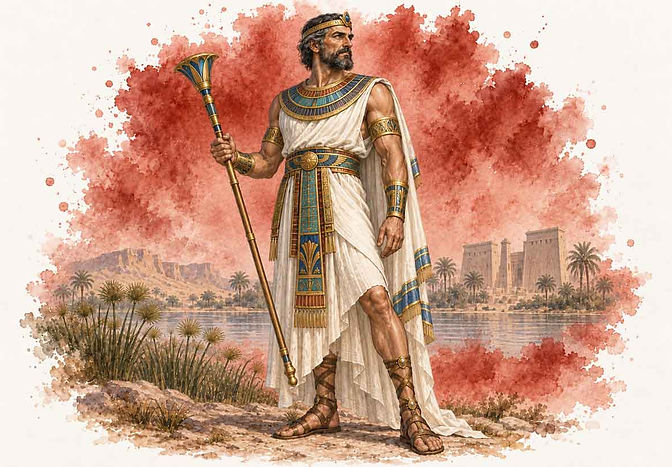
Aegyptus is the legendary king whom Greek myth made the namesake of Egypt, the ruler of Arabia who was said to have conquered the Nile kingdom, and the father of fifty sons, forty-nine of whom were killed on their wedding night by their brides. He is the twin brother of Danaus, the king of Libya who fled across the sea with fifty daughters rather than see them married to his brother's sons. He is the ruler whose quarrel with his brother drew their children into a proposed mass marriage, a union that Danaus feared would conceal a struggle for power. He is the king whose sons were beheaded in a single night by forty-nine of the Danaids, the daughters of Danaus, leaving only Lynceus alive through the mercy of Hypermnestra. And he is an example of how Greek myth-tellers explained places through ancestral figures, connecting the Nile kingdom with the family stories of Argos. His place in that tradition does not establish him as a historical founder or prove that the country's name originated with a real king.
Gallery
Main Article - Who or What was...
Aegyptus
Aegyptus was born of divine blood on both sides. His father was Belus, the son of Poseidon, the god of the sea and earthquakes, who was described in Greek genealogy as a king of Egypt. His mother was Achiroe, also called Anchinoe, a Naiad nymph of the river Nilus, the great Egyptian waterway that flowed from the southern cataracts to the Mediterranean Sea. Aegyptus had a twin brother named Danaus, and together they inherited the kingdom their father had built. Belus divided the realm between them: Danaus received Libya, the land of the west, and Aegyptus received Arabia, the eastern peninsula. But Aegyptus was not content with his share. In the myth, he expanded his territory, conquered the kingdom of the Nile, and renamed it Egypt after himself. This is a legendary explanation of a place-name, not a demonstrated historical event.
The trouble began when the two brothers began to raise their children. Danaus fathered fifty daughters, the Danaids, by various wives and nymphs. Aegyptus fathered fifty sons by an equally varied brood of mothers: Argyphia, a woman of royal blood; Caliadne, a Naiad nymph; Tyria; Gorgo; Hephaestine; and an unnamed Phoenician woman, among others. The sons grew into warriors, and the daughters grew into women, and Aegyptus saw an opportunity. A marriage between all fifty sons and all fifty daughters became part of the dispute, a proposed union that would bind the two families together. But Danaus suspected the truth. He believed that Aegyptus intended to use the marriages as a pretext to overthrow him, to kill him and his daughters, and to seize Libya as he had already seized Egypt. Danaus refused.
Under the advice of Athena, the grey-eyed goddess of wisdom and war who had sprung fully armed from the head of Zeus, Danaus built a ship and fled across the sea with his fifty daughters; Apollodorus credits him with being the first to do so. They sailed from Egypt, stopped at Rhodes to honour Athena Lindia with a monument, and finally landed at Apobathmi on the coast of Argos, the ancient Greek city in the Peloponnese. There Danaus claimed descent from Io, the Argive princess who had been transformed into a white heifer by Zeus and had wandered all the way to Egypt, and he became king of Argos. The conflict followed him across the sea as the sons of Aegyptus came after the daughters and pressed their claim to marry them.
The sons of Aegyptus arrived at Argos and asked Danaus to end the hostility between their families. Danaus distrusted them and resented his exile, but agreed to the marriages. A great wedding feast was held, and on a single night all fifty couples were married. But Danaus had prepared his daughters for treachery with treachery of his own. He gave each of the Danaids a dagger and commanded them to cut off their husbands' heads after the men had fallen asleep. Forty-nine of the daughters obeyed. They killed their bridegrooms in the darkness and brought the severed heads to their father as proof. Only Hypermnestra, the eldest, refused. Her husband was Lynceus, and he had respected her wish to remain a virgin on their wedding night, so she spared him and helped him escape to safety. The heads of the murdered sons were buried at Lerna, and the bodies elsewhere, while Athena and Hermes, the messenger god, purified the daughters at Zeus's command.
What became of Aegyptus himself is told only in fragments. The Greek traveller Pausanias, walking through Greece in the 2nd century CE, reported that the tomb of Aegyptus could be seen in a sanctuary of Serapis at Aroe, near Patrae in Achaea. The local tradition connected his arrival in the region with the disaster that had overtaken his sons and his fear of Danaus. The reported tomb formed part of the landscape through which later Greeks remembered the story. In other versions, Lynceus later killed Danaus in revenge and became king of Argos himself, founding the dynasty that would rule the city for generations. The name of Aegyptus, meanwhile, remained part of the Greek attempt to connect Egypt with its own legendary genealogies. The story must not be mistaken for a proven derivation of the country's name, and its tragedy is not the extinction of every son: Lynceus survived.
Summary
Aegyptus endures as the king whose name outlived his kingdom, the father of fifty sons, forty-nine of whom died in one of Greek mythology's most devastating family tragedies. From the divided inheritance of Belus to the wedding night slaughter at Argos, from the sanctuary tomb at Patrae to the modern name of Egypt, his story is one of ambition, kinship, and catastrophic loss. His story shows how Greek storytellers connected the name of a foreign land with their own family legends. Aegyptus reminds us that the greatest empires can begin with a single man's pride, and that the most terrible defeats sometimes come not from armies, but from the ones who were supposed to love us.
Now enter the Mythopouch World!
You’ve discovered:
Aegyptus
From Myth to Game
Join to access FREE real-world mythology "Learn Quests" and "Courses". Sign up to the newsletter for new releases, game updates, insider news, and more as Mythopouch brings real mythology to life. EARN the right to purchase an offline board game by completing FREE modules.


It's FREE to join as a MEMBER!
Not ready to join? Get the newsletter instead below


Looking for others?
Click into the field below to search, or click the icon to go to full page search function!

Looking for Mythology Insights?


Click below to view our mythology blog article insights, where we delve into the current Mythopouch Tier regions, and what we think you should know!
Sources & Retellings
Explore the original mythological Source texts (most from over 75 years ago, some as translated, possibly with mature content) and Mythopouch's source Retellings (a modern retelling also suitable for 15+) connected to this mythological entity. We are growing this resource and will link these in the future; for now, check the References below, then find the Sources or Retellings on those pages!


References
Validation References:
- Apollodorus, Library 2.1.4-5: family, marriages, surviving Lynceus and purification
- https://www.theoi.com/Text/Apollodorus2.html
- Pausanias, Description of Greece 7.21.13: the tomb and local tradition at Patrae
- https://pausanias.symmachus.org/translation/7/21/13.html
- Bonner, Campbell, "The Danaid-Myth" in Transactions and Proceedings of the American Philological Association, Vol. 31 (1900) - scholarly analysis of the myth's development
- Garvie, A. F., Aeschylus: Suppliants (Edinburgh University Press, 2006) - scholarly commentary on the Aeschylean trilogy
- Gantz, Timothy, Early Greek Myth: A Guide to Literary and Artistic Sources (Johns Hopkins University Press, 1993) - pp. 184-193 - comprehensive survey of the Danaid tradition
Cultural Context Notice
Mythology developed across different cultures, periods and traditions, and there is rarely one universally accepted version of a story. Mythopouch approaches these traditions with respect while remaining faithful to the complexity of the surviving material. Retellings and educational content may interpret or adapt historical sources, but are not presented as definitive accounts of any culture, religion or belief system.