Egyptian
Bennu Bird Phoenix
Name in Non-English, or Alternative Name/s
bnnw (Egyptian), Bennu
Also known as, and/or Titles and Roles
The Bennu Bird, the Soul of Ra, the Lord of Jubilees, the Herald of Time, the Phoenix of Heliopolis, the Self-Created One, the Star of the Ship of Bennu-Asar

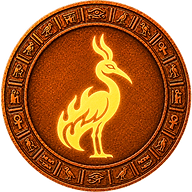
Mythopouch artistic interpretation
Details
Region
Egyptian
Regional Information Additional (if applicable)
Ancient Egypt
Category
Deity
Historicity (actuality or factual truth of persons, events, and claims)
Mythological
Gender
N/A
Time Period
c. 3000 BCE - Roman period
Symbol
The heron with two tall feathers on its crest, perched upon the benben stone or crowned with the sun disk
Tags
egyptian, phoenix, bennu, ra, osiris, helipolis, benben, rebirth, egyptian-mythology
Introduction - Overview
The Bennu bird is the Phoenix of Heliopolis, the original firebird from which every later legend of rebirth was born. It is the heron-like deity whose cry marked the beginning of time itself, the first sound that broke the silence of the primordial waters and set the cosmos in motion. It is the soul of Ra, the supreme sun god, the ba that flew with him through the hours of night and perched upon the benben stone, the primordial mound that rose from the dark abyss of Nun to become the first dry land. It is the self-created one who needed no mother or father, born like Atum from the chaos that existed before creation, and who embodied the eternal cycle of death and renewal that the Egyptians saw in every sunrise and every Nile flood. It is the bird that Herodotus, the Greek historian who visited Egypt in the fifth century BCE, called the phoenix, describing it as a rare eagle-like creature that returned to Heliopolis every five hundred years bearing its father's body in an egg of myrrh. And it is the eternal ancestor of the Greek phoenix, the Roman phoenix, and every modern story of a bird that rises from ashes, a legacy that began not in fire but in the cool waters of the Nile.
Gallery
Main Article - Who or What was...
Bennu Bird Phoenix
The Bennu bird emerged from the dark waters of Nun before the world existed, in the age when there was only the formless abyss and no land, no sky, and no light. According to the priests of Heliopolis, the solar metropolis where the great temple of the sun god stood, the first thing to break the surface of the waters was the benben stone, the primordial mound that was the foundation of creation. Upon this stone alighted the Bennu, a great heron with a long straight back and a head adorned with two erect feathers, its plumage red and gold like the sunrise. The bird threw back its head and cried out, and that cry was the first sound in the universe, the signal that marked the beginning of time itself. From that moment, the cosmos began to unfold: Atum, the self-created god, stood upon the mound and brought forth Shu, the god of air, and Tefnut, the goddess of moisture, and the Ennead, the council of nine gods, followed in their train. The Bennu was thus present at the birth of everything, the witness and the herald of creation.
In the theology of Heliopolis, the Bennu was the ba of Ra, the soul-manifestation of the sun god that accompanied him on his daily journey. The ba was not merely a spirit but the animating force that gave the god his personality and power, and the Bennu carried this force as it flew with the solar barque through the twelve hours of night. When Ra descended into the Duat, the shadowy underworld, the Bennu perched upon the benben stone in the Mansion of the Bennu and awaited the dawn, a promise that the sun would rise again. The bird was also the ba of Osiris, the murdered king of the afterlife, and in this role it was often shown perched in the sacred willow tree of Osiris, the tree that grew at the entrance to the underworld and whose branches sheltered the dead. This dual association made the Bennu the bridge between the sun and the grave, the creature that linked Ra's daily rebirth with Osiris's resurrection from death.
The Bennu was the lord of the royal jubilee, the Sed festival, the ritual that renewed the pharaoh's divine authority and ensured his continued rule. Every thirty years, the king ran a ceremonial race around a walled court to prove his fitness, and the Bennu was invoked as the god who measured the years and decreed the cycles of time. The bird's name, derived from the Egyptian word weben meaning to rise or to shine, connected it to the rising sun and the renewal of light, and its presence at the jubilee guaranteed that the king would be reborn like the sun. The Bennu was also associated with the inundation of the Nile, the annual flood that turned the desert black with fertile silt, for the heron was a bird of the marshes and the floodwaters, and its appearance on the high ground during the flood was a sign that life would return to the land.
The most famous account of the Bennu comes from Herodotus, the Greek historian who travelled through Egypt around 450 BCE and recorded the beliefs he found in the temples of Heliopolis. Herodotus described a sacred bird called the phoenix, which he had never seen but knew from paintings, a creature that visited Egypt only once every five hundred years, on the occasion of the death of its parent. According to the Greek version, the phoenix came from Arabia, its plumage gold and crimson like the sun, and it carried the body of its father encased in an egg of myrrh to the temple of the sun at Heliopolis. Before it died, the phoenix built a nest of incense twigs and laid down in it, and the sun's heat consumed it, leaving only ashes from which a small worm emerged and grew into a new bird. This story, which added the element of fire and self-immolation to the Egyptian original, became the foundation of the Western phoenix myth, and the name phoenix itself may derive from the Egyptian Bennu through the Greek phoinix, meaning crimson or purple.
In later mythology, the regenerative power of the Bennu was invoked in the most important story of Egyptian religion: the resurrection of Osiris. When Set, the crimson-haired god of chaos, murdered Osiris and scattered his body across the provinces, Isis, the queen of magic, gathered the fragments and used the essence of the Bennu in her spells to restore her husband to life. The bird's cry, which had begun time, was now the sound that reversed death, and its presence on the benben stone was the guarantee that the murdered king could rise again. The planet Venus, the morning star that heralds the sun, was called in Egyptian the star of the ship of the Bennu-Asar, the ship of Bennu-Osiris, linking the bird to the brightest object in the dawn sky and the promise of return after darkness.
The Bennu outlasted the temples of Heliopolis. In 1977, archaeologists in the United Arab Emirates discovered the remains of a large extinct heron species that lived around 1500 BCE, a bird that resembled the descriptions of the Bennu and was later named Ardea bennuides, the Bennu heron, in honour of the deity. This discovery suggested that the myth may have been inspired by a real bird, a giant heron that lived in the Persian Gulf and was seen by Egyptian travellers, sparking the legend of a very large heron that appeared only rarely and seemed to embody the sun. In modern times, the Bennu survives as the ancestor of every phoenix in literature and film, from the ashes of the Greek myth to the firebird of Harry Potter, and its image still appears on Egyptian jewellery and tattoos as the emblem of rebirth. Every sunrise that breaks over the Nile is still, in the ancient sense, the cry of the Bennu, the bird that began time and that will begin it again when the world is renewed.
Summary
The Bennu Bird Phoenix endures as the supreme symbol of creation and cyclical renewal, the Bennu bird whose cry began time and whose soul linked the sun god Ra with the resurrected Osiris. From the benben stone of Heliopolis to the Greek histories of Herodotus, from the willow tree of the underworld to the extinct heron that bore its name, it spans four millennia as the original firebird. Every legend of a bird that rises from death, every promise of rebirth at dawn, every symbol of eternal return carries the mark of its ancient form. In the human imagination, the Phoenix remains the eternal herald, the proof that life can begin again from the darkest waters and that the first cry of creation still echoes at every sunrise.
Now enter the Mythopouch World!
You’ve discovered:
Bennu Bird Phoenix
From Myth to Game
Join to access FREE real-world mythology "Learn Quests" and "Courses". Sign up to the newsletter for new releases, game updates, insider news, and more as Mythopouch brings real mythology to life. EARN the right to purchase an offline board game by completing FREE modules.


It's FREE to join as a MEMBER!
Not ready to join? Get the newsletter instead below


Looking for others?
Click into the field below to search, or click the icon to go to full page search function!

Looking for Mythology Insights?


Click below to view our mythology blog article insights, where we delve into the current Mythopouch Tier regions, and what we think you should know!
Sources & Retellings
Explore the original mythological Source texts (most from over 75 years ago, some as translated, possibly with mature content) and Mythopouch's source Retellings (a modern retelling also suitable for 15+) connected to this mythological entity. We are growing this resource and will link these in the future; for now, check the References below, then find the Sources or Retellings on those pages!


References
Validation References:
- Pyramid Texts, Utterance 600 (5th Dynasty, c. 2345 BCE) - Atum mounting the benben in the Mansion of the Bennu at Heliopolis
- Coffin Texts and Book of the Dead references to the Bennu as the ba of Ra and guide of souls (Middle Kingdom - New Kingdom, c. 2055-1070 BCE)
- Herodotus, The Histories Book II (c. 440 BCE) - Greek account of the phoenix visiting Heliopolis every 500 years
- Plutarch, De Iside et Osiride (c. 100 CE) - Bennu associated with Osiris and resurrection
- Inscriptions from the temple of Ra at Heliopolis (Old Kingdom - Ptolemaic period, c. 2600-30 BCE) - cult of the Bennu and the benben stone
- Richard H. Wilkinson, The Complete Gods and Goddesses of Ancient Egypt (Thames & Hudson, 2003) - Bennu as ba of Ra and solar symbolism
- Geraldine Pinch, Egyptian Mythology: A Guide to the Gods, Goddesses, and Traditions of Ancient Egypt (Oxford UP, 2002) - Bennu in creation myths and royal jubilee
- George Hart, The Routledge Dictionary of Egyptian Gods and Goddesses (Routledge, 2005) - etymology and iconography of the Bennu bird
- Archaeological discovery of Ardea bennuides (1977, United Arab Emirates) - extinct heron species linked to Bennu mythology
Cultural Context Notice
Mythology developed across different cultures, periods and traditions, and there is rarely one universally accepted version of a story. Mythopouch approaches these traditions with respect while remaining faithful to the complexity of the surviving material. Retellings and educational content may interpret or adapt historical sources, but are not presented as definitive accounts of any culture, religion or belief system.