
Details
Region
Egyptian
Regional Information Additional (if applicable)

Ancient Egypt / Ancient Near East
Category
Artifact/Object/Weapon
Historicity (actuality or factual truth of persons, events, and claims)
Historical
Gender
N/A
Time Period
c. 1360-1332 BCE (written), discovered 1887 CE
Symbol
Cuneiform tablet
Tags
amarna-letters, egyptian, cuneiform, akkadian, bronze-age, diplomacy, rib-addi, abdi-heba, egyptian-history
Introduction - Overview
The Amarna Letters preserve the anxious, demanding and carefully diplomatic voices of the ancient world. They form the majority of a larger clay-tablet archive that also includes literary and scribal-learning texts. They are the cuneiform correspondence of kings, written mainly in Akkadian, a major diplomatic language of the Bronze Age, on clay tablets of varying sizes whose wedge-shaped impressions survived for more than three thousand years. They are the letters of Rib-Addi of Byblos, who sent dozens of urgent dispatches begging the pharaoh for troops as his city starved, each one more desperate than the last. They are the letters of Abdi-Heba of Jerusalem, who swore he was no rebel but a loyal officer of the king, even as the 'Apiru marauders swallowed his neighbours' cities. They are the letters of the Great Kings, Tushratta of Mitanni, Burnaburiash of Babylon, and the king of Assyria, who addressed the pharaoh as "brother" and traded gold, lapis lazuli, and princesses in marriage. They are the letters of threatened governors, rival city-states and powerful kings, whose accusations and appeals must be read as attempts to influence the pharaoh, not as impartial reports. And they are the tablets that began to emerge in 1887, although accounts of the original discovery conflict, a treasure that transformed the study of Bronze Age diplomacy.
Gallery
Main Article - Who or What was...
Amarna Letters
The Amarna Letters were born from the routine of empire. In the fourteenth century BCE, Egypt controlled a network of vassal city-states stretching from Syria to the Sinai, and the pharaohs Amenhotep III and his son Akhenaten received constant correspondence from their subjects and their peers. Most of the letters were written in Akkadian using cuneiform, the wedge-shaped script developed in Mesopotamia, because this language served communication between many courts of the ancient Near East. Scribes in Canaan, Babylon, Mitanni, and Hatti all wrote in this same script, though the Canaanite governors often laced their Akkadian with local idioms and Canaanite glosses, creating a mixed dialect that scholars now call Canaanite-Akkadian. Each tablet was shaped from clay, impressed with a reed stylus while wet, and allowed to dry; firing was not essential to preserve every example. The length of the message and the scribe's layout helped determine a tablet's size; some carried writing on several surfaces.
The defining drama of the archive is the voice of Rib-Addi of Byblos, whose numerous letters form one of its most substantial bodies of correspondence. Rib-Addi ruled the port city of Byblos, modern Jbeil in Lebanon, and repeatedly appealed to the pharaoh as his position became more precarious. He accused Abdi-Ashirta of Amurru and other rivals of threatening Egyptian interests, asked for troops and supplies, and insisted that his own loyalty deserved protection. The repeated demands can sound painfully immediate, but they are also political arguments: Rib-Addi had reasons to emphasise danger and to portray his opponents as enemies of Egypt. The letters preserve a ruler struggling to obtain help across a great distance, not a complete, neutral account of every event in his city.
Another powerful voice belongs to Abdi-Heba of Jerusalem, whose six letters are conventionally numbered EA 285 to EA 290. He insists that his authority depends on the Egyptian king and that his opponents, including Milkilu of Gezer and the sons of Lab'ayu of Shechem, threaten the king's interests. He reports losses of territory and accuses groups described as 'Apiru of contributing to the disorder. His appeals for archers and royal attention reveal how a local ruler tried to turn Egyptian power towards his own urgent needs. These letters are important early evidence for Jerusalem and its political relationships. They give us the voice of a participant seeking support, not an account written with the detachment of a later historian.
The archive also holds the correspondence of equals. The Great Kings of the Near East addressed the pharaoh as "my brother," a term of diplomatic equality that recognised Egypt as one of the great powers of the age. Tushratta of Mitanni sent letters and gifts, including the dispatch of a cult image of the goddess Shaushka, and negotiated the marriage of his daughter Tadukhepa to Amenhotep III. Burnaburiash of Babylon complained that his merchants had been murdered in Canaan and demanded compensation. The king of Assyria, newly risen to power, wrote to announce himself as a brother king, a claim to recognition among the major powers. The king of Hatti, the Hittite empire that was swallowing Mitanni, sent threats and demands. These letters reveal a world of elaborate protocol, of gift exchange and royal marriages, of envoys who travelled for months between courts, and of kings who measured their status by the quality of the gold they received.
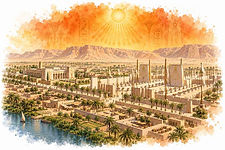
The tablets are associated with the administrative quarter at Amarna, the capital Akhenaten built for the Aten. One building is identified by stamped bricks as the Place of the Correspondence of Pharaoh, although the circumstances of the initial discoveries cannot all be reconstructed. When the royal court left Amarna, some records remained behind. In 1887 tablets began entering the antiquities market, and museums acquired parts of the dispersed archive. Petrie's excavations in 1891-1892 recovered further material, followed by other expeditions. Jørgen Alexander Knudtzon's Die El-Amarna-Tafeln, published in 1907-1915, became a foundational edition, and later scholarship expanded and revised the catalogue and readings. The tablets are now held in several collections, but together they remain an extraordinary source for the language and political relationships of the fourteenth century BCE.
Summary
The Amarna Letters endure as the most intimate archive of ancient diplomacy, the clay tablets that let us hear the voices of kings and governors who lived three thousand years ago. From the frantic pleas of Rib-Addi to the wounded pride of Abdi-Heba, they reveal competing interests, local insecurity and the negotiations that helped sustain an international system. A detail worth remembering: Canaanite scribes slipped their own language into the Akkadian text, adding glosses that help scholars study the Canaanite languages of the period. In the human imagination, the Amarna Letters remain the letters that history wrote to itself, proof that the ancient world was as full of fear and desperate hope as our own.
Now enter the Mythopouch World!
You’ve discovered:
Amarna Letters
From Myth to Game
Join to access FREE real-world mythology "Learn Quests" and "Courses". Sign up to the newsletter for new releases, game updates, insider news, and more as Mythopouch brings real mythology to life. EARN the right to purchase an offline board game by completing FREE modules.


It's FREE to join as a MEMBER!
Not ready to join? Get the newsletter instead below



Looking for others?
Click into the field below to search, or click the icon to go to full page search function!

Looking for Mythology Insights?


Click below to view our mythology blog article insights, where we delve into the current Mythopouch Tier regions, and what we think you should know!
Sources & Retellings
Explore the original mythological Source texts (most from over 75 years ago, some as translated, possibly with mature content) and Mythopouch's source Retellings (a modern retelling also suitable for 15+) connected to this mythological entity. We are growing this resource and will link these in the future; for now, check the References below, then find the Sources or Retellings on those pages!


References
Validation References:
- Amarna tablets, conventional corpus EA 1-EA 382 - correspondence and non-letter texts.
- Amarna Letters EA 285-EA 290 - correspondence of Abdi-Heba of Jerusalem.
- Letters of Rib-Addi of Byblos - appeals and political reports preserved in the archive.
- Jørgen Alexander Knudtzon, Die El-Amarna-Tafeln (1907-1915).
- William L. Moran, The Amarna Letters (Johns Hopkins University Press, 1992).
- Anson F. Rainey, The El-Amarna Correspondence: A New Edition (2015).
- Mario Liverani, International Relations in the Ancient Near East, 1600-1100 BC (2001).
- https://www.metmuseum.org/essays/the-amarna-letters
- https://books.google.com/books/about/The_Amarna_Letters.html?id=wS0-tjOvMtgC
Cultural Context Notice
Mythology developed across different cultures, periods and traditions, and there is rarely one universally accepted version of a story. Mythopouch approaches these traditions with respect while remaining faithful to the complexity of the surviving material. Retellings and educational content may interpret or adapt historical sources, but are not presented as definitive accounts of any culture, religion or belief system.