Arthurian
Gromer Somer Joure
Name in Non-English, or Alternative Name/s
Syr Gromer Somer Joure; Gromore Somir Joure (Malory); Gromore Somyr Joure; Sir Gromoreson (Winchester manuscript form)
Also known as, and/or Titles and Roles
Sir Gromer Somer Joure, Gromore Somir Joure, Gromore Somyr Joure, Sir Gromoreson
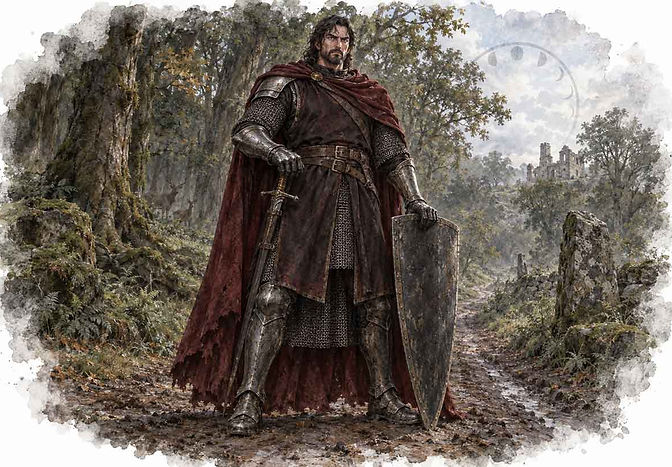
Mythopouch artistic interpretation
Details
Region
Arthurian
Regional Information Additional (if applicable)

British / Middle English Arthurian romance / Ragnelle tradition and Malory
Category
Person
Historicity (actuality or factual truth of persons, events, and claims)
Legendary
Gender
Male
Time Period
Legendary Arthurian age; 15th-century Ragnelle poem and Malory's Le Morte d'Arthur
Symbol
Sword
Tags
gromer-somer-joure, arthurian, person, ragnelle, gawain, inglewood-forest, sovereignty, riddle, malory
Introduction - Overview
Gromer Somer Joure is the armed challenger who catches King Arthur alone in Inglewood Forest and turns a dispute over land into a riddle upon which the king's life depends. In The Wedding of Sir Gawain and Dame Ragnelle, he accuses Arthur of giving his estates to Sir Gawain. Rather than accept an offer of redress, he requires the king to return in twelve months and explain what women most desire. The answer comes from Gromer's own sister, Dame Ragnelle, whose bargain draws Gawain into a marriage that ultimately releases her from enchantment. The poem ends with her seeking reconciliation between her brother and Arthur. A related name appears in Malory as Gromore Somir Joure, one of the knights who join the ambush of Lancelot in Guinevere's chamber. Together these appearances give Gromer an unusual place in Arthurian tradition, as both a threat encountered beyond the court and a participant in its internal conflict. They remain separate literary accounts rather than a fully narrated sequence of one man's career.
Gallery
Main Article - Who or What was...
Gromer Somer Joure
The forest encounter begins while Arthur is hunting near Carlisle. He has killed a hart and is occupied with it when an armed knight approaches. Arthur wears hunting clothes rather than armour, leaving him at a serious disadvantage. Gromer identifies himself and says that the king has wrongfully given his lands to Gawain. This is his accusation; the poem does not supply a charter or an independent account settling the ownership dispute. Arthur appeals to the dishonour of killing a defenceless man and offers to amend what is wrong. Gromer instead uses his advantage to impose a dangerous agreement.
Arthur must swear on Gromer's sword to return alone at the end of twelve months. Unless he can say what women most desire, he will lose his head. Back at Carlisle, the king eventually shares his predicament with Gawain. They travel separately, gathering answers about wealth, affection, marriage, admiration and other desires, but cannot be certain which will satisfy the challenger. The threat therefore requires something that military strength cannot provide. Gromer remains absent through much of this search, yet the obligation he has imposed shapes every decision made by the king and his nephew.
The decisive encounter is with Dame Ragnelle, who knows Arthur's danger and offers the answer on condition that Gawain marry her. Arthur does not bind his nephew without consulting him. Gawain accepts the bargain, and Ragnelle reveals the answer concerning women's sovereignty. When Arthur returns, Gromer rejects the collected alternatives but recognises this final reply as the answer his sister would have supplied. He is angry with her, yet the king has fulfilled the condition and must be allowed to leave. The poem's riddle is answered through a woman's knowledge rather than through Gromer's sword or Arthur's authority.
Gawain then keeps his promise to Ragnelle. His willingness to let her choose between the forms offered by her enchantment gives practical force to the answer about sovereignty, and the spell is broken. Afterwards she asks Arthur to be a good lord to Gromer despite his offence, and Arthur agrees for her sake. This reconciliation is explicit, but the poem does not describe a separate ceremony installing Gromer at the Round Table. Readings that make the marriage a solution to an inheritance dispute are interpretations of the land grievance and family relationships, not a detailed transfer of estates narrated in the wedding scene.
Malory names Sir Gromore Somir Joure among the knights gathered by Agravain and Mordred at Carlisle to catch Lancelot with Guinevere. The attempted arrest becomes a fight: Lancelot kills Colgrevance, takes his armour and overcomes the other attackers, while the wounded Mordred escapes. Gromore is among those killed. The textual form Sir Gromoreson is also recorded in the Winchester manuscript, as noted by the modern editor of the Ragnelle poem. These links justify discussing the related names together, but they do not turn Malory's brief appearance into an explicit sequel to the wedding. Gromer survives in the tradition through contrasting scenes of coercion, reconciliation and conflict within Arthur's fellowship.
Summary
Gromer Somer Joure challenges Arthur to answer what women most desire after accusing him of taking his lands. Ragnelle supplies the answer, Gawain fulfils the marriage bargain, and the poem allows a reconciliation between Gromer and the king. Malory's related Gromore Somir Joure appears among the attackers killed by Lancelot at Carlisle. The two accounts should remain distinguishable, as should the poem's events and later interpretations of inheritance or seasonal symbolism. Gromer's significance lies in the contrast between force and agreement: his sword creates the danger, but Ragnelle's knowledge and Gawain's promise make its resolution possible.
Now enter the Mythopouch World!
You’ve discovered:
Gromer Somer Joure
From Myth to Game
Join to access FREE real-world mythology "Learn Quests" and "Courses". Sign up to the newsletter for new releases, game updates, insider news, and more as Mythopouch brings real mythology to life. EARN the right to purchase an offline board game by completing FREE modules.


It's FREE to join as a MEMBER!
Not ready to join? Get the newsletter instead below



Looking for others?
Click into the field below to search, or click the icon to go to full page search function!

Looking for Mythology Insights?


Click below to view our mythology blog article insights, where we delve into the current Mythopouch Tier regions, and what we think you should know!
Sources & Retellings
Explore the original mythological Source texts (most from over 75 years ago, some as translated, possibly with mature content) and Mythopouch's source Retellings (a modern retelling also suitable for 15+) connected to this mythological entity. We are growing this resource and will link these in the future; for now, check the References below, then find the Sources or Retellings on those pages!


References
Validation References:
- The Wedding of Sir Gawain and Dame Ragnelle, edited by Thomas Hahn, Sir Gawain: Eleven Romances and Tales (1995), Middle English Texts Series - challenge, twelve-month oath, answer, marriage and request for reconciliation.
- https://metseditions.org/read/49MyYpRH2ZvaUg6llivLljIbGqZaEGDY
- Hahn's note to line 62 identifies Malory's Gromore Somyr Joure and the Winchester manuscript's Sir Gromoreson.
- Thomas Malory, Le Morte d'Arthur, Book XX, chapters II-IV - the Carlisle ambush and attackers' deaths.
- https://www.gutenberg.org/files/1252/1252-h/1252-h.htm
- Thomas Hahn, Introduction to The Wedding of Sir Gawain and Dame Ragnelle - interlocking promises, reconciliation and the unspecified location of Gromer's estates.
- https://metseditions.org/read/bwMEpVMu2m7tX625H0ZxWH19R8eMx19
Cultural Context Notice
Mythology developed across different cultures, periods and traditions, and there is rarely one universally accepted version of a story. Mythopouch approaches these traditions with respect while remaining faithful to the complexity of the surviving material. Retellings and educational content may interpret or adapt historical sources, but are not presented as definitive accounts of any culture, religion or belief system.