Greek Mythology List


Welcome to the Mythopouch list of Greek mythology entries! We also delve into the ancient history of Greece and the surrounding areas. From heroes to goddesses, places, monsters, artifacts, weapons, creatures and more - which will only grow over time. Mythopouch provides real-world information extracted from the original source material such as that from: Homer, Hesiod, Apollodorus, Ovid, Pausanias, Pindar, Aeschylus, Sophocles, Euripides, Hyginus, Diodorus Siculus and Apollonius of Rhodes. Words and stories carry powerful messages that were passed down from one generation to the next, many of which are still very applicable to modern times. Our unique imagery is meant to capture the imagination and ignite the magic mythology spark within us all. Our "token mark" coin symbol that is assigned to each record is a visual representation of the entity, for use in Mythopouch learning modules and games.
Learn - Earn - Play
Greek Entity Quick Index
Our current list of ancient Greek mythology and ancient history entities are here - which are growing day by day!
Search by using the:
-
"Search Mythology Records" function to browse all mythology records and blog pages;
-
Browse the visual cards with overviews by clicking "Go to Visual A-Z";
-
Or just browse and click the A-Z entries below....
See more list entries
Read Ancient Greek Insights
Click below to view our ancient Greek mythology blog article insights, where we delve into the current Mythopouch Tier regions and what we think you should know!


Greek Entity Card Index
See more card entries

Triptolemos
Triptolemos is the prince of Eleusis who became the first mortal to receive the secret of agriculture from Demeter, the goddess of the harvest, and who travelled the world in a winged chariot drawn by serpents to teach mankind how to sow grain and reap bread. He is the son of Celeus, the king of Eleusis, or in some traditions the son of Oceanus and Gaia, a divine parentage that explained his connection to the earth and the waters that made it fertile. He is the youth who found Demeter wandering in grief on the shores of Eleusis after her daughter Persephone had been abducted by Hades, the god of the underworld, and who offered her kindness when the rest of the world had turned away. He is the student who sat at the goddess's feet while she taught him the mysteries of the plough, the seed, the sickle, and the threshing floor, knowledge so sacred that it would become the foundation of the Eleusinian Mysteries, the most important religious rites in the ancient Greek world. He is the messenger who flew over land and sea in his serpent-drawn chariot, scattering grain to every people he visited, bringing civilisation to barbarians and ending the age when men had eaten only acorns and wild roots. And he is the founder of the Mysteries at Eleusis, the secret rites that promised initiates a blessed afterlife, a legacy that lasted for nearly two thousand years until the temple was closed by the Christian emperor Theodosius in the 4th century CE.

Tros
Tros is the legendary Dardanian king whose name became the name of the Trojans and the Troad. Homer places him in the royal genealogy between Erichthonius and the three sons Ilus, Assaracus and Ganymede. Later mythography makes Tros the ruler after whom the country is called Troy, while his son Ilus becomes the founder of Ilium in a separate foundation tradition. Ilus' descendants lead to Laomedon and Priam; Assaracus' line leads through Anchises to Aeneas. The abduction of Ganymede by the gods also becomes attached to Tros, with divine horses appearing in the family tradition as compensation. Tros is therefore an eponym and genealogical hinge rather than the documented builder of the city later ruled by Priam.
Typhon
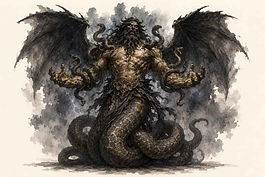
Typhon is the greatest monster ever born in Greek mythology, a hundred-headed serpent giant with fire blazing from his eyes and a body so vast his head touched the stars. He is the final child of Gaia and Tartarus, born to challenge the rule of Zeus after the Titanomachy had ended and the Olympian gods thought themselves secure. He is the creature who made the gods flee in terror to Egypt, where they hid themselves as animals to escape his wrath. He is the monster who captured Zeus himself, cut the sinews from his hands and feet, and left him immobilized in a Cilician cave. He is the father of the most terrible monsters in all Greek myth: Cerberus, the Hydra, the Chimera, the Sphinx, and the Nemean Lion, all born from his union with the she-dragon Echidna. And he is the prisoner buried beneath Mount Etna in Sicily, where his struggles still cause the volcano to erupt and thunder, a reminder that the earth itself holds a monster that once nearly overthrew the king of the gods.

Tyrrhenian Pirates
The Tyrrhenian Pirates are the Etruscan sailors who captured Dionysus and were transformed into dolphins, the only mortals in Greek mythology punished by becoming sea creatures for failing to recognise a god. They are the crew of the dark-prowed ship that spotted a beautiful youth on the shores of the Aegean and thought they had found a prince worth ransoming. They are the men who bound the god of wine with ropes that would not hold, who watched vines grow from the deck of their vessel and ivy twine around the mast while they still refused to believe. They are the victims of a miracle that turned to terror, the pirates who leapt overboard to escape a lion and a bear only to find themselves breathing through blowholes and swimming with fins. They are the cautionary tale that runs through every story of hubris on the sea, the warning that the stranger on the shore might be more than he seems. And they are the origin of every dolphin that follows a ship, the creatures who remember their human past in the music of the waves.

Urania
Urania is one of the nine Muses, daughters of Zeus and Mnemosyne, and later tradition makes her the Muse of astronomy. Hesiod lists her eighth among the nine named Muses, between Polyhymnia and Calliope. Her name means the Heavenly One, and later art represents her with a celestial globe and a staff or compass. The specialised astronomical role belongs to the later differentiation of the Muses, not to Hesiod's original catalogue. Her modern afterlife includes asteroid 30 Urania, one of several minor planets named after members of the Muse tradition.

Uranus
Uranus is the primordial god of the sky, the vast brass dome of heaven that stretched over the earth and held the stars in place. He is the first ruler of the cosmos, the father who created the Titans, the Cyclopes, and the Hecatoncheires upon the body of the earth goddess Gaia. He is the tyrant who locked his own monstrous children inside the earth, causing such pain that Gaia herself turned against him. He is the god castrated by his own son Cronus with a sickle of adamant, an act so violent that it birthed new gods from his spilled blood and the sea foam of his severed genitals. He is the grandfather of Zeus, the king of the Olympian gods, and the ancestor of almost every deity in the Greek pantheon. And he is the namesake of the seventh planet from the sun, a distant ice giant that carries his name into the modern age, a reminder that the sky itself was once a living god.

Virgil
Virgil is Publius Vergilius Maro, the Roman poet whose Eclogues, Georgics and Aeneid became the three central works of Latin literature. He is the farmer's son born near Mantua whose poems turned the Italian countryside into a landscape of shepherds, ploughmen, rivers, orchards, bees, labour and longing. He is the pastoral poet whose ten Eclogues created the Roman Arcadia and gave Latin verse its most influential image of ideal song. He is the didactic poet of the Georgics, whose four books praise crops, trees, cattle, horses and bees while asking what labour, nature and empire mean after civil war. He is the epic poet of the Aeneid, whose twelve books follow Aeneas from burning Troy to the foundation of Roman power in Italy. He is the Augustan writer whose poem joins Trojan destiny, Carthaginian rivalry, Roman virtue, divine prophecy and the victories of Augustus into a national epic. He is the poet who died in 19 BCE leaving the Aeneid unfinished in its final polishing, and whose dying request that it be burned was countermanded by Augustus. He is the author whose works became school texts, Christian prophecies, magical books, imperial symbols and guides through the afterlife. And he is the writer whose three secure works stand apart from the later collection called the Appendix Vergiliana. The poems in that appendix were attributed to Virgil in antiquity and by Renaissance editors, but only individual pieces or short poems within them have attracted serious support, and no complete Appendix poem can be counted among Virgil's secure works.

Winged Sandals of Hermes
The Winged Sandals of Hermes are the first flying shoes ever crafted, the footwear that let the newborn god step from his cradle to the ends of the earth in a single morning, and the gift that made him the fastest being in the cosmos. They are the sandals Perseus borrowed to cross the sea and the sky in his quest to slay the Gorgon Medusa, the monster whose face turned all who looked upon it to stone, carrying him over deserts and oceans to the land where the Gorgons slept. They are the shoes that carried Hermes down to the Underworld to guide dead souls, up to Mount Olympus to bear messages between gods, and across the wine-dark sea to the island prison of Calypso, where the hero Odysseus languished for seven years. They are the symbol that the Romans gave to their god Mercury, and the image that still adorns the winged foot of every messenger, postal service, and express delivery in the Western world. And they are the ancestor of every flying shoe in story and film, the original proof that the fastest way to travel is to grow wings on your feet.

Zephyrus
Zephyrus is the god of the west wind, the gentle breeze that carries spring across the earth and coaxes flowers from their buds. He is one of the four Anemoi, the wind gods born to the Titan Astraeus and the goddess Eos, the rosy-fingered dawn who paints the sky each morning. He is the wind who blew the mortal princess Psyche to the hidden palace of Eros, the winged god of love, lifting her from a rocky cliff and setting her down in a garden of impossible splendour. He is the father of the immortal horses Xanthus and Balius, the swift-footed steeds who carried the hero Achilles into battle during the Trojan War. He is the jealous lover who, according to some tellers, caused the discus of Apollo, the god of music and prophecy who drove the sun across the sky, to strike the beautiful youth Hyacinthus and kill him. He is the husband of Chloris, the goddess of flowers, whom he carried away in a storm of petals and made his bride. And he is the wind that still blows across the Mediterranean each spring, a warm and whispering reminder that even the elements of nature were once gods with loves and griefs of their own.

Zethus
Zethus is the twin son of Zeus who built the walls of Thebes with his own hands while his brother Amphion moved stones with the music of a golden lyre, the hunter-king whose strength complemented his brother's art and whose tragedy proved that even divine parentage cannot protect a man from grief. He is the son of Zeus, the king of the gods, and Antiope, the princess of Thebes who was driven from her city in shame after Zeus took her by force, a child born in exile on Mount Cithaeron and left to die before shepherds found him and raised him among their flocks. He is the herdsman and hunter who grew to manhood on the mountain slopes, strong as an ox and silent as the woods he roamed, while his twin brother Amphion learned to play the lyre given to him by Hermes, the messenger god, and became the most famous musician in Greece. He is the avenger who marched on Thebes with his brother, killed the usurper Lycus, and tied the tyrant's wife Dirce to the horns of a wild bull, dragging her to her death as punishment for the cruelty she had shown their mother. He is the co-king who fortified Thebes with seven gates and seven towers, carrying stones on his back while Amphion's music made the walls rise of their own accord, a collaboration of muscle and melody that created one of the most famous cities in the Greek world. And he is the father who killed himself when his wife, in a fit of jealousy, accidentally murdered their only son, a grief so total that it ended the life of a man who had survived exposure, usurpation, and war.

Zeus
Zeus is the king of the Olympian gods, the wielder of the thunderbolt who rules the sky and commands the storms. He is the son who escaped his father Cronus's belly to lead a ten-year war against the Titans and seize control of the cosmos. He is the husband of Hera who fathered gods and heroes across the Greek world, from Athena who sprang fully armed from his forehead to Heracles, the greatest of mortal heroes. He is the god who sits in judgment upon Mount Olympus, whose nod shakes the earth and whose will none may defy. He is the patron of kings and lawgivers, the guardian of oaths and the protector of strangers. And he is the namesake of the planet Jupiter, the Roman Jupiter, and countless words from "zealous" to "zenith," a legacy that has shaped Western civilization for three millennia.

Zeus's Thunderbolt
Zeus is the king of the Olympian gods, the wielder of the thunderbolt who rules the sky and commands the storms. He is the son who escaped his father Cronus's belly to lead a ten-year war against the Titans and seize control of the cosmos. He is the husband of Hera who fathered gods and heroes across the Greek world, from Athena who sprang fully armed from his forehead to Heracles, the greatest of mortal heroes. He is the god who sits in judgment upon Mount Olympus, whose nod shakes the earth and whose will none may defy. He is the patron of kings and lawgivers, the guardian of oaths and the protector of strangers. And he is the namesake of the planet Jupiter, the Roman Jupiter, and words like "jovial" and "Jove" that descend from his Roman name, a legacy that has shaped Western civilization for three millennia.