Greek Mythology List


Welcome to the Mythopouch list of Greek mythology entries! We also delve into the ancient history of Greece and the surrounding areas. From heroes to goddesses, places, monsters, artifacts, weapons, creatures and more - which will only grow over time. Mythopouch provides real-world information extracted from the original source material such as that from: Homer, Hesiod, Apollodorus, Ovid, Pausanias, Pindar, Aeschylus, Sophocles, Euripides, Hyginus, Diodorus Siculus and Apollonius of Rhodes. Words and stories carry powerful messages that were passed down from one generation to the next, many of which are still very applicable to modern times. Our unique imagery is meant to capture the imagination and ignite the magic mythology spark within us all. Our "token mark" coin symbol that is assigned to each record is a visual representation of the entity, for use in Mythopouch learning modules and games.
Learn - Earn - Play
Greek Entity Quick Index
Our current list of ancient Greek mythology and ancient history entities are here - which are growing day by day!
Search by using the:
-
"Search Mythology Records" function to browse all mythology records and blog pages;
-
Browse the visual cards with overviews by clicking "Go to Visual A-Z";
-
Or just browse and click the A-Z entries below....
See more list entries
Read Ancient Greek Insights
Click below to view our ancient Greek mythology blog article insights, where we delve into the current Mythopouch Tier regions and what we think you should know!


Greek Entity Card Index
See more card entries

Meliae
The Meliae are the ash-tree nymphs born from the blood of the sky itself, springing from the earth when the Titan Cronus castrated his father Uranus with a jagged sickle of adamantine. They are the nurses who fed the infant Zeus on the milk of the goat Amalthea and the honey-comb of bees in a cave on Mount Ida, hiding the future king of the gods from his murderous father. They are the wives of the Silver Race of Man and the mothers of the Bronze Race, the third generation of mortals who were born hard as iron and armed with spears carved from the wood of their mothers' own trees. They are the nymphs whose very name means both "ash-tree" and "honey," whose sap was called manna and thought to fall from the stars of heaven, a food fit for gods. And they are the spirits who bind heaven to earth, born from the blood of the sky upon the body of the earth, a living bridge between the celestial and the terrestrial that has rooted itself in the human imagination for three thousand years.

Melpomene
Melpomene is one of the nine Muses, daughters of Zeus and Mnemosyne, and later tradition makes her the Muse of tragedy. Hesiod lists her fourth among the named Muses, not last, and does not yet divide the nine into separate artistic professions. Later art gives Melpomene the tragic mask and other theatrical attributes. Pseudo-Apollodorus also preserves one genealogy in which Melpomene and Achelous are parents of the Sirens, although other ancient sources give the Sirens different mothers. Her identity therefore combines a later specialised theatrical role with variant mythic genealogy.

Menelaus
Menelaus is the Spartan king whose wife was stolen by a Trojan prince, sparking a war that burned a great city to the ground and cost the lives of the greatest heroes Greece ever produced. He is the younger brother of Agamemnon, the high king who commanded the thousand ships, yet the war was fought in Menelaus's name alone. He is the warrior who challenged Paris to single combat and broke his sword across the Trojan's helmet, only to watch the goddess Aphrodite snatch her favorite away in a cloud of mist before the killing blow could fall. He is the man who wandered the Mediterranean for eight years after the war, becalmed in Egypt and forced to wrestle the prophetic old man of the sea to learn how to get home. He is the husband who found Helen in the ruins of Troy, sword in hand and murder in his heart, yet lowered his blade when he saw her weep. And he is the only mortal king promised a place in the Elysian Fields, the paradise of heroes, not for his strength but for his marriage to a daughter of Zeus, a man whose greatest claim to fame was the woman he loved and lost and found again.

Menippus of Corinth
Menippus is the Corinthian youth who almost married a monster, the handsome student of philosophy whose bride turned out to be a lamia, the vampire-like creature who had already devoured his two predecessors and planned to make him her third wedding feast. He is the young man of twenty-five, tall and well-formed, with a face that attracted both women and spirits, who fell in love with a woman of extraordinary beauty and wealth who appeared beside the road to Lechaeum and claimed to be a Phoenician merchant's daughter. He is the bridegroom who prepared a wedding feast and invited his friends, including the philosopher Apollonius of Tyana, the wandering sage whose eyes could see through any disguise mortal or divine. He is the man who sat at his own wedding table and watched his bride turn from a beautiful woman into a howling fiend when Apollonius exposed her true form. And he is the proof that in Greek mythology, the most dangerous monsters do not lurk in caves or forests but sit beside you at the marriage bed, wearing the face of everything you desire.

Menippus the Achaean
Menippus is the Achaean warrior of Phylace who died defending the Greek ships from Hector's assault, the spearman whose death in the dust of the Scamander plain was one of the small but necessary losses that made the Trojan War a tragedy rather than a triumph. He is the son of Hippasus, the lord of Phylace in Thessaly, and the companion of Patroclus, the beloved friend of Achilles whose own death would change the course of the war. He is the warrior whom Hector, the greatest Trojan champion, singled out as a target in the desperate battle to burn the Greek fleet, and whom Antilochus, the swift-footed son of Nestor, avenged with a spear-thrust that killed his killer. He is the minor hero whose death occupies only a few lines of the Iliad but whose absence from the camp was felt by every man who had shared a fire with him on the shores of the Troad. And he is the proof that the Greek epic did not forget the ordinary soldier, the man who fought without divine blood and died without a tomb, whose only immortality was the poet's mention of his name and his father's name in the catalogue of the slain.

Metis
Metis is the Titan goddess of wisdom, cunning, and deep counsel, the first wife of Zeus who helped him win the throne of Olympus and was then devoured by him in fear of her own power. She is the shapeshifter who transformed into a fly to escape her husband and was swallowed whole, trapped forever within the king of gods. She is the mother of Athena, the goddess of wisdom and warfare, whom she crafted armour for while imprisoned inside Zeus's skull, hammering out a helmet and weaving a robe until the pounding drove her captor to madness. She is the architect of the Titanomachy, the war between the old Titans and the young Olympian gods, who devised the emetic potion that forced Cronus to vomit up the children he had swallowed. She is the personification of metis itself, the Greek quality that combines wisdom with cunning, the same trait that made Odysseus, the cunning king of Ithaca, the most resourceful of all Greek heroes. She is the only deity in Greek mythology who was defeated not by force but by being outsmarted at her own game, and whose voice still whispers counsel from within the god who consumed her. Every clever plan, every shapeshifting trick, and every burst of wisdom from an aching head carries her ancient signature.

Minoan Crete
Minoan Crete is the Bronze Age island world whose palaces, painted walls and seaborne connections became linked with some of Greece's most enduring legends. It is the setting of Knossos and the other great Cretan palace centres, of storerooms filled with huge jars, intricate craftsmanship and images of people confronting powerful bulls. Later Greek storytellers made the island the kingdom of Minos, the home of the Minotaur and the place from which Daedalus and Icarus escaped on wings. Egyptian tomb paintings provide a different connection, showing Aegean visitors bringing gifts into the world of the pharaohs. These strands belong together, but they are not the same kind of evidence. Minoan Crete was a historical civilisation; the Labyrinth and its inhabitants belong to mythology. Archaeology has revealed a remarkable Bronze Age society, not proved that a bull-headed monster lived beneath a palace.

Minos
Minos is the king of Crete whose name gave the ancient world one of its greatest civilisations, the Minoan culture that flourished across the Aegean Sea. He is the son of Zeus, king of the gods, and Europa, the Phoenician princess he carried across the sea on the back of a white bull, and the lawgiver whose judgements were so just that he became one of the three judges of the dead in the Underworld. He is the monarch who kept the Minotaur, a monstrous creature with the head of a bull and the body of a man, imprisoned in a labyrinth built by the master craftsman Daedalus beneath his palace at Knossos. He is the father of Ariadne, the princess who gave Theseus, the Athenian hero who slew the Minotaur, the thread that guided him through the maze. And he is the king who demanded a terrible tribute from Athens after his son Androgeus was killed there, a tribute that sent fourteen young people to their deaths every nine years until Theseus ended it. His death came in Sicily, where he was murdered in a bath by the daughters of King Cocalus while hunting the fugitive Daedalus, and his bones were returned to Crete to rest in a tomb that became a place of worship.
Minotaur
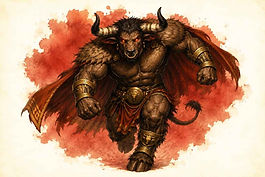
The Minotaur is the half-man, half-bull monster who lived at the center of the Labyrinth, the vast maze beneath the palace of Knossos on the island of Crete, a creature born from a queen's forbidden desire and a god's cruel jest. He is the devourer of Athenian youths, the beast who fed on the tribute of seven young men and seven maidens sent every nine years from Athens to satisfy his hunger for human flesh. He is the offspring of Pasiphae, the wife of King Minos of Crete, and a white bull sent by the sea-god Poseidon, a union made possible only because the master craftsman Daedalus built a hollow wooden cow to hide the queen's shame. He is the enemy that the hero Theseus traveled to Crete to destroy, armed with nothing but a sword and a ball of thread given to him by the princess Ariadne, Minos's own daughter, who betrayed her family for love. And he is the namesake of the labyrinth itself, a word that still means any maze so complex that finding the centre means risking never finding the way out again.

Mnemosyne
Mnemosyne is the Titaness of Memory, the divine power of remembrance itself, and the mother of the nine Muses, the goddesses who rule every art from epic poetry to the dance of the stars. She is the daughter of Uranus, the starry Sky, and Gaia, the broad Earth, one of the twelve Titans who ruled the cosmos before the Olympian gods, and one of the few who kept her place after the war between them. She is the goddess whom Zeus, the king of the gods, visited for nine consecutive nights in the hills of Pieria, and who bore him nine daughters, one for each night, the Muses who sing at the feasts of Olympus. She is the guardian of the clear spring of Memory in the underworld, whose waters the initiated dead were told to drink instead of the waters of Forgetfulness, and the mistress of the twin springs at the oracle of Trophonius, where visitors drank first to forget and then to remember. And she is the root of every word we use for remembering and forgetting, from mnemonic to amnesia to amnesty, the goddess hidden inside the language of the mind.
Moirai
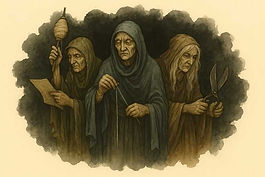
The Moirai are the three sisters who spin, measure, and cut the thread of every life that enters the world, deciding how long each mortal and even each god shall endure.
Clotho - The Spinner
Lachesis - The Allotter
Atropos - The Inevitable
Clotho spins the thread of life upon her spindle at the moment of birth, drawing raw existence from the void. Lachesis measures its length with her rod, allotting years and fortunes to kings, beggars, and heroes alike. Atropos, the eldest and most terrible, waits at the end with her bronze shears, and when the measured thread runs out she cuts it without mercy, and no power in heaven or earth can stay her hand. Even Zeus, king of the Olympian gods, is said to bow before their decrees, for the Fates stand outside the order of the gods themselves, older than Olympus and more absolute than law. They appear at every birth, at every turning point, and at every deathbed, and their presence is felt in every prophecy that cannot be escaped, every curse that must be fulfilled, and every life that ends exactly when it was always going to end.

Moon-Marked Cow
The Moon-Marked Cow is the sacred heifer who led the Phoenician prince Cadmus from the oracle at Delphi to the spot where he would found the city of Thebes. She is the animal with a half-moon marking on her flank that the god Apollo, the Olympian god of prophecy and music who drove the sun across the sky in his golden chariot, singled out through his oracle as the guide to a new kingdom. She is the cow that Cadmus bought from Pelagon, the local king of Phocis, and followed through the mountains of central Greece until she lay down exhausted on the banks of the River Cephissus. She is the beast intended for sacrifice to Athena, the grey-eyed goddess of wisdom and war, whose death was interrupted by the dragon of Ares, the god of war who shook the earth with his spear. She is the animal whose wanderings gave Boeotia its name, the land of the cow, and whose resting place became the acropolis of one of the greatest cities in Greece. And she is the cow whose trail led to the sowing of the dragon's teeth, the birth of the Spartoi, and the founding of a dynasty that would produce Oedipus, the king who killed his father and married his mother, and Dionysus, the god of wine and ecstatic madness.