Greek Mythology List


Welcome to the Mythopouch list of Greek mythology entries! We also delve into the ancient history of Greece and the surrounding areas. From heroes to goddesses, places, monsters, artifacts, weapons, creatures and more - which will only grow over time. Mythopouch provides real-world information extracted from the original source material such as that from: Homer, Hesiod, Apollodorus, Ovid, Pausanias, Pindar, Aeschylus, Sophocles, Euripides, Hyginus, Diodorus Siculus and Apollonius of Rhodes. Words and stories carry powerful messages that were passed down from one generation to the next, many of which are still very applicable to modern times. Our unique imagery is meant to capture the imagination and ignite the magic mythology spark within us all. Our "token mark" coin symbol that is assigned to each record is a visual representation of the entity, for use in Mythopouch learning modules and games.
Learn - Earn - Play
Greek Entity Quick Index
Our current list of ancient Greek mythology and ancient history entities are here - which are growing day by day!
Search by using the:
-
"Search Mythology Records" function to browse all mythology records and blog pages;
-
Browse the visual cards with overviews by clicking "Go to Visual A-Z";
-
Or just browse and click the A-Z entries below....
See more list entries
Read Ancient Greek Insights
Click below to view our ancient Greek mythology blog article insights, where we delve into the current Mythopouch Tier regions and what we think you should know!


Greek Entity Card Index
See more card entries

Lynceus son of Aphareus
Lynceus, son of Aphareus, is the Messenian prince whose extraordinary eyes made him both the lookout of the Argo and the mortal who discovered the hidden Dioscuri. He is the brother of the bold warrior Idas, born beside Arene in the royal house of Messenia. He is the Argonaut whose sight could reach beneath the earth and through wood, rock, darkness and distance. He is the Calydonian hunter who joined Meleager and the greatest heroes of Greece against the monstrous boar. He is the betrothed of Hilaeira, daughter of Leucippus, whose abduction by Castor and Pollux turned a marriage alliance into a fatal feud. He is the mortal who saw too well, piercing the concealment that protected the divine twins and helping unleash the combat that killed his brother, his rival and himself. And he is the Lynceus who must be distinguished from the Egyptian prince of the same name who married Hypermnestra: this Lynceus belongs to Messenia, the Argonauts and the feud with the Dioscuri, not to the Danaid cycle.

Lynceus, son of Aegyptus
Lynceus, son of Aegyptus, is the Egyptian prince who survived the Danaid massacre because his bride Hypermnestra refused to kill him. He is one of the fifty sons of King Aegyptus and the nephew of Danaus, father of the fifty Danaids. He is the bridegroom of Hypermnestra, the daughter who spared him when all her sisters obeyed their father's command to murder their husbands. He is the man who escaped Argos by night and signalled his safety with a torch from the city of Lynceia. He is the avenger or patient successor of Danaus, depending on the version, and the king who carried the Argive throne into a new generation. He is the husband whose survival gave Greece one of its most important dynasties: his son Abas fathered Acrisius and Proetus, the Argive line that produced Danae, Perseus and ultimately Heracles. And he is the Lynceus who must be distinguished from the Messenian Argonaut, son of Aphareus. This Lynceus belongs to Egypt, mass marriage, Hypermnestra and the foundation of the Argive royal house, not to the Argo or the feud with the Dioscuri.

Lynkos
Lynkos is the Scythian king who tried to murder Triptolemus, the Eleusinian hero sent by Demeter to teach agriculture to the world, and was transformed by the goddess into a lynx, the spotted cat whose Greek name he now bears for eternity. He is the ruler of the northern steppes beyond the Black Sea, a land of horse-riding nomads where the soil is too thin for wheat and the winters freeze the rivers solid. He is the king who received Triptolemus with hospitality by day and drew a sword against him by night, the man who understood that the secret of the seed was worth more than any guest-friendship and who was willing to kill a sleeping guest to possess it. He is the would-be thief of divine agriculture, the barbarian who thought he could steal the gift of Demeter and claim it for his own frozen kingdom. And he is the cautionary tale that the Greeks told about the north, the proof that the civilised world must be defended against those who would take its gifts by force, and that the goddess of the grain punishes theft with a transformation that erases both name and humanity.

Lyre
The Lyre is the first musical instrument ever crafted, invented by the infant god Hermes from the shell of a tortoise he found outside his mother's cave on the day he was born. It is the gift that turned a cattle thief into the patron of music, the sound that charmed Apollo so completely that the god of prophecy forgot his anger over fifty stolen cows and traded his entire herd for seven strings of music. It is the instrument that passed to Orpheus, the Thracian poet whose voice and strings could charm beasts, bend trees, and coax stones to dance, and who descended into the Underworld to retrieve his dead wife Eurydice. It is the artifact that sang its way into the stars, placed in the heavens by Zeus himself after Orpheus's murder, where it still shines tonight as the constellation Lyra. And it is the ancestor of every harp and stringed instrument that has ever played a human song, a tortoise shell that taught the gods what music could do.

Lyssa
Lyssa is the personified spirit of mad rage and rabid frenzy, the daughter of Night who appears in Greek tragedy as a divine assassin sent to destroy the minds of heroes. She is the figure who steps onto the stage in Euripides' Heracles, sent by Hera, the queen of the gods, to drive the greatest hero in Greece into a madness so complete that he slaughters his own wife and children with his bare hands. She is the hound-capped demon who stands beside Actaeon, the hunter transformed into a stag by the goddess Artemis, and whips his own dogs into a killing frenzy so they tear their master apart. She is the sting in the brain of the warrior, the rabies in the throat of the dog, the force that turns love into murder and reason into animal howling. And she is the warning that the gods do not always strike with thunderbolts or floodwaters; sometimes they simply remove the wall between a man and his own worst self, and watch what happens.

Maenads
The Maenads are the frenzied female followers of Dionysus, the god of wine, ecstasy, and the wild forces of nature, women who abandon their homes and families to dance on the mountainside in a state of divine madness that strips away every civilised restraint. They are the worshippers who tear living animals apart with their bare hands and eat the raw flesh, a ritual called omophagia, believing that in the blood and meat they consume the god himself. They are the women of Thebes who, under the spell of Dionysus, hunted down King Pentheus, the ruler who had denied the god's divinity, and tore him limb from limb on Mount Cithaeron, his own mother Agave leading the pack with his severed head impaled upon her thyrsus. They are the Thyiades of Delphi who every other winter climbed Mount Parnassus in midwinter to perform the orgiastic rites of Dionysus in the snow, dancing through the night while the priests of Apollo slept. And they are the eternal symbol of the boundary between civilisation and chaos, the reminder that beneath the ordered life of the Greek city lies a wildness that the gods can unleash at any moment, and that women, so carefully confined to the household, could become the most terrifying force in nature when the god of wine called them forth.
Maia
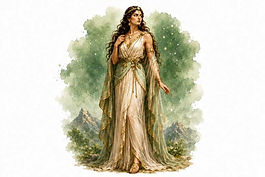
Maia is the eldest of the Pleiades, the seven daughters of Atlas who were transformed into stars, and the mother of Hermes, the trickster god who invented the lyre and stole Apollo's cattle on the day he was born. She is the nymph of Mount Cyllene in Arcadia, the mountain cave where she lived in seclusion, shunning the company of gods and mortals alike. She is the lover of Zeus, the king of the gods who ruled from Olympus, who visited her in the dead of night while his wife Hera, the queen of Olympus, slept unaware. She is the mother who raised a child so precocious that he crawled from his cradle, fashioned a lyre from a tortoise shell, and drove fifty of Apollo's sacred cattle backward to hide his tracks before noon on his first day of life. She is the figure who stands at the origin of commerce, music, theft, and travel, for without Maia there would be no Hermes, and without Hermes the world would lack its messenger. And she is the star that rises in late spring, the brightest of the Pleiades, whose name the Romans gave to the month of May. Every lyre ever played, every message ever delivered, and every star that guides a sailor home carries her memory.

Manticore
The Manticore is the man-eating monster whose very name means "devourer of human flesh," a creature so terrible that travelers in India feared nothing more than the sound of its voice drifting across the desert. It is the hybrid beast with the body of a red lion, the face of a man with three rows of teeth, and a scorpion tail that shoots venomous stingers like arrows from a bow. It is the nightmare that leaves no trace of its victims behind, consuming bones, clothes, and possessions whole so that a village might lose a dozen men and never find a single shred of evidence. It is the creature that the Greek physician Ctesias claimed to have seen with his own eyes at the Persian court, brought from India as a gift to the king. And it is the beast that stalked medieval bestiaries for fifteen hundred years, its image carved into church stonework and woven into heraldic shields, a symbol of the unknown terrors that lurked beyond the borders of the known world.

Marathonian Bull
The Marathonian Bull is the magnificent white beast sent by Poseidon, the god of the sea and earthquakes, from the ocean depths to King Minos of Crete as proof of divine favour, only to become a monster that terrorised two kingdoms. It is the bull that Minos promised to sacrifice but kept for himself, the broken vow that cursed his wife Pasiphae with an unnatural passion and produced the Minotaur, a creature with the head of a bull and the body of a man. It is the beast that went mad and ravaged the island of Crete, then swam across the Aegean Sea to the plain of Marathon near Athens, where it gored farmers, trampled crops, and laid waste to the countryside. It is the monster captured by Heracles, the hero forced to complete twelve impossible labours, as his seventh task, and later released by King Eurystheus to wander back to Marathon. And it is the creature that Theseus, the prince of Athens, captured and sacrificed on his way to claim his father's throne, a beast whose rampage began with a king's pride and ended with a hero's strength.

Medea
Medea is the sorceress who betrayed her own father, murdered her brother, and tricked a king's daughters into butchering him alive, all for the love of a man who would later abandon her. She is the priestess of Hecate, goddess of witchcraft, who could quench flame with a word, stop rivers in their course, and turn an old ram into a lamb with nothing but herbs and a cauldron. She is the woman who helped Jason steal the Golden Fleece from a dragon that never slept, then killed her own brother and scattered his pieces into the sea to slow her father's pursuit. She is the mother who murdered her own children to punish their father for taking a younger bride, then escaped into the sky in a chariot drawn by dragons. And she is the only mortal woman in Greek myth who was never punished for her crimes, who ended her days in the paradise of the Elysian Fields, a testament to the terrifying power of a woman who would rather destroy everything she loved than be cast aside.

Medusa
Medusa is the Gorgon whose face turned all who looked upon it to stone, a monster so terrible that even her reflection was deadly and her severed head remained a weapon of divine power. She is the only mortal of the three Gorgon sisters, the one who was born beautiful and was transformed into a nightmare by the goddess Athena as punishment for a crime committed in the goddess's own temple. She is the mother of Pegasus, the winged horse, and Chrysaor, the warrior with the golden sword, both born from the blood that spilled from her neck when the hero Perseus cut off her head. She is the trophy that Perseus carried across the Mediterranean, using it to petrify the sea monster Cetus and the tyrant Polydectes, then gave to Athena to mount upon her shield. And she is the image that still guards doorways, temples, and armor across the ancient world, her face carved into the aegis of Athena and the breastplate of Alexander the Great, a symbol of protection through terror that has outlasted every empire that ever feared her.

Meleager
Meleager is the hero of the Calydonian Boar Hunt, the prince who gathered the greatest warriors in Greece to kill a monster sent by a goddess and who died not in battle but by his own mother's hand. He is the son of Oeneus, the king of Calydon in Aetolia, and Althaea, the queen whose love for her brothers proved stronger than her love for her son. He is the hunter who killed the monstrous boar that Artemis, the goddess of the hunt, had sent to ravage his father's kingdom, and who gave the trophy hide to Atalanta, the fastest woman in Greece, rather than to his own uncles. He is the man who murdered his mother's brothers in a quarrel over the spoils, and who was killed when Althaea took the brand of his life from the fire and burned it to ashes. And he is the brother whose death was so mourned by his sisters that the gods transformed them into guinea fowl, the Meleagrids who still weep for him in the bird-calls of the ancient world.