Greek Mythology List


Welcome to the Mythopouch list of Greek mythology entries! We also delve into the ancient history of Greece and the surrounding areas. From heroes to goddesses, places, monsters, artifacts, weapons, creatures and more - which will only grow over time. Mythopouch provides real-world information extracted from the original source material such as that from: Homer, Hesiod, Apollodorus, Ovid, Pausanias, Pindar, Aeschylus, Sophocles, Euripides, Hyginus, Diodorus Siculus and Apollonius of Rhodes. Words and stories carry powerful messages that were passed down from one generation to the next, many of which are still very applicable to modern times. Our unique imagery is meant to capture the imagination and ignite the magic mythology spark within us all. Our "token mark" coin symbol that is assigned to each record is a visual representation of the entity, for use in Mythopouch learning modules and games.
Learn - Earn - Play
Greek Entity Quick Index
Our current list of ancient Greek mythology and ancient history entities are here - which are growing day by day!
Search by using the:
-
"Search Mythology Records" function to browse all mythology records and blog pages;
-
Browse the visual cards with overviews by clicking "Go to Visual A-Z";
-
Or just browse and click the A-Z entries below....
See more list entries
Read Ancient Greek Insights
Click below to view our ancient Greek mythology blog article insights, where we delve into the current Mythopouch Tier regions and what we think you should know!


Greek Entity Card Index
See more card entries

Golden Ram
The Golden Ram is the winged, golden-fleeced creature whose rescue of Phrixus and Helle began the story of the Golden Fleece. He is the offspring of Poseidon, god of the sea, and Theophane, a beautiful daughter of the solar king Bisaltes. He is the miraculous animal given to Nephele so that her twins could escape a false oracle demanding their sacrifice. He is the flying beast that carried the children from Boeotia across the sea towards Colchis, losing Helle above the strait that became the Hellespont. He is the speaking ram who instructed Phrixus to sacrifice him and place his golden fleece in the grove of Ares. He is the guardian treasure whose skin became the impossible prize of Jason and the Argonauts. And he is the ram set among the stars as the constellation Aries, where his golden body still lifts above the horizon in the season when seed returns to the earth.

Gorgons
The Gorgons are the three dread sisters whose faces turn any living creature to stone, the most terrifying siblings in Greek mythology and the source of the most famous trophy ever taken by a hero. They are Stheno, the mighty one whose strength is absolute; Euryale, the wide-leaping whose voice can shatter stone; and Medusa, the guardian who alone among them was mortal and therefore alone could be killed. They are the daughters of Phorcys, the old man of the sea who dwells in a cave at the ocean's bottom, and Ceto, the primordial goddess of the sea's monstrous depths, which makes them sisters of the Graeae, the three grey women who share a single eye and a single tooth. They are the winged demons with serpents for hair, brazen hands, and tusks like boars, who live beyond the river Oceanus at the world's edge where night meets the setting sun, or in later tales in the deserts of Libya where their gaze turns travellers to pillars of salt. They are the monsters whose heads became the most powerful weapon in Greek myth, mounted upon the aegis of Athena, the goddess of wisdom and war, so that every enemy who looked upon her shield turned to stone before her spear could strike. And they are the sisters who pursued Perseus across the sky after he beheaded Medusa in their sleep, chasing the hero who wore the helmet of Hades and could not be seen, their shrieks echoing through the air as the winged horse Pegasus and the golden warrior Chrysaor sprang from the bloody neck of their fallen sister.
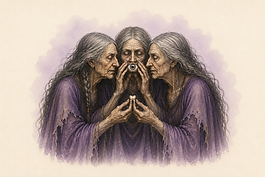
Graeae
The Graeae are the three grey sisters of Greek mythology, born old and grey-haired from the moment they entered the world, who share a single eye and a single tooth between them. They are the daughters of Phorcys, the old man of the sea, and Ceto, the monstrous goddess of the deep, making them sisters to the Gorgons, the most terrible creatures in the Greek world. They are the keepers of secrets, the only beings who know the location of the magical objects that Perseus, the son of Zeus, would need to kill the Gorgon Medusa, whose face turned all who looked upon it to stone. They are the gatekeepers who must be tricked before the hero can pass, the ones who guard the boundary between the known world and the realm of monsters. And they are the personifications of the white foam on the waves, the grey scum that marks the edge of the sea, an image that has echoed through centuries from Aeschylus' lost plays to modern films, the eternal guardians who know the way but will not tell it unless forced.

Griffin
The griffin represents one of the oldest and most geographically widespread of all mythological guardians-a majestic hybrid combining the body of a lion, the head and wings of an eagle, and the cumulative power of both sovereign beasts to create the ultimate protective spirit. Though commonly associated with Greek mythology, the griffin's origins lie deep in the ancient Near East, where it first appeared in Elamite art from what is now southwestern Iran as early as the fourth millennium BCE. From Elam, the griffin spread across Mesopotamia, reaching predynastic Egypt by around 3000 BCE, Syria in the second millennium BCE, and the Aegean civilizations of Minoan Crete and Mycenaean Greece by the 14th century BCE. This ancient pedigree makes the griffin one of the few mythological creatures whose history spans the entirety of recorded civilization, a testament to the enduring power of its protective symbolism.
The griffin's physical form embodies a cosmic duality that explains its persistent appeal across cultures and millennia. The lion, supreme predator of the earth, represents terrestrial strength, courage, and kingship; the eagle, sovereign of the skies, represents celestial vision, speed, and divine authority. Their fusion creates a creature that commands both realms-a guardian whose vigilance extends from the highest heavens to the deepest earth. In ancient Near Eastern traditions, this cosmic duality made the griffin an ideal symbol for divine protection of royalty and sacred spaces. Elamite cylinder seals and palace reliefs depict griffins flanking thrones and temple entrances, their hybrid forms marking the boundary between the human and divine worlds. The Achaemenid Persians, who built upon Elamite artistic traditions, incorporated the shirdal (lion-eagle) into the monumental architecture of Persepolis, where griffin-headed columns supported the roofs of royal palaces and griffin reliefs guarded the throne rooms of the Great Kings.

Hades
Hades is the king of the dead and lord of the underworld, the dark realm beneath the earth where every mortal soul must one day arrive. He is the brother of Zeus and Poseidon who drew the shortest lot when the three sons of Cronus divided the cosmos, winning not the sky or the sea but the misty kingdom of shadows and silence. He is the god who seized Persephone, the springtime goddess of flowers and growth, dragging her beneath the earth in his golden chariot to make her his queen -- an act that plunged the world into famine and forced the creation of the seasons. He is the unseen one, so dreaded that the Greeks rarely spoke his true name aloud, preferring to call him Plouton, the Giver of Wealth, because all the gold and silver mined from the dark earth belong to him. He is the stern judge who keeps the gates of death locked tight, ensuring no shade escapes and no living soul enters unbidden. And he is the god who wept only once -- when the musician Orpheus played his lyre in the halls of the dead and begged for the return of his beloved wife.

Hadrian
Hadrian is the Roman emperor who traded conquest for consolidation and spent much of his twenty-one-year reign travelling through the empire he ruled. He is the cultivated Spanish-born aristocrat whose love of Greece reshaped his beard, dress, speech, public image and relationship with the Greek world. He is the commander who strengthened the army, raised fortifications from Britain to Africa and built Hadrian's Wall to mark the northern limit of Roman power. He is the builder who completed the Pantheon, raised the Temple of Venus and Roma, created his imperial villa at Tivoli and left his mausoleum on the bank of the Tiber. He is the emperor whose beloved Antinous drowned in the Nile and was mourned with a new god, a new city and temples across the eastern empire. He is the ruler whose attempt to refound Jerusalem as Aelia Capitolina helped ignite the catastrophic Bar Kokhba revolt. And he is the dying poet who left behind one short Latin address to his wandering, charming, pale little soul before passing into imperial divinity.

Harmonia
Harmonia is the daughter of Aphrodite and Ares, the goddess of love and the god of war, a child born from the union of opposites who would spend her life trying to reconcile what her parents had set at odds. She is the wife of Cadmus, the Phoenician prince who slew the dragon of Thebes and founded the city that would become the most tragic stage in Greek mythology. She is the mother of Semele, the mortal woman who was consumed by the thunderbolt of Zeus and became the mother of Dionysus, and of Ino, the queen who leaped into the sea with her son and was transformed into a sea-goddess. She is the owner of the Necklace of Harmonia, the golden wedding gift forged by Hephaestus, the lame smith-god, that brought death and ruin to every woman who wore it for five generations. And she is the woman who, in her old age, was transformed into a serpent alongside her husband and sent to dwell in the Elysian Fields, the paradise of the blessed dead, a strange reward for a life that had known more sorrow than any mortal deserved.

Harpe of Perseus
The Harpe of Perseus is the curved blade of adamant that severed the head of the Gorgon Medusa, the monster whose face turned all who looked upon it to stone, and the weapon that made the impossible quest possible. It is the sickle that the Titan Cronus used to castrate his father Uranus, the sky, at the dawn of the cosmos, and that passed through divine hands until it reached the hero who needed it most. It is the blade that Hermes, the messenger god and patron of thieves, placed in the hand of a young man who had never held a sword, trusting that courage and cunning mattered more than experience. It is the weapon that cut through the serpent locks of Medusa, the only mortal Gorgon, whose blood gave birth to the winged horse Pegasus and the warrior Chrysaor as her head fell. And it is the ancestor of every curved sword in myth and history, from the scimitars of the east to the sickles of harvest and death, the original proof that the right blade in the right hand can change the world.

Harpy
The Harpy is the storm-spirit who snatches mortals from the earth with claws like iron hooks, a winged woman whose shriek is the sound of a sudden gale tearing through the trees. She is the Hound of Zeus, dispatched by the king of the gods to punish those who reveal divine secrets or offend the immortals, swooping down to steal food, children, and even souls before vanishing into the wind. She is the mother of immortal horses, having coupled with Zephyros, the god of the west wind, to bear Xanthus and Balius, the divine steeds of the hero Achilles. She is the monster who tormented the blind king Phineus, befouling every meal set before him until the winged Boreads drove her and her sisters to the ends of the earth. And she is the creature whose face changed across the centuries -- from a beautiful winged maiden with flowing hair in the oldest songs, to a foul bird-woman with a hag's face, drooping breasts, and a belly crusted with feathers in the tales that followed.

Hebe
Hebe is youth itself made divine, the prime of life with a face and a name, the season when strength flowers and nothing has begun to fade. She is the daughter of Zeus and Hera, the king and queen of heaven, and sister to Ares the war god and Eileithyia, the goddess of childbirth. She is the cupbearer of the gods, the graceful hand that pours the golden nectar at the feasts of heaven, an office she held until the Trojan boy Ganymede was carried up by an eagle to take her place. She is her mother's attendant, who fits the wheels of Hera's chariot and bathes her brother Ares when he comes bleeding from the wars. And she is the bride of Heracles, the gift given to the hero who toiled more than any mortal: when his labours were done and his mortal flesh had burned away on the pyre, the gods welcomed him to Olympus and gave him Youth herself for a wife, that he who had spent his strength for others might never grow old. Her name is the Greek word for the bloom of life, and everything that blooms passes through her hands.

Hecate
Hecate is the torch-bearing goddess who stands at the crossroads where three roads meet, the keeper of keys who opens the gates between the world of the living and the world of the dead. She is the only child of the Titans who was not cast down when Zeus and the Olympian gods rose to power, but instead was granted dominion over earth, sea, and sky by the king of the gods himself. She is the companion of Persephone, the springtime goddess of flowers, whom she guided with twin torches through the darkness of the underworld after her abduction by Hades. She is the unseen presence who heard Persephone's scream when no other god or mortal did, and who alone dared to approach the raging Demeter with news of what she had heard. She is the goddess of liminal spaces -- doorways, thresholds, and the dark of the new moon -- who was worshipped at household shrines and shadowed intersections with offerings of garlic and eggs. And she is the figure whose image shifted across the ages from a benevolent bestower of wealth and victory to the dread queen of ghosts, sorcery, and the witch's midnight craft.

Hecatoncheires
The Hecatoncheires are the three primordial giants who each bear fifty heads and one hundred arms, born so terrible in size and strength that their own father tried to bury them before they could draw breath. They are Briareus, Cottus, and Gyges, the sons of Gaia the Earth and Uranus the Sky, whose very existence shook the cosmos and whose liberation decided the fate of the gods. They are the creatures who hurled three hundred mountain-sized rocks at once during the Titanomachy, the war between the old Titans and the young Olympian gods, burying the elder generation beneath the earth and securing Zeus's eternal rule. They are the eternal wardens of Tartarus, the pit of punishment beneath the underworld, where they stand guard over the defeated Titans with bronze gates and walls that no prisoner can breach. And they are the brothers whose very name -- "hundred-handed" -- has become a byword for overwhelming, impossible strength, a force so vast that no single enemy could stand against it.