Greek Mythology List


Welcome to the Mythopouch list of Greek mythology entries! We also delve into the ancient history of Greece and the surrounding areas. From heroes to goddesses, places, monsters, artifacts, weapons, creatures and more - which will only grow over time. Mythopouch provides real-world information extracted from the original source material such as that from: Homer, Hesiod, Apollodorus, Ovid, Pausanias, Pindar, Aeschylus, Sophocles, Euripides, Hyginus, Diodorus Siculus and Apollonius of Rhodes. Words and stories carry powerful messages that were passed down from one generation to the next, many of which are still very applicable to modern times. Our unique imagery is meant to capture the imagination and ignite the magic mythology spark within us all. Our "token mark" coin symbol that is assigned to each record is a visual representation of the entity, for use in Mythopouch learning modules and games.
Learn - Earn - Play
Greek Entity Quick Index
Our current list of ancient Greek mythology and ancient history entities are here - which are growing day by day!
Search by using the:
-
"Search Mythology Records" function to browse all mythology records and blog pages;
-
Browse the visual cards with overviews by clicking "Go to Visual A-Z";
-
Or just browse and click the A-Z entries below....
See more list entries
Read Ancient Greek Insights
Click below to view our ancient Greek mythology blog article insights, where we delve into the current Mythopouch Tier regions and what we think you should know!


Greek Entity Card Index
See more card entries

Eurydice
Eurydice is the nymph whose death by a snake bite sent her husband Orpheus into the Underworld, and whose rescue was undone by a single backward glance. She is the wife of the greatest musician in Greek mythology, the Thracian poet whose songs could move stones and tame beasts and whose voice charmed even the gods of the dead. She is the bride who died on her wedding day, or shortly after, while walking through a meadow in the Vale of Tempe, a valley in Thessaly famous for its beauty. She is the woman who followed her husband up the dark path from Hades, the kingdom of the dead, silent and hopeful, only to vanish the moment he turned to look at her. She is the ghost who spoke one last time before dissolving into the shadows, telling Orpheus that his love had failed at the final step. And she is the eternal symbol of love lost at the threshold, the name that poets and composers have invoked for two thousand years as the archetype of the beloved who cannot be reclaimed. Every opera about a musician descending into darkness, every story of a love that dies at the last moment, carries her shadow.

Eurylochus
Eurylochus is the second-in-command of Odysseus whose cowardice saved the crew from Circe and whose hunger destroyed them on the island of the sun. He is the kinsman of Odysseus, the king of Ithaca who spent ten years struggling to return home after the Trojan War, and the most trusted lieutenant among the men who sailed the wine-dark sea. He is the man who refused to enter Circe's palace, staying outside while his companions were transformed into swine by the sorceress's magic. He is the voice that warned Odysseus of the witch's power, the only witness who escaped to tell the tale. He is the mutineer who convinced the starving crew to slaughter the sacred cattle of Helios, the sun god who drove his chariot across the sky each day, bringing divine vengeance upon them all. And he is the man whose body sank beneath the waves when Zeus, the king of the gods who ruled from Olympus, shattered their ship with a thunderbolt for the sacrilege. Every mutiny born of desperation, every warning that proves true, and every feast that becomes a funeral carries the shadow of Eurylochus.

Eurynome
Eurynome is the wide-ruling daughter of Oceanus, the Titan goddess who danced upon the waves of creation and gave birth to the three Charites, the goddesses of beauty and joy whose presence made every feast worth attending. She is the queen who ruled Olympus before Cronus, the Titan who castrated his father Uranus, and before Zeus, the thunderbolt king, when she and her consort Ophion, the great serpent, held sway over heaven and earth. She is the mother of Aglaea, Euphrosyne, and Thalia, the three Graces whose names mean Splendour, Joy, and Festivity, and who attended Aphrodite, the goddess of love, and Hera, the queen of Olympus, with flowers and song. She is the goddess whose wooden statue, bound in golden chains, stood beside the river Neda at Phigalia, where the locals remembered her as a daughter of the sea who had come to live among the mountains of Arcadia. And she is the forgotten queen of the Greek pantheon, the ruler whom Cronus overthrew and cast into the stream of Oceanus, a Titan who survived her fall and became something gentler: the mother of beauty itself.

Eurystheus
Eurystheus is the king of Mycenae and Tiryns who assigned Heracles the Twelve Labours, the man whose very existence was a trick played by Hera upon Zeus and whose cowardice became the counterpoint to the greatest hero Greece ever knew. He is the son of Sthenelus and Nicippe, the grandson of the hero Perseus, who slew the Gorgon Medusa and rescued Andromeda from the sea monster, and the rightful heir to the throne of Mycenae by the letter of a divine promise meant for someone else. He is the king who sent Heracles to slay the Nemean Lion, to clean the Augean Stables, to fetch the apples of the Hesperides, and to capture Cerberus from the underworld, each task designed to destroy the hero and each one completed in spite of him. He is the coward who hid in a buried storage jar when Heracles returned with the Erymanthian Boar, and who tried to cheat the hero by declaring two labours invalid. And he is the man who outlived Heracles only to be decapitated in battle by the hero's children, his severed head defiled by Heracles' mother Alcmene in a final act of vengeance.

Euterpe
Euterpe is one of the nine Muses, daughters of Zeus and Mnemosyne, and later tradition assigns her music and lyric poetry. Hesiod lists her second among the nine named Muses, after Clio. In later art her characteristic instrument is the aulos, the paired reed pipe, although ancient myths also gave the instrument independent stories involving Athena and Marsyas. Pseudo-Apollodorus says Euterpe bore the Thracian king Rhesus to the river god Strymon, while acknowledging another tradition that made Calliope his mother. Like the other Muses, Euterpe belongs first to the collective divine world of song before later writers and artists give her a specialised artistic sphere.
Gaia
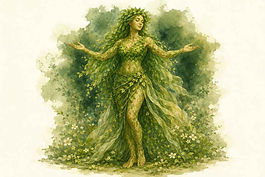
Gaia is the primordial goddess who is the Earth itself, the second being to emerge from Chaos at the dawn of creation and the mother of every god, giant, and mortal creature who ever lived. She is the great mother who gave birth to the starry heavens, the mountains, and the raging sea from her own body without union. She is the wife of Ouranos, the sky, who became her husband and oppressor, forcing her children back into her womb until she armed her son Cronus with a sickle and set him against his father. She is the protector of Zeus, the youngest god, whom she hid in a cave on Crete and helped overthrow the Titans in a war that shook the cosmos for ten years. She is the eternal enemy of every king who imprisons her children, from Ouranos to Cronus to Zeus himself, whom she sent the monster Typhon to destroy. And she is the first oracle at Delphi, the ancient ash altar at Olympia, and the living soil beneath every temple ever built, the foundation that outlasts every empire built upon it.

Galatea
Galatea is the Nereid whose beauty drew a Cyclops out of his cave and made the wild giant of Sicily learn music, vanity and heartbreak. She is the daughter of Nereus, the Old Man of the Sea, and Doris, the Oceanid mother of the fifty Nereids, and one of the fairest sisters in their watery company. She is the sea nymph loved by Polyphemus, the monstrous son of Poseidon, who wooed her with songs, panpipes, rustic gifts and enormous protestations of devotion. She is the beloved of Acis, the beautiful Sicilian youth whose blood she transformed into a living river after Polyphemus crushed him beneath a rock. She is the goddess of milk-white foam and calm water, whose name made her a natural bride for the sea. And she is one of Greek mythology's most malleable figures, loved and rejected by the giant in different traditions, sometimes mocked, sometimes pursued, sometimes won, and finally carried by Renaissance and later art into both the Triumph of Galatea and the mistaken identity of Pygmalion's unnamed statue.

Ganymede
Ganymede is the Trojan prince whose beauty was so surpassing that Zeus, the king of the gods who rules from Olympus, descended from the sky in the form of an eagle and snatched him away to serve as cupbearer to the immortals. He is the son of Tros, the king of Troy who gave his name to the city and the Trojans, and Callirhoe, the daughter of Scamander, the great river that flows through the plain of Troy. He is the youth who replaced Hebe, the daughter of Hera and Zeus, as the server of nectar and ambrosia at the divine feasts, and who was granted eternal youth and immortality as a gift for his service. He is the figure whose abduction became one of the most painted scenes in Western art, from the red-figure vases of Athens to the ceilings of the Vatican, and whose name would echo across centuries into the English language as the origin of the word catamite. And he is the constellation Aquarius, the Water-Bearer, whose jar pours the winter rains upon the earth every January and February.

Geryon
Geryon is the three-bodied lord of the western island of Erytheia, whose cattle Heracles was sent to steal in the most distant and costly of his labours. He is the son of Chrysaor, the golden-sworded warrior born from Medusa's severed neck, and Callirrhoe, the Oceanid daughter of Oceanus and Tethys. He is the grandson of Medusa and nephew of Pegasus, making his monstrous body part of a family born from divine blood and violence. He is the guardian of a fabulous herd of red cattle, whose hides were stained by the light of the setting sun, protected by the herdsman Eurytion and the two-headed hound Orthrus. He is the warrior whose shape changed with every poet: one body and three heads in Hesiod, three bodies joined at the waist in Apollodorus, six hands and six feet in Stesichorus. And he is the giant who faced Heracles not merely as a monster to be slain, but as a king defending his home, his wealth and his honour at the very edge of the world.

Glaucus
Glaucus is the sea-god who began life as a mortal fisherman in Boeotia and became immortal by eating a magical herb that brought his catch back to life, a transformation that gave him prophecy but cost him his human form. He is the merman with copper-green hair and a serpentine fish-tail who dwells in the depths of the sea, accepted by Oceanus and Tethys as one of their own and granted the power to foretell the future. He is the lover who fell for the nymph Scylla and sought a love potion from the sorceress Circe, only to find that Circe had fallen in love with him and transformed Scylla into a monster out of jealousy. He is the prophet who once a year visited every coast and island of Greece to deliver his oracles to fishermen and sailors, and who helped the Argonauts survive their mutiny and a deadly storm by foretelling their futures. And he is the builder who, in one tradition, constructed the ship Argo and sailed with Jason and the heroes as their steersman, a mortal who became a god and never forgot the men he had left behind.

Golden Apples of the Hesperides
The Golden Apples of the Hesperides are the fruit of a tree that Gaia, the earth herself, gave as a wedding gift to Hera, the queen of Olympus, and the most closely guarded treasure in the western world. They are the apples that grew in a garden at the edge of the earth, tended by the Hesperides, the nymph daughters of the Titan Atlas, and watched by the sleepless dragon Ladon, a beast with a hundred heads that never all closed their eyes at once. They are the prize of Heracles' eleventh labor, the impossible task set by King Eurystheus of Tiryns, who believed that no man could reach the garden and return. They are the fruit that Heracles obtained only by tricking Atlas, the Titan condemned to hold up the heavens, into fetching them while the hero briefly took the weight of the sky upon his own shoulders. And they are the golden orbs that reappear in the most famous quarrel in myth, the Apple of Discord that the goddess Eris threw among the gods and that began the chain of events leading to the Trojan War, proof that the most beautiful fruit can carry the bitterest seed.

Golden Fleece
The Golden Fleece is the glowing hide of a flying ram, nailed to an oak at the edge of the world, and the one prize every hero of Greece would have sailed to win. It is the last relic of Chrysomallos, the wonder-working ram sent by the god Hermes to snatch the boy Phrixus from the altar of sacrifice and carry him east across the sea, a flight from which his sister Helle fell into the strait that still bears her name. It is the treasure of King Aeetes of Colchis, hung in the grove of the war god Ares and watched day and night by a serpent that never slept. It is the impossible price set by the usurper Pelias, the task meant to destroy young Jason, and the reason the Argo was built and the finest generation of heroes ever gathered climbed aboard her. And it is the golden bed on which Jason and the witch Medea were wed in a sea-cave far from home, the light that outshone the torches of their wedding, and the trophy that came back to Thessaly having cost far more than it was worth.