Greek Mythology List


Welcome to the Mythopouch list of Greek mythology entries! We also delve into the ancient history of Greece and the surrounding areas. From heroes to goddesses, places, monsters, artifacts, weapons, creatures and more - which will only grow over time. Mythopouch provides real-world information extracted from the original source material such as that from: Homer, Hesiod, Apollodorus, Ovid, Pausanias, Pindar, Aeschylus, Sophocles, Euripides, Hyginus, Diodorus Siculus and Apollonius of Rhodes. Words and stories carry powerful messages that were passed down from one generation to the next, many of which are still very applicable to modern times. Our unique imagery is meant to capture the imagination and ignite the magic mythology spark within us all. Our "token mark" coin symbol that is assigned to each record is a visual representation of the entity, for use in Mythopouch learning modules and games.
Learn - Earn - Play
Greek Entity Quick Index
Our current list of ancient Greek mythology and ancient history entities are here - which are growing day by day!
Search by using the:
-
"Search Mythology Records" function to browse all mythology records and blog pages;
-
Browse the visual cards with overviews by clicking "Go to Visual A-Z";
-
Or just browse and click the A-Z entries below....
See more list entries
Read Ancient Greek Insights
Click below to view our ancient Greek mythology blog article insights, where we delve into the current Mythopouch Tier regions and what we think you should know!


Greek Entity Card Index
See more card entries

Dryad
The Dryad is the spirit of the oak tree, the shy and beautiful nymph whose life is woven into the bark and roots of the forest itself. She is the guardian of sacred groves, the voice that rustles in the leaves when no wind blows, and the presence that makes a solitary woodland feel alive with watching eyes. She is the Hamadryad, whose soul is bound so tightly to a single tree that if the axe falls, she dies with it, a fragility that made the ancient Greeks treat every oak with reverence. She is the nurse who helped raise the infant Zeus in his hidden Cretan cave, the Meliai ash-tree nymphs who fed the future king of the gods with honey and the milk of the goat Amalthea. She is the Daphnaie, the laurel-tree nymph who witnessed the terrible pursuit of Daphne by Apollo and wept when the girl was transformed into a tree to escape his grasp. And she is the echo of Europe's oldest religion, a reminder that before temples of stone, the Greeks worshipped in groves of oak, where every tree held a goddess and every forest was a cathedral.

Echidna
Echidna is the half-woman half-serpent monster who gave birth to the most terrible creatures in Greek mythology, the mother of a brood that would test every great hero from Heracles to Bellerophon and from Perseus to Jason. She is the daughter of Ceto, the primordial sea goddess of the dark depths, and Phorcys, the old man of the sea, or in some accounts the child of Gaia, the earth herself, and Tartarus, the pit beneath the world, making her a creature of both ocean and underworld. She is the consort of Typhon, the hundred-headed storm giant who challenged Zeus for the throne of heaven, and together they produced a lineage of horror: Orthrus, the two-headed hound who guarded the cattle of Geryon; Cerberus, the three-headed dog who guards the gates of the underworld; the Lernaean Hydra, the many-headed serpent whose heads grew back two for every one cut off; and the Chimera, the fire-breathing beast with the head of a lion, the body of a goat, and the tail of a serpent. She is the ancestress of the Sphinx, the Nemean lion, the Caucasian eagle that ate Prometheus's liver, and the dragon that guarded the golden apples of the Hesperides. And she is the monster who lived in a cave far from gods and men, preying upon passers-by, until the hundred-eyed giant Argus Panoptes crept into her lair and killed her as she slept, or in other accounts lived on forever as an immortal terror in the darkness.

Echo
Echo is the mountain nymph who was cursed by Hera to repeat only the last words spoken to her, the voice that answered Narcissus when he called out to his own reflection and found no one there. She is the daughter of the air, or of Pan, the goat-foot lord of Arcadia who played the panpipes and chased nymphs through the wild, or of Gaia, the broad-bosomed Earth, depending on which teller you ask. She is the chatterer who distracted Hera, the queen of Olympus and wife of Zeus, the king of the gods who ruled with his thunderbolt, with endless talk while Zeus slipped away to his affairs with other nymphs. She is the lover who followed Narcissus through the forests of Boeotia, unable to speak her own heart, able only to throw back the words he spoke to the water. She is the nymph who wasted away until only her bones and her voice remained, her body turning to stone while her sound lingered in the caves and mountains. She is the spirit who still answers every shout in the hollow places of the earth, the voice that comes back when you call into the dark. And she is the namesake of the echo itself, the acoustic phenomenon that has outlasted her story by millennia.

Electra
Electra is the princess of Mycenae who refused to let the murder of her father Agamemnon sink into silence, even when silence was the price of her own survival. She is the daughter who smuggled her infant brother Orestes out of a palace ruled by killers, preserving the last male heir of a cursed royal house. She is the mourner who dressed in rags, cut her hair and spent years beside Agamemnon's tomb, answering comfort with outrage and reminders of blood. She is the sister who recognised Orestes when he returned in disguise and turned grief into a plan for vengeance against their mother Clytemnestra and her lover Aegisthus. She is the woman who urged on the matricide in one telling, shared the blade in another, and vanished from the stage before it in a third. And she is the tragic figure whose name became shorthand for a daughter's fierce devotion to her father and furious hatred of her mother, giving literature and psychoanalysis one of its most enduring and disturbing symbols.

Eleusis
Eleusis is the sacred city of ancient Attica where Demeter, goddess of grain and the fertile earth, revealed rites that promised initiates a happier fate after death. It is the place the grieving goddess entered disguised as an old woman, accepted the hospitality of King Keleos and Queen Metaneira, and tried to make their son Demophon immortal over the palace fire. It is the site of the Eleusinian Mysteries, the most famous secret initiations of the ancient Greek world, held each year for Demeter and her daughter Persephone. It is the destination of the Sacred Way, the road along which initiates carried torches and sacred chests from Athens while calling upon Iacchos, the bright god of the procession. It is the city whose Telesterion held thousands of initiates in darkness before torches, words and visions transformed their understanding of death. And it is the place whose true secret was so well kept that more than two thousand years of empire, scholarship and excavation have never fully recovered what happened inside the innermost sanctuary.

Elysium
Elysium is the paradise of the Greek dead, the Elysian Plain at the farthest edge of the earth where heroes live on in bliss, free of snow and storm and every human sorrow. It is the reward promised to Menelaus, the king of Sparta whose wife Helen was the cause of the Trojan War, simply for being the son-in-law of Zeus, the king of the gods. It is the Isles of the Blessed where Cronus, the old Titan king deposed by his own son, reigns in peace over the heroes who fell at Thebes and Troy, and where the earth bears honey-sweet fruit three times a year. It is the island of golden flowers in Pindar's odes, where ocean breezes blow and the just come before the judge Rhadamanthys, and where Achilles, the greatest warrior of Greece, was taken at his goddess mother's plea. It is the Elysian Fields of the Roman poet Virgil, a green country deep in the underworld with its own sun and stars, where the hero Aeneas met his father's shade. And it is the dream that gave its name to the most famous avenue in the world, the Champs-Elysees of Paris.

Empusa
Empusa is the shape-shifting spectre of Greek mythology, the phantom servant of Hecate, the goddess of witchcraft and the crossroads, sent to terrify travellers on the roads by night. She is the monster of the mismatched legs: one of bronze, and the other of an ass or of dung, a detail so absurd that only the Greeks could have made it frightening. She is the apparition who ambushed the god Dionysus himself on his journey to the underworld in Aristophanes' comedy Frogs, melting before the audience's eyes from ox to mule to beautiful woman to dog, while the terrified god begged his own priest for protection. She is the mother of a whole brood, the empousai, vampiric she-demons with flaming hair who seduced handsome young men in order to drain them of blood and life. She is the phantom that the wandering sage Apollonius of Tyana shouted down on the banks of the river Indus, driving it shrieking into the dark with a storm of curses. And she is a fright that has never quite gone away, from the insults of Athenian politicians to the monster pages of the Percy Jackson novels, where her flaming daughters still hunt young heroes.
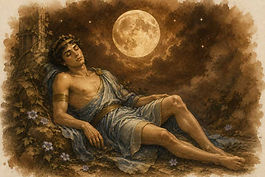
Endymion
Endymion is the most beautiful mortal in Greek mythology, the king or shepherd whose face was so perfect that the moon goddess Selene fell in love with him and asked Zeus to grant him eternal youth. He is the son of Aethlius and Calyce, or in some accounts the son of Zeus himself, who led the Aeolians from Thessaly and founded the kingdom of Elis in the western Peloponnese. He is the man who chose immortality in the form of endless sleep, sealed in a cave on Mount Latmus in Caria where Selene visits him every night, and by whom she bore fifty daughters, the Menai, who are the fifty months of the Olympiad. He is the figure whom the Roman writer Pliny the Elder called the first astronomer, whose study of the moon's movements was transformed by later poets into a love story. And he is the namesake of the proverb "Endymionis somnum dormire," to sleep the sleep of Endymion, and of John Keats's 1818 poem, the most famous literary work ever inspired by a man who never woke up.

Epaphus
Epaphus is the son born to Zeus and Io after the wanderings that carried a transformed Argive princess across Europe and Asia to the banks of the Nile. He is the child whose name means Touch, remembering the moment when Zeus laid his hand upon Io and restored her to human form. He is the boy Hera could not leave alone, stolen from his mother by divine agents and hidden far away in Phoenicia until Io found him again. He is the legendary king of Egypt and founder of Memphis, husband of the water-nymph Memphis and father of Libya, the woman whose name gave the African land its identity. He is the ancestor from whom Danaus, Aegyptus, Cadmus and Europa descended, making him the bridge between the royal houses of Egypt, Phoenicia, Argos and Thebes. And he is the Greek double of Apis, the sacred bull of Memphis, a mortal-born king absorbed into the animal religion of Egypt. From a single touch of Zeus came a genealogy that tied half the mythic world together.

Ephialtes of Trachis
Ephialtes of Trachis is the Malian Greek remembered for showing Xerxes the mountain path that turned the pass at Thermopylae and brought destruction upon Leonidas and the last Greek defenders. He is the son of Eurydemus, a local man whose family and early life Herodotus does not record. He is the native of Trachis who knew the Anopaea path, a difficult track across the ridge of Mount Callidromus that bypassed the narrow coastal pass. He is the opportunist who came to the Persian king after two days of failed frontal assaults and offered to sell the secret of the Greek position. He is the guide who led Hydarnes and the Persian force over the mountain during the night, surprising the Phocian guard and placing the Persians behind the Greek line. He is the man whose information forced Leonidas to dismiss most of the allied army, leaving the Spartans, Thespians and Thebans to fight the final stand. He is the fugitive who expected a rich reward but instead fled to Thessaly when the Greek allies placed a price on his head. He is the outlaw who returned years later to Anticyra and was killed by Athenades of Trachis, not for the betrayal itself but for another quarrel, though the Spartans honoured the killer all the same. And he is the historical figure whose name became the Greek archetype of the traitor and whose story still haunts the memory of Thermopylae.

Epimetheus
Epimetheus is the Titan of afterthought, the brother whose name means hindsight and whose nature was the opposite of everything his brother Prometheus stood for. He is the son of the Titan Iapetus and the Oceanid nymph Clymene, born alongside Prometheus, the forethinker who stole fire from the gods; Atlas, the Titan condemned to hold up the heavens; and Menoetius, the rash giant blasted into darkness by Zeus's thunderbolt. He is the scatter-brained distributor who gave every good gift to the animals of the earth - claws to the lion, swiftness to the deer, feathers to the bird, a shell to the tortoise - and only realised when he reached mankind that the storeroom was empty, forcing Prometheus to steal fire from heaven to make up the deficit. He is the husband who accepted Pandora from the gods despite his brother's explicit warning never to take a gift from Zeus, the king of the gods who delights in thunder, and who welcomed the first woman into his house with open arms. He is the father of Pyrrha, the girl who with her husband Deucalion, the son of Prometheus, survived the great flood that drowned the world and became the mother of the new human race. And he is the eternal proverb of the fool who acts first and thinks later, the being whom Pindar called the father of Excuse, the one whose forgetfulness unleashed every sorrow upon the earth.

Erebus
Erebus is Darkness itself, one of the first beings to emerge from Chaos at the making of the world, the shadow in which everything else had to find its shape. He is the brother and the husband of Nyx, the Night, and the Greeks did not separate the two: where Night is the dark that wheels above the world, Erebus is the dark that pools beneath it, the gloom at the foundations. He is the father of the light, for with Night he begot Aether, the bright upper air, and Hemera, the Day, a paradox the Greeks never tired of: from the marriage of Darkness and Night are born Brightness and Morning. He is both a god and a place, the region of shadow beneath the earth through which the dead must pass to the house of Hades, and Odysseus, with his bowl of blood at the edge of the world, summoned the ghosts up out of Erebus. And he is the dark without a temple: no statues, no hymns, no altars, for you do not worship the dark, you simply live inside its hours, and the Greeks gave those hours a name and a face.